More than two centuries after its founding, the French jeweler Vever has come home.
The house’s first retrospective is scheduled to run through May 18 at the Musée de La Cour d’Or in Metz, a city in northeastern France where Pierre-Paul Vever opened a small jewelry shop in 1821.
For Camille Vever, a seventh-generation owner of the brand, the display of 200 objects, including jewels, archival documents and drawings, reflects a homecoming in more ways than one. “The house is primarily known for Art Nouveau jewels, so this show is our chance to put that creative effervescence into a broader context,” she said.
In 1871, the family — and its business — left Metz, eventually opening up shop on the Rue de la Paix in Paris. It operated there until 1982, when it suspended operations.
In 2021, Ms. Vever and her brother Damien revived the house, reopening on the Rue de la Paix exactly 200 years after it opened in Metz.
Although the initial plan was to use lab-grown diamonds, the brand has since refocused its designs on only natural gemstones and recycled gold. Its jewels, representing ginkgo leaves, money plant pods (lunaria annua) and vines, as well as a bridal collection, are now available at shops in 15 countries.
The Metz exhibition — titled “Éclats Messins: Vever, Joailliers d’Exception, 200 Ans de Création,” or “Metz Brilliance: Vever, Exceptional Jewelers, 200 Years of Creation” — was born of a much smaller one that Ms. Vever staged in mid-2023 in Paris. Among its exhibits was her own diamond barrette brooch dating from 1900, a 16th birthday present from her paternal grandmother. “That barrette was what first got me thinking about relaunching Vever,” she said.
Others included a daisy brooch and earrings in white enamel and gold that René Lalique — a friend, collaborator and occasional rival of the house’s third-generation designer, Henri Vever — made in 1898 for the 12th birthday of Henri’s daughter, Marguerite.
Ms. Vever said the initial exhibition turned into an unexpected success. “The place was packed every day and all the time,” she said of the homespun show. “It was incredibly moving.”
For the event, she borrowed a bronze bust of Ernest Vever, Pierre-Paul’s son, who moved the business to Paris. When she returned it to the Musée de La Cour d’Or, the idea of a full-blown exhibition began to take shape.
Linked to History
Valérie Kozlowski, the museum’s director, said the Vever saga mirrors the history of the Alsace-Lorraine region. “The exhibition lets us tell a story about a family over generations that also represents a history that’s different from that of the rest of the country and has been a little bit forgotten,” she said, referring to a part of the region that was twice annexed by Germany.
“We’re very attached to our history,” she added. “For many French families, the Vever story will feel like a full-circle moment.”
In an effort to set the exhibition apart from traditional jewelry shows, the museum created what Ms. Kozlowski described as “immersive, theaterlike” sets. They include recreations of the original Rue de la Paix boutique, a jewelry atelier and reimagined displays from the Universal Exhibitions of 1889, 1900 and 1925. (The show is open daily except Tuesdays and public holidays; admission is free.)
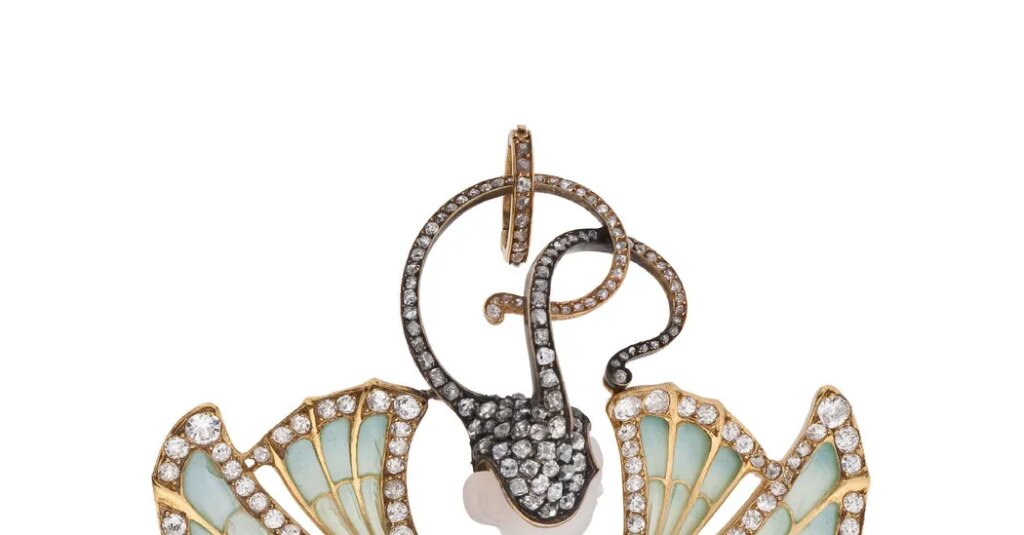
The museum also expanded its collection for this exhibition by purchasing six molds made for Vever jewels in a Swiss auction. One was used in the production of the house’s 1900 Femme Ailée, or winged woman, a pendant-brooch depicting a woman’s profile with a dragonfly wing, in gold, diamonds and plique-à-jour enamel. (Plique-à-jour is an enameling technique that produces all but transparent panels.)
And it purchased a late 19th-century floral tremblant corsage in silver, gold and diamonds from the S.J. Phillips jewelry store in London. Anna Wintour wore the jewel on her lapel at the 2024 Met Gala.
At the time that piece was made, Ernest had expanded the business by creating medals and charms, such as miniature soldiers and smoothbore cannons, for the local military. The brand also became known for religious designs, such as a quatrefoil enameled gold ring with a large square-cut Colombian emerald, four diamonds and sculpted angels that was made in 1868 for the bishop of Metz, which has been lent to the exhibition by the Cathédrale Saint-Etienne de Metz.
Inspired by Japan
But it was Henri, the third-generation creative and historian, who brought the house international renown with the three F’s — flora, fauna and la femme — design themes inspired by Japanese art and the tsuba, or Japanese sword guards, that he collected.
His designs for jewels, hair combs, belt buckles and bottles for perfume or smelling salts often combined plique-à-jour enamel with precious stones, horn and ivory.
One of his most recognizable pieces, the Apparitions brooch — a Symbolist art jewel in enamel, ivory and gold set with topaz — is presented in the show in two versions: One, now owned by the Musée d’Orsay in Paris, was shown at the 1900 Paris Exhibition; the other belongs to a private collection.
Ms. Vever credited Henri with being among the first designers to challenge the hierarchy between the major and minor arts. “His point was that we’re not just talking about jewels, we’re talking about art, full stop,” she said. “To me that’s very modern. He was always obsessed with novelty and innovation.”
The taste for novelty carried into the next generation. In the exhibition is an Art Deco bracelet in emeralds, diamonds and onyx by the house’s fourth-generation jewelers, André and Pierre Vever. It has not been displayed publicly since it was introduced at the 1925 Universal Exhibition in Paris, at which Vever won a grand prize.
On Nov. 13, Ms. Vever was in Metz to present the Vever Prize, which Henri seeded with 10,000 francs in 1926. The endowment now funds an annual prize of 2,500 euros ($2,797), awarded by the Académie Nationale de Metz to a young artist or artisan in the decorative arts from the region around Metz.
It was purely coincidental that the awards event was the day after the exhibition’s opening, Ms. Vever said. But no coincidence has been involved in the house’s plans to introduce a new flagship next summer at the corner of Rue Daunou and the Rue de la Paix. Its opening will be like a second homecoming, Ms. Vever said: It is next door to the jeweler’s onetime Paris address, a boutique that opened in 1907.
The post More Than 200 Years Later, a Jewelry Brand Comes Home appeared first on New York Times.