Norway is famed for its Viking history, its troll-filled fairy tales and, more recently, a certain World Cup soccer player, but it has a lesser-known vein of art jewelry from makers inspired by practicality, nature and sometimes humor.
The Viking period is the oldest-known era of jewelry making in Norway, said Knut Astrup Bull, a senior curator at the National Museum in Oslo, which draws visitors who want to see “The Scream” by Edvard Munch.
Viking silversmiths, Mr. Bull said before a private tour of the museum’s jewelry collection, “made more practical jewelry — pins and that sort of thing — to hold a cape. But I think they imported quite a lot more-exclusive jewelry to show their status.”
The explorers “traded over vast areas, all the way down to the Black Sea and the Middle East,” he added, selling gold and acquiring amber from Baltic countries.
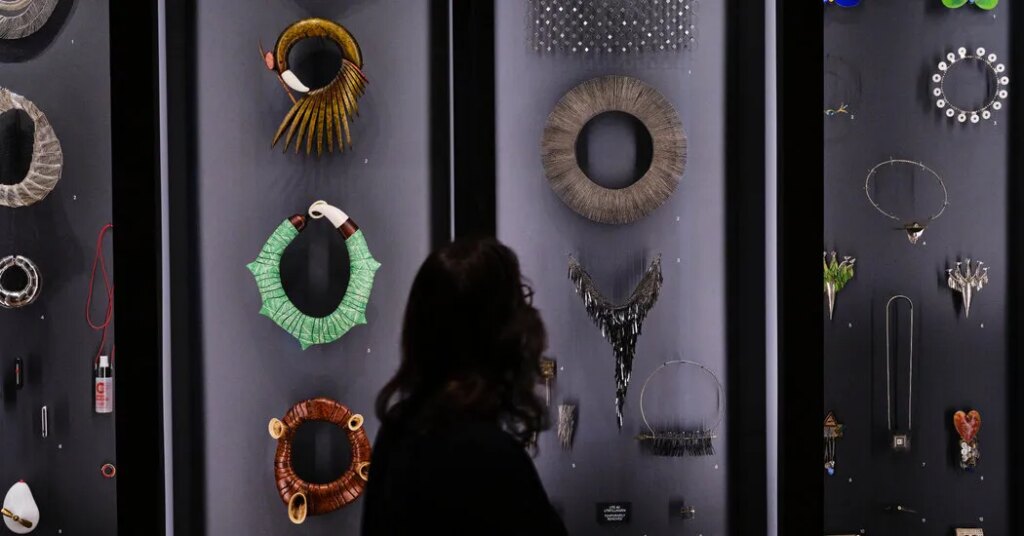
The National Museum has no Viking-era jewelry in its collection, Mr. Bull said, focusing instead on showing dozens of pieces from the 18th century to today, including “a complete set of silver jewelry that was a wedding gift in the mid-1700s.
“It took a long time to prepare a woman’s costume for a party or a ball. So most of the jewelry you had to stitch onto the dress. That was common in the upper classes.”
The museum also displays dozens of pieces of what Mr. Bull called “jewelry art,” a sector that had a heyday in the 1980s in Norway with pieces now being offered as vintage collectibles at auction houses and on resale sites.
The artistic approach to jewelry in Norway in the ’70s was, he said, “perhaps a bit more connected to what you would call Scandinavian design style. But when they get into the ’80s, it becomes more conceptual. The artists also start experimenting with nonprecious materials. Could be plastic, or wood, or also nylon, for instance.”
“One thing you could say is special about Norwegian jewelry artists is that functionality has always been a part of it,” he said. “So most of what they made could be worn.”
By the end of the ’80s, he said, “Norwegian jewelry was quite internationally recognized, and a lot of the artists exhibited abroad. I think that was probably a halo period, a turning point.”
(Pieces by Norwegian jewelers can be found in the collections of major museums including the Victoria and Albert Museum in London, the Musée des Arts Décoratifs in Paris, and the Cooper Hewitt, Smithsonian Design Museum and the Museum of Modern Art in New York City.)
Technical But Humorous
Among those with a wide following is Sigurd Bronger, 69, “probably our most internationally recognized jewelry artist,” Mr. Bull said. “Many of his items are quite humorous. But he has this extremely high technical level and uses a lot of found objects as well.”
Bronger pieces on display include his “diamond necklace” from 2007, formed of a plastic spray can with a chrome-plated brass band and a red rubber cord, and a brooch from 1985 made with a plastic table tennis ball.
Another fan of the found object whose work is displayed at the museum is the jeweler Millie Behrens.
She was part of a new jewelry movement in the ’80s as a founding member of Trikk, a close-knit collective of former art students who showed their work in joint exhibitions. (Trikk means tram in Norwegian; Oslo has several light rail lines.)
Now 68, she said in a video interview from her home near Oslo that the name came about casually. “We were talking, probably drinking beer and having a good time,” she said, “and then this name comes up, and we said, ‘Yeah, why not?’”
Her current studio is in a house built in 1868, updated in 1924 and shared with several painters.
“I’m the only jeweler,” she said. “I think when they understood that I actually was going to solder, you know, use the flame, I think they were a little shocked.”
Among her wearable art pieces on display in the National Museum are a postmodern-style brooch from 1984 of silver, niobium and acrylic fiber, with feathery strands of acrylic protruding from a silver sheath, and a 2010 necklace of brushed silver, gold and a stone, smoothed by the sea, all threaded on nylon cord.
“Sometimes I use a stick or something, but it’s mostly the pebbles,” she said. “I pick them at beaches when we travel, from all over Europe actually, but mostly Italy and Crete.”
Such a stone also appears in her brushed silver, gold and copper cuff made in 2009. “The bracelets might be big,” she said, “but you know that you are carrying it, not just a little thing. It’s a statement.”
She describes her style as being inspired by her surroundings, including furrows in a plowed field, a decaying greenhouse, a bridge or a wooden fence and having “a strong emphasis on geometry but in a soft way. I often mix geometric shapes with a contrasting organic shape or material, or precious materials with some low value, like gold and beach stones; or silver with iron or wood. Such combinations make a tension and vibrance that I like.”
While it is important for her jewelry to be wearable, she said, “I have always stayed with the thought that a piece must be artistically interesting on its own; on the table, or the wall as well as on the body.”
The museum’s collection also includes a bracelet, a brooch and a ring that Ms. Behrens made during a decade in collaboration with the David-Andersen company, founded by the Norwegian enameling master David Andersen (who died in 1901) and known for its leaf and nature designs.
She also has worked with the Norwegian royal family, designing a lightweight diadem in yellow gold with three interchangeable central ornaments, in diamonds, orange fire topaz and green tourmaline, that King Harald V presented to Queen Sonja for her 60th birthday in 1997.
Practical and Wearable
The London jeweler Alma Sophia Groenli Geller, 37, grew up in Norway, years that she said still influenced her work.
“The way that jewelry is worn there: You want all your joy to be practical,” she said during an exhibition at the 2026 Goldsmiths’ Fair this fall in London. “A Norwegian person wants their jewelry to be something they can live in, that they can wear all the time.”
She described the gold, silver and gemstone pieces she made as being sculptural and minimalistic, “a bit more experimental than some of the jewelry that is in the Norwegian market, but it’s still very wearable, and I want people to wear it every day.”
One memorable project, she said, arose in 2009 when she was studying near Oslo. She made a silver bracelet using a hammer technique and design by Tone Vigeland, a pioneer jeweler who helped and inspired many of her Norwegian compatriots. The school has “all these samples of her original work, which is amazing,” Ms. Groenli Geller said. “Obviously you’re not allowed to sell it as your own, but as a school project, we’re allowed to use her designs.”
Several pieces by Ms. Vigeland, who died in 2024 at age 85, are on display at the National Museum, among them a 1995 collarlike necklace of silver spikes, almost tribal in design.
There is also a rustic-looking 1983 bracelet made of oxidized and partly gilded silver.
In an Art Jewelry Forum article after her death, Mr. Bronger wrote that Ms. Vigeland’s jewelry “was a symphony of darkness, strength and wearability” and that working with her had been “a journey of learning and self-discovery.”
The post Come for ‘The Scream,’ Stay for the Jewelry appeared first on New York Times.