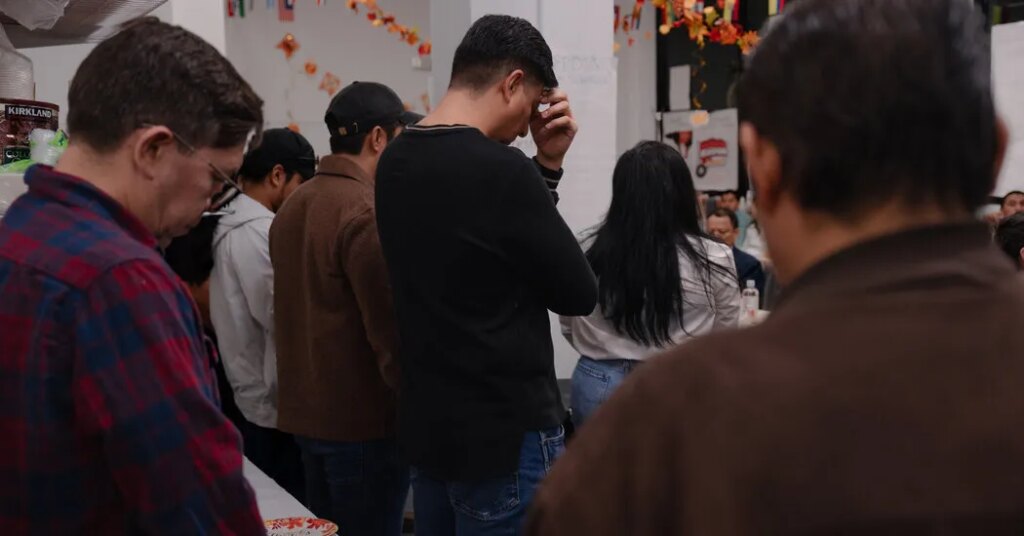
After hours of toiling at construction sites across New York, dozens of Hispanic workers filed into a makeshift dining hall in Brooklyn one evening last week for an early Thanksgiving dinner.
Dialects from across Latin America filled the air as the men and their families caught up in Spanish. But before they dug into the turkey, cassava and roast pork, the room fell quiet.
A moment of silence honored the eight people, including three Latino workers, who were killed days earlier when a building collapsed into a Brooklyn construction site not terribly different from the ones where the men spend long hours working.
“Report, denounce, lift your voices,” said Armary Perez, a leader at the Worker’s Justice Project, the advocacy nonprofit that organized the dinner. “When a tragedy of this magnitude occurs, we grow worried. But we realize it’s on us to enact change.”
The calamity in the Flatbush neighborhood on Nov. 11 was among the deadliest structural collapses in New York’s recent history. But for the thousands of immigrant workers who form the backbone of the city’s construction industry, the disaster resurrected perennial fears that were anything but new.
Videos of the devastation, which killed three construction workers from Latin America, ricocheted across construction sites, immigrant WhatsApp groups and the street corners where day laborers pick up work.
The tragedy crystallized the worst fears and the perils that the immigrants, often undocumented, navigate each day as they perform some of the riskiest jobs in the industry — excavation, demolition and scaffolding work.
“Sometimes, we put ourselves at risk out of necessity,” said Elías, a 36-year-old from Guatemala who has labored at construction sites in New York for two decades and spoke on the condition that his last name be withheld because he lacks legal status.
“There is always fear,” he said in Spanish. “Fear because of not having papers, fear to lose our jobs, the fear of not being able to bring home the means to support your family and pay rent.”
Immigrants in the New York City construction industry — estimated to number 133,800 — make up two-thirds of its work force, according to census data, placing them on the front lines of an industry that remains one of the deadliest, despite new regulations that have been issued after high-profile accidents.
From 2015 to 2024, a total of 218 construction workers died in the city, with about 22 fatalities on average each year, according to local and federal data analyzed by the New York Committee for Occupational Safety and Health, known as NYCOSH, a nonprofit organization.
Immigrants made up a large share of the construction-related deaths: More than half of the workers who died in 2023 and 2024 were Hispanic and born outside the United States, according to data from the Bureau of Labor Statistics.
Zoey Laskaris, an occupational epidemiologist at Queens College, said that foreign-born workers in New York were “disproportionately represented in hazardous jobs, including construction.”
“As a result, they face a greater burden of occupational injuries, illnesses and fatalities, even when their risk within these jobs is comparable to that of U.S.-born workers,” she said.
For contractors, immigrants are a source of willing and inexpensive labor in an industry with a persisting shortage of workers. For recently arrived migrants, the jobs are physically demanding but accessible entry-level jobs in a new country.
In New York, they are less likely to belong to unions that often offer more protections and higher pay, according to the Economic Policy Institute, a left-leaning think tank. Many are paid off the books, picking up work informally from contractors and making them susceptible to wage theft, according to experts.
And migrants say that they are often fearful of reporting unsafe conditions because of concerns about retaliation, especially amid the Trump administration’s immigration crackdown. About 27 percent of all workers in the city’s construction industry are undocumented, according to the Center for Migration Studies of New York, a research organization.
“Sometimes, you just need to take the insults and scowling from foremen just to win a bit of money,” said Andrés Lopez, 38, an immigrant worker from Ecuador, recalling his first experience at a Brooklyn work site after he migrated to the United States in 2024.
Mr. López said he had left the job after the contractor refused to pay him about a month of wages, roughly $4,000, which he is seeking to recoup with help from the Worker’s Justice Project.
Many immigrant workers toil on smaller residential projects outside of Manhattan that are subject to looser oversight rules than the soaring commercial towers or public infrastructure projects that generally employ unionized workers.
Safety advocates assert that nonunion sites can be riddled with violations, including a lack of properly anchored ladders or harnesses and missing guardrails to protect workers from falling off scaffolds.
“It’s like the wild, wild West,” said Charlene Obernauer, the executive director at NYCOSH. “If you have a trained eye, even a somewhat trained eye toward construction safety, you’ll see violations all over the place.”
Construction industry leaders often counter that New York already has some of the strictest building rules in the nation, arguing that catastrophic accidents are driven by a small subset of unscrupulous actors, not by systemic industry failures.
Carlo A. Scissura, the president of the New York Building Congress, a construction and real estate trade group, argued that the industry had made great strides bolstering safety, especially in large projects, but that “we’re now at a pivotal moment.”
“The city needs to ensure that every job site, no matter what type of job it is, is following safety guidelines,” he said. “The minute there is excavation, groundwork, walls coming down, we really need to have a uniform policy.”
City officials are racing to decipher what caused the three-story building in Flatbush to collapse, while Brooklyn prosecutors have opened a criminal investigation into the disaster. A visual analysis by The New York Times pointed to faulty excavation work at the construction site next door as a likely cause of the collapse, which killed two workers from Ecuador and one from Guatemala, all in their 20s.
Miguel Tigsilema, 35, a laborer from Ecuador, started working at the site two days before the collapse and managed to escape. He said that he had believed the work would be safe in a city full of renowned architects and engineers.
“How could I have imagined that there would be irregularities?” Mr. Tigsilema said in Spanish. “But then, when I saw the videos and the news, I realized that we should not have been there because that building was not safe.”
In a flurry of lawsuits, at least eight workers who were injured accused the developer and contractor of recklessly sending the laborers into an excavated pit where engineering concerns and visible signs of an imminent collapse were ignored.
“They were not in a position to ask any questions,” said Jonathan Damashek, a lawyer representing four of the workers, including one man who lost his hearing and remains in the hospital after fracturing his jaw and cheek bone, and suffering a brain hemorrhage.
The building’s developer and general contractor did not respond to requests for comment.
Elite Concrete, a Brooklyn subcontractor that did work at the site and was named in one of the lawsuits, said in a statement that the company was “still reeling.”
“A tragedy of this magnitude has never occurred in our company’s history,” the firm said in a statement. “Safety is our highest priority, and we are cooperating fully with inspections of our active projects and with the investigation into the collapse.”
Despite persistent safety concerns in the industry, regulators point to signs of progress. Fatality rates have dropped since the 1990s, though the gains have largely stalled during the past decade.
Data from the city’s Department of Buildings shows a downward trend in construction-related injuries, from 692 in 2023 to 320 in 2025. The agency credits unannounced sweeps, mandatory safety training, and stricter crane and scaffolding rules.
But labor advocates and the state comptroller have warned that the city’s inspections too often happen after receiving complaints and that injury tallies rely on 911 calls and contractor reporting, which probably results in an undercount of accidents.
Elías, the Guatemalan laborer, who makes $35 an hour working on home renovations in Manhattan, stressed that while contractors were sometimes to blame, workers also bear responsibility for keeping their safety training current and following protocols.
“It’s on us, too.”
Ana Ley and Hurubie Meko contributed reporting.
The post For Immigrant Construction Workers in New York, Danger Is Part of the Job appeared first on New York Times.