When Xi Jinping, the Chinese leader, set about expanding China’s nuclear forces a decade ago, his goal was to ensure that enough missiles could survive an initial attack so Beijing could deliver a devastating counterattack.
That ability to withstand a strike and hit back would deter any enemy from risking nuclear blackmail or war against China in the first place, Chinese strategists have said.
But now, researchers in the Chinese military worry that American advances in artificial intelligence could weaken Beijing’s nuclear hand in a crisis or conflict. They have been warning that artificial intelligence could make it easier for U.S. forces to find and wipe out Chinese nuclear missiles, giving Washington a menacing advantage.
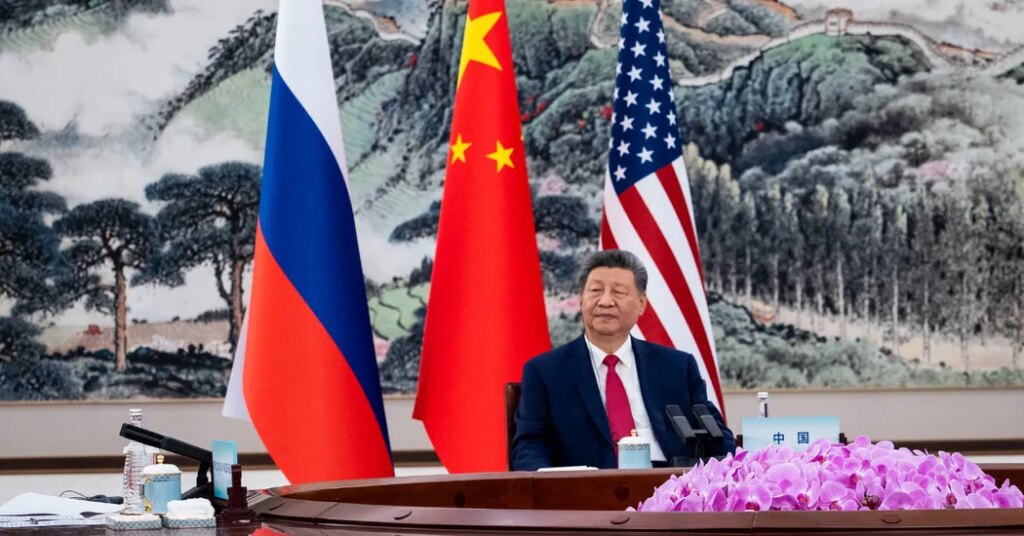
The worries over A.I. complicate the growing nuclear tensions between Washington and Beijing, and could make China more reluctant to consider limits to its smaller arsenal. At a summit on Thursday, Mr. Xi, President Trump and President Vladimir V. Putin of Russia spoke of reducing nuclear risks. But Mr. Xi has shown no interest in Mr. Trump’s calls for China to join arms control commitments.
A review of more than 100 recent studies by Chinese civilian and military researchers, as well as interviews with experts and former U.S. officials, points to a deep wariness in China about the American pursuit of A.I. in nuclear systems. At the same time, Chinese military institutes are also exploring how A.I. could make Chinese missiles harder to detect and knock from the sky.
China, the United States and Russia use radars, satellites and sensors to monitor each other’s nuclear weapons. Breakthroughs in A.I. could help create technology to detect, track and strike nuclear weapons more quickly and accurately. Experts in China worry that it could lag the United States in applying such advances.
A study from China’s top military institute described a scenario in which artificial intelligence accelerated U.S. actions in a crisis to mere moments, potentially overwhelming slower rivals.
“By embedding A.I. and other technologies into nuclear decision-making systems, the United States could compress the decision-making process from the traditional 15 to 30 minutes to 90 seconds or less, drastically increasing the speed of response,” two researchers from the Academy of Military Science in Beijing wrote in an overview of global nuclear trends published several months ago.
China has about 620 nuclear warheads that could be delivered by land- or submarine-based missiles, or by bombers, the Federation of American Scientists estimates. China’s arsenal is widely forecast to grow to about 1,000 warheads by 2030. (The United States and Russia each have around 1,800 nuclear warheads deployed for missiles and bombers, with thousands more stockpiled.)
China fears that A.I. advances could enable the United States “to rapidly engage in strikes as soon as something pops out from a hiding spot or mobilizes,” said Gerald C. Brown, a former analyst with the State Department who studies China’s nuclear strategy. “Basically, in their view, it could make survivability a lot more difficult.”
Fear of a First Strike
China’s missile force is closely watching the U.S. Strategic Command, which controls nuclear missiles and has said that it wants to use A.I. to enhance “decision-making capabilities.” Chinese military analysts are also studying how American conventional forces use A.I. to coordinate operations and pick targets.
The U.S. edge in making advanced chips is adding to Chinese concerns that the United States can move faster to incorporate A.I. into its military, including in nuclear-related systems, said Jacob Stokes, a senior fellow at the Center for a New American Security in Washington.
Official history reinforces China’s anxieties. Chinese military officers studied the Korean War and crises over Taiwan in the 1950s, when the United States signaled that it could drop atomic bombs on Mao Zedong’s forces, which then had no nuclear weapons, said Mr. Brown, now an international affairs fellow at the Council on Foreign Relations.
China has already been diversifying its nuclear weapons to enhance their “survivability.”
In July, it held a test launch of a long-range missile from a submarine, showing its intention to create an undersea nuclear deterrent that could be harder for the United States to detect and destroy. China has also built about 320 launch silos in its northern deserts, which could make it harder for an enemy to determine which ones hold nuclear-armed missiles and knock them all out with precision strikes.
But Chinese experts now warn that breakthroughs in military A.I. could help the United States overcome China’s efforts to protect its arsenal and, in an extreme case, could tempt Washington to attempt a crippling first strike against those forces.
“I believe these risks weigh heavily in China’s strategic considerations,” Sun Chenghao, a senior fellow at the Center for International Security and Strategy at Tsinghua University in Beijing, wrote in emailed answers to questions.
“What China needs to assess is whether, under extreme circumstances, the U.S. might rely on A.I. reconnaissance, precision strikes and missile defense to weaken China’s capabilities to launch nuclear retaliation after an attack,” he wrote.
A Race to Get Ahead
China’s leaders appear determined not to fall too far behind. In July, Mr. Xi held a meeting of senior officials to study the military implications of A.I. and other technological advances. He demanded steady progress toward their deployment.
In China, there is “great optimism that A.I. is the tool that is going to allow you to finally catch up to or surpass the United States militarily,” said Sam Bresnick, a research fellow at the Center for Security and Emerging Technology at Georgetown University.
Studies published by China’s Rocket Force, which controls most of its nuclear missiles, show a wide interest in A.I.
One study involving a Rocket Force scientist published last year examined how A.I.-enabled “deep reinforcement learning” could help hypersonic glide vehicles — weapons designed to dodge and weave as they approach their targets — better evade missile defenses.
The researchers simulated millions of possible flight paths to train an A.I. system to guide a hypersonic vehicle in flight. They used no-fly zones around Alaska as real-life examples of the challenges a hypersonic weapon might encounter, and test if A.I. could help the weapon navigate the defenses.
In another study, Rocket Force scientists used computer simulations to model how A.I. could help a ballistic missile get back on course after swerving to evade high-speed interceptors. An A.I.-assisted autopilot could calculate when to fire steering thrusters, secondary rocket engines that help change direction, while conserving fuel.
China should “apply cutting-edge technologies such as artificial intelligence and hypersonics, strengthening deployment of forces, and improving their survivability and retaliatory capabilities,” five scholars from a Rocket Force university wrote in a paper published this year that examined other countries’ nuclear exercises.
Risk of Miscalculation
But even some researchers in the People’s Liberation Army have warned against rushing to introduce the technology in nuclear weapons systems.
In the most dire projections, rogue A.I.-generated internet viruses could commandeer nuclear weapons controls, disabling or launching the weapons.
But short of that, A.I. could incorporate and magnify false data, leading to dangerous, even disastrous, errors in crisis decision-making. Commanders could put too much trust in A.I.-generated conclusions or advice, experts say. Chinese studies have pointed to U.S. battlefield errors in conventional wars that they say reflect too much faith in automated targeting.
Erroneous information magnified through A.I. creates “enormous decision-making risks,” researchers from China’s National University of Defense Technology and the Academy of Military Sciences wrote in a study this year. “This is becoming the core obstacle to its deep application in the highly serious, high-risk field of command and control.”
Nuclear weapons systems have long contained high levels of automation to ensure accuracy, speed and security. But A.I. advances could reduce the role of human oversight in ways that can be dangerous during a fast-moving crisis, said Philip Reiner, the chief executive officer of the Institute for Security and Technology, a California-based group based that examines the implications of A.I. for nuclear weapons security and stability.
“This is a technology that is moving faster than anything any human has ever seen before,” he said of advanced A.I. “Nobody’s turning launch decisions over to A.I., but everything that tells you whether you should launch is now going to be shaped by A.I. And so, does that make it riskier? Yes.”
Yet even as the need for safeguards has become greater, the United States and China have made little progress in discussing them. Mr. Xi agreed with then-President Biden in 2024 to maintain human control over the decision to use nuclear weapons, but no official talks on the issue have followed. Mr. Xi, Mr. Trump and Mr. Putin did not mention the role of A.I. in nuclear weapons during their summit last week.
“Right now, there’s a lot of attention on the risks that A.I. is going to cause which could kill us all, but it’s abstract. Well, it has to have a mechanism,” said Melanie Sisson, a senior fellow at the Brookings Institution who has discussed nuclear arms and A.I. with Chinese researchers. “Nuclear weapons are probably one of the most likely mechanisms. That’s why it’s so urgent.”
The post Behind China’s A.I. Anxieties, Fear of a Nuclear Checkmate appeared first on New York Times.