Stocks have swooned in recent weeks, with investors becoming increasingly wary of the A.I. trade and questioning just how much investment in the technology can scale up. On Friday, the drag in tech pushed the S&P 500 stock index into a correction, a Wall Street term for a decline of 10 percent or more from a recent high.
Investors have digested a spate of news this month that have rattled tech stocks: from the departure of Nvidia’s chief executive, Jensen Huang, to midterm election results that triggered fears of a slowdown in A.I. data center build-out. The tech-heavy Nasdaq slumped more than 5 percent on Friday, and suffered its worst week since March 2020, at the beginning of the pandemic.
What constitutes a market correction?
A correction is a drop of 10 percent or more in stocks from their most recent high. Since its Oct. 6 peak, the S&P 500 has fallen more than 11 percent.
The 10 percent trigger for a correction is an arbitrary, round-number threshold. But it serves as a signal that investors have turned pointedly more pessimistic about the market. That is particularly the case for technology stocks., with the Nasdaq composite index down 18 percent from its most recent peak, also on Oct. 6.
Are market corrections common?
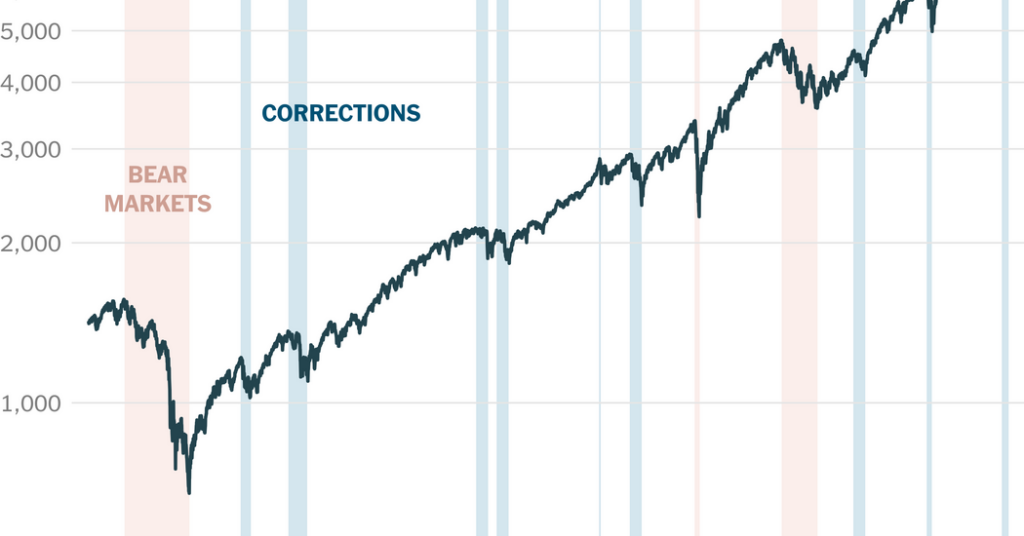
This is the 14th correction in the S&P 500 since the turn of the century, according to data from Yardeni Research. Of the 13 previous corrections, four turned into bear markets, defined as a more severe decline of at least 20 percent.
Does this mean stocks will continue to fall?
Not necessarily.
Some corrections don’t last very long, like the one in early 2018, which spanned less than two weeks. Others can be more drawn out, generally when they develop into full-fledged bear markets.
That said, one previous bear market, at the start of the pandemic, was severe but relatively short — it erased about 33 percent in value from stocks in just over a month. Less than three months later, stocks had regained their previous peak.
The post What Is a Stock Market Correction? appeared first on New York Times.