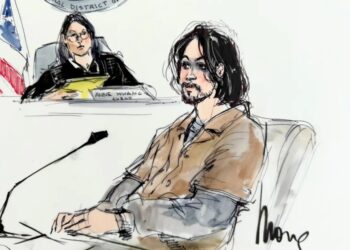
Following a mistrial over the summer, a federal jury on Friday convicted a 30-year-old former Uber driver accused of intentionally setting a blaze that later became the most destructive wildfire in Los Angeles history.
Federal prosecutors accused Jonathan Rinderknecht of using a lighter to ignite the Lachman fire on Jan. 1, 2025 — a fire they said burned underground for days and reignited as the deadly Palisades fire. Rinderknecht’s defense attorney argued there was no evidence proving his client set the fire and offered fireworks as an alternate cause.
The jury deliberated for just over two days before returning its verdict of guilty on both counts he faced.
Rinderknecht was being tried for a second time, after a federal jury in June deadlocked 10 to 2 in favor of acquittal. U.S. District Judge Anne Hwang ordered that there be no reference to the first trial and instructed the second jury to disregard a defense witness’ mention of it during his testimony.
Despite the jury’s lean toward acquittal over the summer, prosecutors vowed to retry Rinderknecht, who has remained in custody since his arrest in October 2025. Earlier this year, prosecutors obtained a revised indictment that narrowed the scope of one charge to focus solely on damage from the initial Lachman fire, while a second count still sought to hold him responsible for both the Lachman and Palisades fires.
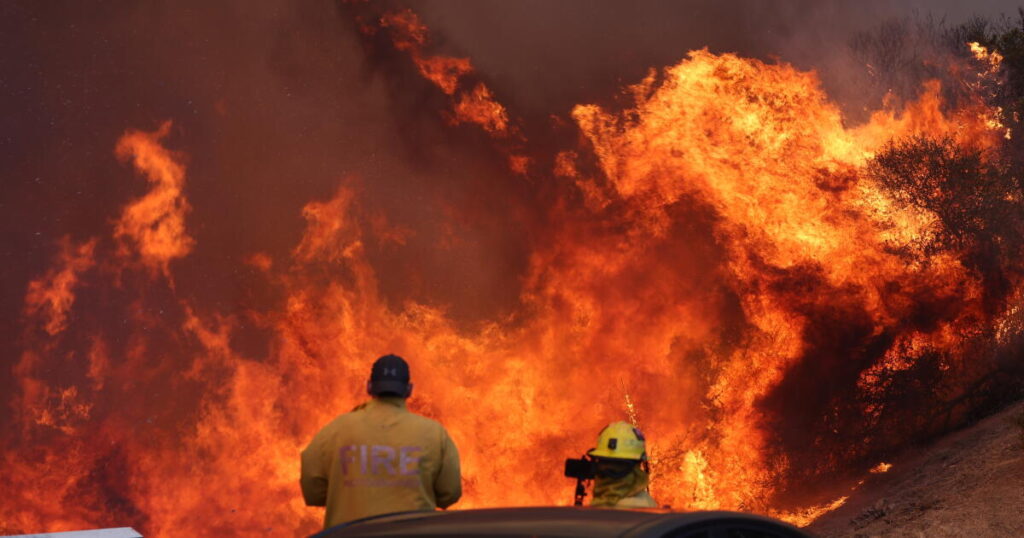
The secondary inferno erupted on Jan. 7, 2025, killed 12 people, destroyed 6,500 structures across the Palisades and Malibu, and caused billions of dollars in damage and insurance claims.
Rinderknecht’s second trial was contentious, with prosecutors accusing a defense witness of perjury, the defense attempting to introduce a new witness at the eleventh hour to bolster their theory of fireworks, and constant sniping between the two sides.
In closing arguments Wednesday, Assistant U.S. Atty. Mark Williams told jurors that Rinderknecht was “mad at everything and frustrated” when he hiked to a clearing overlooking Pacific Palisades and set a fire on New Year’s Eve 2024. Williams said investigators ruled out fireworks as a cause “because there was no evidence to prove it.”
“This fire was an incendiary fire started by an open flame,” he said. “The defendant is the only one who could have started it … He was angry that night and he set the fire and watched it burn.”
Williams also reminded the jury that they were not to consider the adequacy of the Los Angeles Fire Department’s fire suppression efforts, something jurors raised following the June mistrial. In a civil lawsuit against the city and the state, Los Angeles firefighters testified about a series of communication failures and questionable decisions by higher-ups that led crews to leave the area of the New Year’s Day fire prematurely.
“This case is about arson, the fire that the defendant started — not about first responders who responded to it,” Williams said.
In his closing argument, Steve Haney, Rinderknecht’s defense attorney for both trials, said jurors were “to decide the case based on the evidence” not on anything his client did “outside of the act of arson.” He argued that no one saw his client start the fire and that the ignition wasn’t captured in thousands of photos and videos reviewed by investigators.
Haney said investigators concluded in August 2025 that an open flame started the fire. Rinderknecht was charged that October, but Haney said authorities didn’t request lab tests to prove a lighter could have ignited the fire until the following year.
“The decision came first, the test came 11 months later,” Haney said. “Decided, charged and tested. That’s backwards.”
The post Palisades arson retrial ends with conviction of man accused of sparking deadly wildfire appeared first on Los Angeles Times.