Defense Secretary Pete Hegseth has imposed new restrictions on the U.S.-Canada defense relationship, officials familiar his directive said, escalating a multifaceted clash between Washington and Ottawa highlighted by President Donald Trump’s repeated threat of annexation.
Hegseth issued the guidance, which has not been previously reported, in a classified memo circulated last week, the officials said, speaking on the condition of anonymity because of the issue’s sensitivity. The new restrictions are sure to be seen as a “slap in the face” to the Canadians, and they raise questions about how the two militaries’ interaction will be curtailed, one official said. The Washington Post has not reviewed the classified memo.
A spokesman for Hegseth, Sean Parnell, said in response to questions that the Pentagon is “taking steps to ensure its engagements with Canada advance tangible U.S. defense objectives and ultimately support a reinvigorated defense relationship.”
The Defense Department, Parnell said, “is prioritizing opportunities for bilateral cooperation that strengthens the defense of our Homelands and shared hemisphere, while supporting Canada’s ability to meet NATO obligations.”
Hegseth’s directive will not affect defense intelligence sharing or how the U.S. and Canadian militaries collaborate through the NATO military alliance, which also includes European allies, and the bilateral North American Aerospace Defense Command, or NORAD, Parnell said. The United States and Canada are founding members of NATO, organized in the aftermath of World War II, and they coordinate daily at NORAD headquarters in Colorado to protect the skies and maritime boundaries of both nations.
The White House referred questions to the Pentagon. The Canadian Embassy in Washington did not respond to a request for comment.
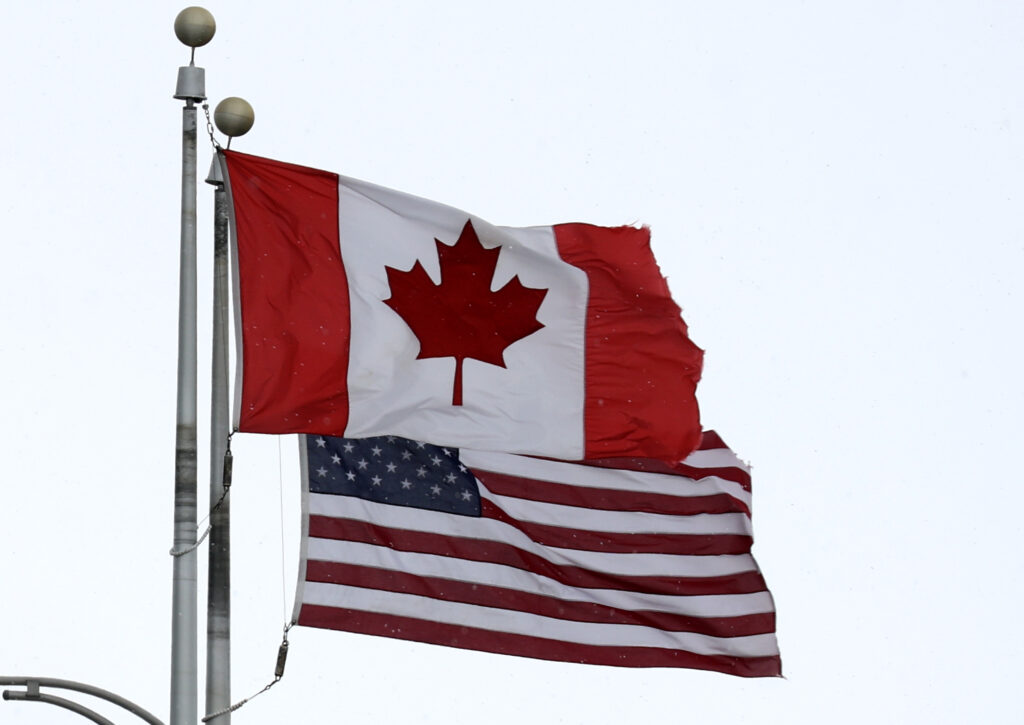
The United States and Canada have maintained a close relationship for decades and share a 5,525-mile border. Canadian forces have deployed alongside U.S. troops in combat, including in Afghanistan, where at least 158 Canadian troops were killed and 2,000 more were wounded.
Canada also is a member of the “Five Eyes,” a decades-old intelligence-sharing consortium that, in addition to the U.S., includes Britain, New Zealand and Australia. An official with one of the Five Eyes countries said there has been no formal indication from the United States that information sharing will change, but U.S. officials have shared less over the past year “across a number of platforms.”
During Trump’s first term as president, he routinely criticized Canada’s defense spending and grouped Ottawa with other NATO allies that he said have relied too heavily on the United States for security. He also criticized U.S. and Canadian trade relationships, saying the United States did not get enough in return.
Since Trump’s reelection in 2024, he has leaned even harder on Canada, suggesting that it should become the 51st U.S. state. Canadian officials said initially that they thought Trump was speaking in jest, but the president has doubled down repeatedly on his talk of annexation.
Canadian Prime Minister Mark Carney eventually told Trump during an Oval Office meeting in May 2025 that Canada is “not for sale” and “won’t be for sale, ever.” Trump acknowledged then that Canada was “stepping up” militarily.
Trump’s economic policies have put additional strain on the relationship. Soon after taking office, he launched a trade war with Canada, imposing tariffs on Canadian steel, aluminum and other goods. Canada responded with retaliatory tariffs. Canada also has sought to reduce its reliance on American weapons.
In March, Carney said that Canada had boosted its defense spending to 2 percent of its gross domestic product, a long-standing goal that NATO had set for all allies. Citing security threats, especially Russia, NATO last year set a new goal for allies to each spend 5 percent of their GDP on defense by 2035.
Trump in August issued an executive order declaring that he was renaming Lake Ontario, which straddles the border, as “Lake America.” Carney responded that the name of the lake predated the birth of both countries and that it would be called Ontario “today and forever.”
Trump, speaking at the White House on Friday, complimented Carney as “very nice” but voiced continued frustration that Canada has not made a trade deal to his liking. “For some reason they feel emboldened,” he said, “and we can’t let them feel that way anymore.”
The economic turmoil associated with the dispute has proved unpopular in the United States. Republican candidates for office in bordering states, like Michigan, said during the midterm elections that the trade war needed to end.
Hegseth, in similar fashion to Trump, has mocked Canada’s military on multiple occasions and downplayed the contributions of U.S. allies during the wars in Iraq and Afghanistan.
In August, Hegseth reposted a photograph on social media showing a teenage female Canadian military cadet and her instructor. He wrote, “This is real,” seemingly disparaging their physical appearance.
The post was condemned by numerous Canadian officials, who called it mean-spirited and inappropriate. “It’s just below the dignity of the office that he holds,” Canadian Defense Minister David McGuinty told reporters.
Hegseth also was criticized in Canada after saying that only “one or two” U.S. allies in Afghanistan were a part of active fighting during the war. Americans, he said, used to joke that ISAF — an acronym for the International Security Assistance Force in Afghanistan — actually stood for “I saw Americans fighting.”
The tension has thrust top U.S. military officers into awkward circumstances. In September, a Canadian reporter asked Adm. Samuel Paparo, the head of U.S. Pacific Command, under what circumstances he’d follow an order to launch military action against Canada.
Paparo appeared incredulous, saying he found “that scenario to be absolutely and utterly preposterous” and that the question was “needlessly emotional.”
“Would you ask me please also,” he continued, “what my attack plans are for the Martians?”
Tara Copp contributed to this report.
The post Secret Hegseth memo restricts U.S.-Canada defense relationship appeared first on Washington Post.