SHENZHEN, China — In August of last year, President Trump hosted Russian President Vladimir Putin in Alaska for a summit labeled at the time as a historic event. This would mark the beginning of the end of the war in Ukraine, Trump vowed, the deadliest conflict of our time.
But as Trump greeted Putin with an outstretched hand this week in Shenzhen, over a year later, Moscow’s assault on Ukraine had only intensified. Russian ballistic missile attacks have surged sharply since the Anchorage summit, by over 60%, increasingly targeting civilians in urban areas, according to independent analysts.
In a similarly choreographed gathering in Beijing earlier this year, Trump huddled with Chinese President Xi Jinping, repeatedly calling him a friend and pledging to work through their most contentious differences. Yet behind the scenes, Beijing was orchestrating an elaborate effort to circumvent U.S. export controls, acquiring more than 1.5 million American chips through back channels to fuel its ambitions to beat the United States for artificial intelligence supremacy.
China’s covert effort came to a head days before the summit, when an alleged espionage campaign by Beijing targeting America’s largest chip maker erupted into public scandal.
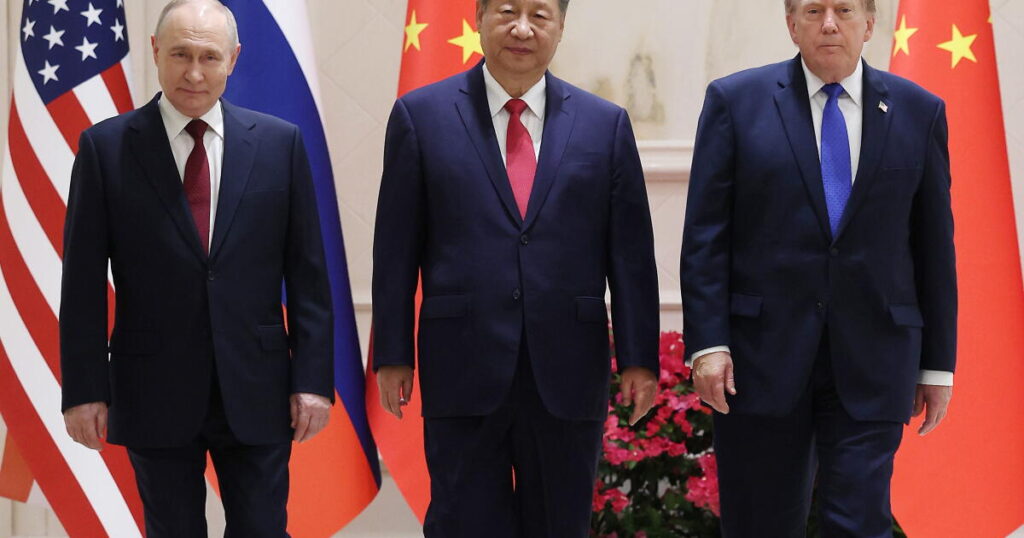
A hastily arranged gathering with all three men, held here Thursday in southern China, produced iconic images of cooperation and peace. It was a first of its kind. But the meeting ultimately continued Trump’s practice of summitry without substance, deferring to powerful adversaries over vital American interests, placating historic rivals to the consternation of longstanding allies.
“The meeting was a terrible signal to real U.S. friends around the world, but there was no lasting substantive outcome to the meeting,” John Bolton, who served as national security advisor to Trump in his first term, told The Times. “I suspect that the bilateral meetings Trump had with Xi and Putin respectively might have had more substance, but details on those meetings are still too sketchy to evaluate.”
Rather than promoting peace, the summit served to generate further angst and distrust across Asia and Europe, with several leaders publicly recoiling at Trump’s overtures of affection. “God, protect us from such friends,” Polish Prime Minister Donald Tusk said, reacting to Trump’s embrace of Putin.
“It was an interesting moment for the president to hold a trilateral with America’s two strategic rivals,” said Kyle Balzer, a national security fellow at the American Enterprise Institute. “Given the nature of Chinese and Russian behavior in their respective neighborhoods, a trilateral summit focused on strategic stability sends a confusing message to allies, who don’t see much ‘stability’ coming from Putin and Xi.”
Still, despite his professed friendship with Putin and Xi, Trump stopped short of explicitly abandoning U.S. support for Ukraine, Taiwan, and other regional partners considered by China and Russia to be within their spheres of influence.
A discussion among the three leaders that resulted in a denunciation of nuclear war may sound obvious, but could be a mark of progress, experts said, after Putin has repeatedly kept open the door to using tactical nuclear weapons on the Ukrainian battlefield.
“The one positive thing I can identify from the meeting is the reiteration of the position that ‘a nuclear war cannot be won and must never be fought,’” said Brian Taylor, a professor of public policy at Syracuse University. “It’s good that they are at least willing to sign on to this condemnation of nuclear weapons use. Cheap talk, perhaps, but at least those are the right words.”
Trump’s focus on non-proliferation in the end seemed to be not on the world’s three largest nuclear arsenals, but on Iran’s potential pursuit of the bomb, the primary justification he has given for starting a war with Tehran earlier this year.
Support from Russia and China was essential in securing an international agreement with Iran in 2015 governing its nuclear program.
Trump’s gestures of friendship to the two autocrats were notable, but not a new phenomenon from the American president, after a decade on the international stage.
In the past, he has dismissed the untoward behavior of U.S. adversaries as the type of activity that the United States, too, engages in with its foes.
“They’re talking about the spying,” Trump said of the Chinese during a visit to Beijing, in the spring, before the spy scandal erupted around chip maker Nvidia. “Well, we do it too. We spy like hell on them too.”
Famously asked about Putin’s targeted assassinations, Trump replied in a Fox News interview in 2017: “There are a lot of killers. We’ve got a lot of killers. What, do you think our country’s so innocent?”
Trump has said he finds it unproductive to “insult” powerful leaders with confrontations around such activities. But he has continued to support counterintelligence operations against both Moscow and Beijing, maintaining a flow of signals support to Kyiv despite consistent tensions with its government, and refusing to give Xi clarity on whether he would come to the defense of Taiwan if China attacked.
The president could have accomplished more, experts said, had he come with a team prepared.
“Unlike Yalta, which some folks see as a sort of precedent, this is not a victory lap for geopolitical winners,” said Chester Crocker, who served as an assistant secretary of State in the Reagan administration, referring to a famous trilateral conference at the end of World War II between President Franklin Delano Roosevelt, British Prime Minister Winston Churchill and Soviet Premier Josef Stalin.
“Shenzhen could have been a seminal moment if the three had scripted a well-prepared agenda focused on strategic nuclear issues, and if the U.S. had reflected on its responsibilities as the leader of the world’s most politically and economically successful country,” Crocker added. “It could be an important moment if they agree to meet again.”
The post In Shenzhen, Trump treats deference to adversaries as peace appeared first on Los Angeles Times.