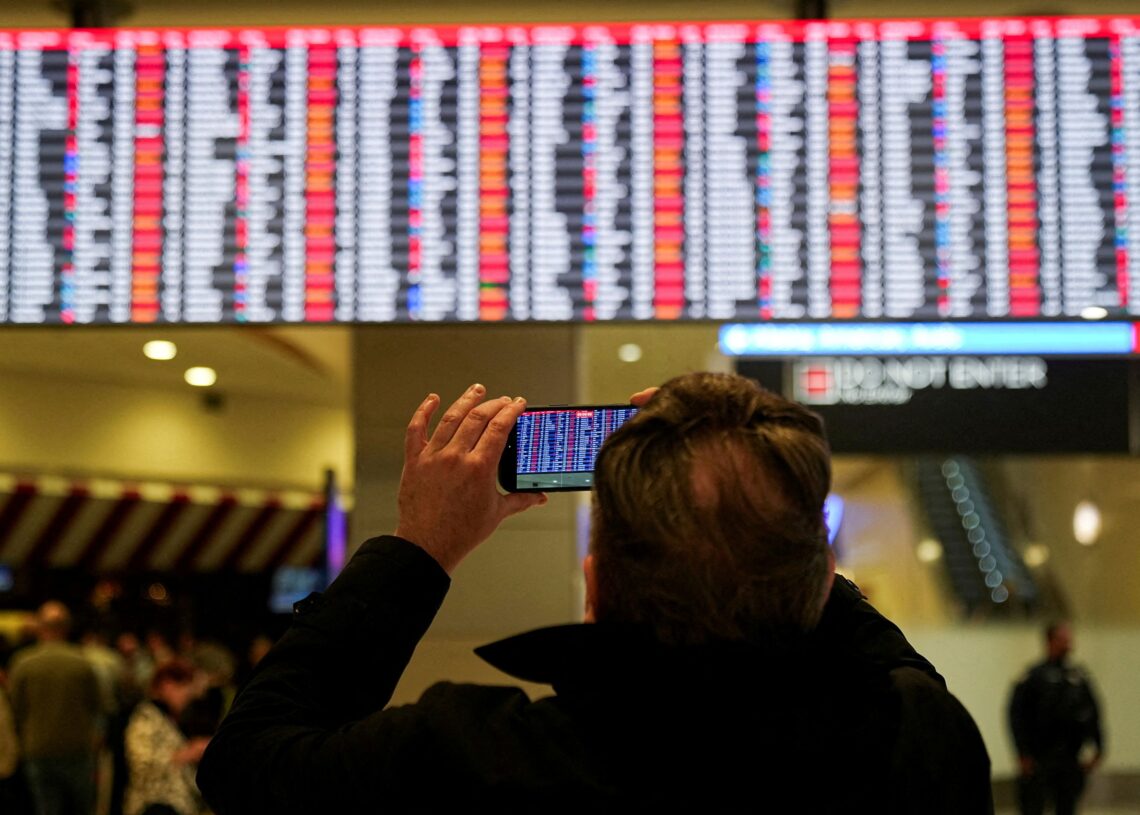
In recent days, it seemed as if the world’s computers went on strike. On Nov. 12, Microsoft announced a massive outage, paralyzing work for some 430 million users. A day later, the Federal Aviation Administration ordered a nationwide shutdown of U.S. air traffic, evoking memories of 9/11. On Nov. 16, JPMorgan Chase and United Airlines both had serious technology platform problems. The next day, even the National Security Agency, one of the nation’s cutting-edge cybersecurity departments, reported a breakdown in its own classified communications network.
Now, it is not clear that any of these were the result of cyberattacks, but it is striking to see how many malfunctions seem to be happening simultaneously. Last Friday, shortly before the FAA grounded all U.S. planes, the FBI issued an urgent warning that a new generation of autonomous artificial intelligence hacking tools was now in widespread use.
These malfunctions shine a light on the challenge we now face. We have built highly complex and interconnected software systems at the heart of modern economies and societies, and they have huge vulnerabilities.
These vulnerabilities are being exacerbated by a crucial problem. As the CEO of cybersecurity firm Rubrik, Bipul Sinha (whom I have advised), puts it, “For most of cybersecurity’s history, we have built defenses around an unstated assumption: the attacker is human.” What works against a band of individuals cannot work against thousands or tens of thousands of AI agents, working 24-7, 365 days a year, relentlessly searching to find a bug in your software. And all software has bugs. AI is exposing flaws in code written over decades.
The costs are mounting. A cyberattack in 2025 reportedly by Russian hackers shut down the global production of British car manufacturer Jaguar Land Rover for over a month, with more than 5,000 organizations affected. Suspected North Korean hackers stole more than $6 billion in cryptocurrency from Binance in October of this year.
Millions of lines of code control almost everything we do. And there is a fundamental asymmetry: The ease and speed of the attack exceed the speed of the defense and patching up of the system. In October, Microsoft patched about 1,400 vulnerabilities, up from about 170 in October 2025. That is an eightfold increase in one year, yet it still isn’t enough. Microsoft’s 2026 Digital Defense Report describes attacks that often begin less than 24 hours after a vulnerability is discovered but remediation that can take 30 to 60 days. Remember CrowdStrike’s 2024 update that disrupted nearly 8.5 million Microsoft devices, causing chaos at airlines, banks and hospitals. That’s because every new patch or software update has to be made compatible with complicated internal software systems. As Nikesh Arora, the CEO of the largest cybersecurity firm, Palo Alto Networks, puts it, cybercriminals “only have to be right once; defenders have to be right 100% of the time.”
And then there is the geopolitical dimension. An important report issued in September by the Council on Foreign Relations describes how China has penetrated America’s infrastructure — water, energy, transport and telecommunications. One Chinese-backed group of hackers called Volt Typhoon had access to U.S. critical infrastructure for at least five years before the extent of its activity was widely reported. Another hacking group called Salt Typhoon conducted a campaign that compromised at least nine major telecom carriers, reaching more than 80 countries. The report’s broader argument is that China has been pre-positioning itself inside America’s digital networks to have the capacity to attack and cripple them in a crisis with Washington.
So what to do? We must plan for a successful attack. The older models of building digital walls are not enough. We must, as Sinha says, assume they will be breached. The focus should be on protecting data and restoring functions fast. That means redundancy, segmented or isolated networks, and backups. This is an area where the private sector cannot act alone. An attack on one company or water system can easily spread throughout the country. Done well, such a system would allow a single attack to instantly trigger defenses in thousands of networks. We need an information-sharing and coordination system, perhaps as a public-private partnership. Most important, we have to use AI to fight AI so that the defense can match the attack in scale and speed. And on the individual level, every one of us should take personal security much more seriously, starting with password managers and two-factor authentication.
We have built a digital civilization with software layered atop software. That’s brought enormous efficiencies, convenience and productivity.
But it has created a world that is staggeringly dependent on these systems and the networks that connect them. Our protection, such as it was, came from the fact that exploiting the vulnerabilities required teams of highly skilled human beings, working ceaselessly, and staying focused even once the crime was committed. But now we face a world of machine-led disrupters, who don’t eat, drink or sleep, and never tire.
This might be the central vulnerability we face in a new world of AI.
The post What grounded planes and downed banking systems say about the AI age appeared first on Washington Post.