A new joke has been making the rounds on the Chinese internet.
Economists have long said that China’s growth has three engines: investment, consumption and exports. The new engines, the joke goes, are raiding officials’ homes, making the rich pay back taxes and collecting social insurance payments from the poor.
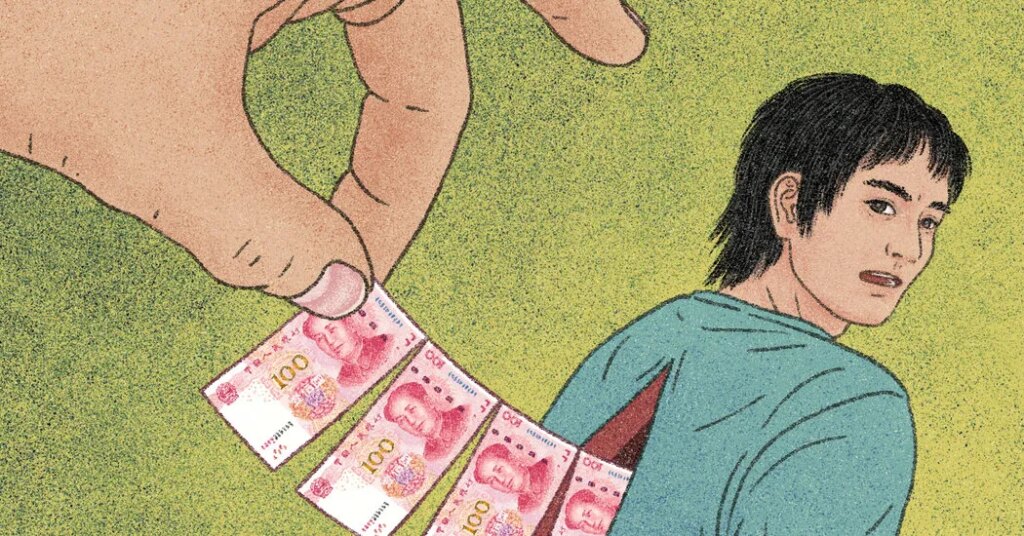
The government needs money to support its rapidly aging population and for costly bets on artificial intelligence. But the economy is in a slump. The result: Chinese people, rich and poor, are feeling the squeeze as Beijing reaches deeper into their pockets to cover its bills.
Hudson Zhou, a 27-year-old freelance illustrator and graphic designer in the southwestern province of Guizhou, saw work dry up as artificial intelligence replaced human-created designs. Zhou, who uses they/them pronouns, had earned only about $4,500 for the year by the end of October — about half as much as in 2025 — but they owe more this year toward the government pension program.
Their pension bill — $1,500 — came out higher than last year because the province raised its minimum contribution for gig workers like Zhou.
China’s economy is in the doldrums, and a property bust has gutted local governments’ revenue from land sales, deepening local government debt.
Workers and employers pay into China’s pension funds, but local governments run them and share some of the cost. Strapped for cash, some have taken money from the funds. In a report released in June 2025, the National Audit Office said 13 provinces had diverted about $6 billion from pension funds to cover government wages and repay debt.
At the same time, the pension system is under strain because of an aging population. Last year only 7.9 million newborns were born in China, roughly half of the average in the 2000s and 2010s.
Beijing also has present-day reasons to encourage people to pay more into the national pension system. If people believe they will have something to rely on in retirement, they might save less and spend their money now, boosting the sluggish economy.
Xu Chenggang, an economist at Stanford, calls the government’s all-out push to collect more social insurance self-defeating. “The economy’s original problem is insufficient domestic demand,” he said. “Now the government squeezes ordinary people to plug its fiscal holes, which makes demand even weaker.”
Last year China’s Supreme People’s Court made it mandatory for employers to pay for employees’ social benefits, which include pensions, health care and unemployment. Businesses have long been required to pay into the system and automatically deduct payments from their employees’ paychecks, just as in the United States, but the law was not always enforced. The court’s decision was met with resistance from small business owners who say they can’t afford the costs and skepticism from workers who fear they will never collect.
This year the Chinese government turned its attention to gig workers, who are estimated by one research center to number some 320 million, or more than 40 percent of the country’s labor force. Only about 70 million of them were enrolled in the basic pension at the end of 2024, according to a government report.
People in the gig economy, which is called flexible employment in China, pay their own social security. The government wants them to pay 20 percent on a base income tied to the provincial average wage. That wage is often far above what gig workers earn, and it rises every year.
To get people to pay, local officials have tried cajoling and coercion. In Yichang, in central Hubei Province, the authorities threw a street festival in October with dancing robots, costumed historical figures and social security planners in matching vests. Elsewhere, the state is steering people toward taking on debt to pay for their retirement. Banks in a few provinces, working with local social security bureaus, offer loans so gig workers can keep paying into the pension fund, with the debt repaid from their future pensions. Some cities also let residents pay with Huabei, a consumer credit platform.
More ominously, the government has also pledged to mine its data to track down people who aren’t contributing. Beijing’s slogan, “leave no one uninsured,” echoes that of the Zero Covid era, “leave no one unquarantined.”
“Where exactly are these people?” Li Zhong, a vice minister of human resources and social security, asked at a news conference last month, referring to people who aren’t contributing. “We have to find them.”
The efforts have drawn widespread criticism on social media. A hashtag on why young people opt out of social insurance drew at least 48 million views on the social media platform Weibo before the topic was blocked in searches.
The Chinese government urgently needs to replenish its pension fund, which experts have said may run out by 2035. It has been raising the retirement age and contribution levels but moving slowly to fix inequalities: Retired government workers receive nearly twice the average pension of private sector retirees and more than 30 times what rural pensioners make.
For Zhou, the visual artist, payments to the pension fund and for medical insurance would amount to $206 a month, or 46 percent of their $450-a-month salary.
Zhou decided to join a growing number of Chinese who have stopped paying into the pension system, which means they won’t get money in retirement.
More concerning for Zhou now is the neighborhood committee that serves as the government’s eyes and ears at the local level.
In 2022 the neighborhood committee tagged Zhou in WeChat groups repeatedly, calling on them and other residents to enroll in medical insurance. Its workers called Zhou’s mother to urge Zhou to enroll. China Mobile, the state-owned wireless carrier, sent automated reminders.
The Chinese government has other ways to compel payment. In some of the biggest cities, residents without local registration can’t buy homes or cars or enroll their children in public schools without contribution records.
Wang, a 24-year-old trainee lawyer in Sichuan Province, has no choice to opt out. (She asked to be identified by only her family name, for fear of government retribution.)
She earns roughly $450 a month and said she had to show proof that her firm pays social insurance for her to obtain a necessary trainee certificate. The social insurance siphons off one-sixth of her pay. She’d rather not pay, she said, partly because it’s too expensive and partly because she questions whether the pension system will still exist by the time she’s old.
Some wealthy Chinese entrepreneurs say they feel like fatty meat the government takes a bite out of when it gets hungry. In recent years, even local police have preyed on businesses, sometimes with trumped-up charges, and extracted payment for debt-plagued local governments.
In July Beijing issued a new rule that demands wealthy Chinese to pay taxes on assets they hold in offshore trusts. Bill, an entrepreneur I’ve known for more than a decade, expects to owe tens of millions of dollars.
Over breakfast overlooking the Imperial Palace in central Tokyo, Bill, who asked to be identified by his English first name because he feared government repercussions, described his confusion and resignation.
He has lived in Hong Kong for more than a decade, holds a Hong Kong passport and says he has paid taxes there for years. Under the new rule, he said, none of that may matter.
He fears making the payment would amount to accepting Chinese tax residency, leaving his income and investments outside China open to taxation later.
“Being born in China has become original sin,” he said.
The post From Gig Workers to Tycoons, China Is Reaching Into Every Pocket appeared first on New York Times.