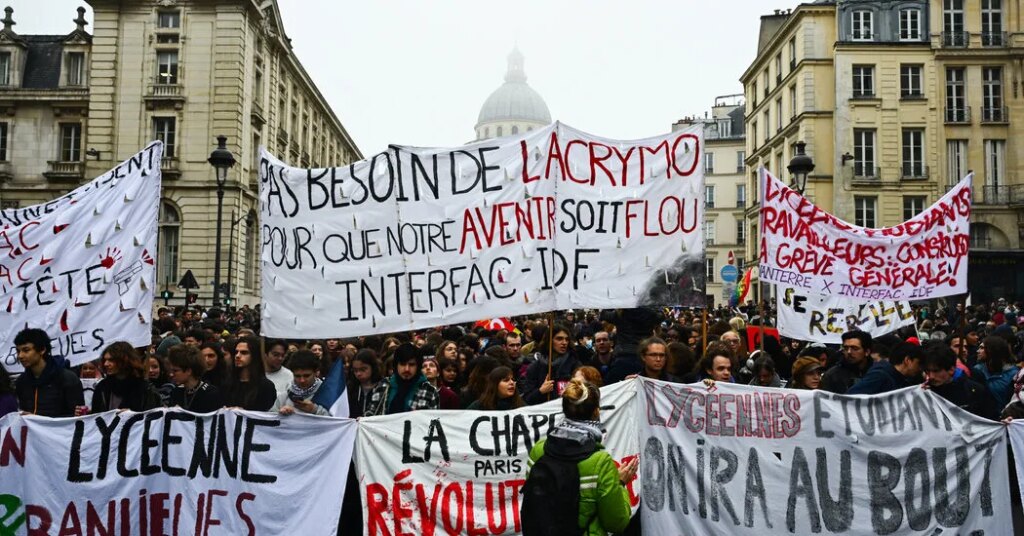
Thousands of students are poised to hold simultaneous and coordinated protests in several European countries on Friday, demanding an end to war, to social-welfare spending cuts and, in some cases, to capitalism itself.
It is the latest iteration of the global youth uprisings that have spilled through streets from France to India this year, and helped to power recent election upsets across Europe and the Americas.
Polling shows that frustrated young people played a disproportionately large role in voting out nationalist leaders in Hungary and Serbia, in electing the first Black senator from Mississippi since Reconstruction, and in putting a German far-right party on track to govern a German state for the first time since World War II. They could prove crucial in upcoming elections in France and Spain.
“It’s becoming harder and harder to not connect all of the different issues facing our generation,” said Adam Powell-Davies, 27, the national chair in Britain of the Socialist Students, one of the groups organizing Friday’s protests. “Not just in specific countries, but globally.”
The beneficiaries of this youth anger are ideologically diffuse. They include centrists — as well as insurgent politicians on the far left and on the far right who offer stark and social-media-friendly solutions to the ailments of an unsettled global order.
Organizers and experts say the connective tissue between these spasms of youth anger is a frustration with established political power structures, whatever their ideological bent — and a perception that economic opportunity is slipping away from young people.
A decade of pandemic, war, warming temperatures and a generation-defining fiscal reckoning in wealthy economies have combined to fuel fears that young people may never enjoy the peace, prosperity and freedoms of their parents and grandparents. Countries like France are struggling with high government debt and face difficult choices for how to maintain the promises of generous social welfare systems.
“There’s no future for us,” Laura Spearey, a 27-year-old information technology student from Bilbao, Spain, who traveled to Britain to join the Friday protests, said in an interview.
She cited difficulties in securing housing, health care and other necessities of adulthood: “You have no chance whatsoever to have your own life, to build your life project.”
Those anxieties have persisted for years: They also drove the “Occupy” protests that followed the 2008 financial crisis. But survey data suggests they are growing more urgent, even in countries, like Germany, where youth unemployment rates are still lower — and there is less government debt — than in Britain and France.
In Germany, young people’s economic concerns have grown in the past decade, according to “Youth in Germany,” an academic study that has surveyed more than 2,000 young people per year over nine years.
“The crucial question is not simply whether today’s young people are objectively worse off than previous generations,” said Klaus Hurrelmann, a professor of public health and education at Berlin’s Hertie School and a co-author of the “Youth in Germany” study. “What matters is that many of them are beginning to believe that the traditional promises of our society no longer apply to them.”
Across much of Europe, that belief has been further fueled by governments’ promises to spend more and more on national defense in the years to come, both to compensate for declining American military support for the continent and to counter threats from Russia. Younger protesters have called for a reversal of that buildup, saying it drains needed money for education, health care and other social services.
In Germany, many protests groups say they have been galvanized by government efforts to encourage young people to sign up for military service in an effort to bolster fighting forces, a move that many young people worry will lead to a military draft.
In a list of demands published ahead of Friday’s protests, one of the German groups organizing the events, “Gen Z Regelt” — roughly translated, “Gen Z Gets Things Done” — called for the resignation of Chancellor Friedrich Merz, who has taken the lead in ramping up German military spending. It also says “not one person, not one cent, for the German armed forces.”
The group’s demands, like the others behind Friday’s events, skew sharply to the left. They critique the capitalist system. They notably refrain from taking aim at older generations that have benefited from opportunities that they fear they are missing out on, like buying homes and securing generous pensions. Instead, they frame the conflict as workers versus the rich and powerful.
“It’s not a battle of the young versus the old,” said Hannah Ponting, 20, a member of the Socialist Students at Liverpool University, who is helping to coordinate protests there. “Neither of those groups are controlling where this money’s going.”
In Berlin in September, similar sentiments — and a surge of voting from people as young as 16 — helped the far-left party Die Linke score an upset victory in the city election.
In other parts of Europe and the world, though, the anxiety has driven young voters to the far right as well as the left.
According to recent polling in France, roughly one in five of voters aged under 25 says they will vote for the main far-right party in next year’s election, and an even higher proportion voted far-right in French legislative elections in 2024.
In the German state of Saxony-Anhalt, exit polls showed the far-right Alternative for Germany party, or AfD, won more than 40 percent of the youngest voters in a state election in September — more than double the share for any other party. The AfD’s main candidate, Ulrich Siegmund, is a telegenic TikTok star who promised to restore opportunity for the state, by deporting some immigrants, providing new benefits to young parents and ending German support for Ukraine.
The success of the AfD and Die Linke in Germany illustrates how quickly young voters are willing to turn on political parties that promised rapid change but failed to deliver, said Mr. Hurrelmann of the Hertie School. Just five years ago, young Germans flocked to centrist parties in a national election.
The centrists have now lost out to the AfD and Die Linke, which have promised radical change by shunning the compromise-driven model of governance that has long dominated German life.
“They are completely free to promise everything,” Mr. Hurrelmann said, “because they are not now in a position to deliver.”
Mainstream parties have few incentives to meet young people’s demands, because doing so risks alienating the older voters who make up the majority of their coalitions, said Tim Vlandas, a professor at Oxford University who studies the political consequences of aging populations.
If the far left or far right were to take power, he added, they would likely face similar pressures — because they would also have to appeal to older generations to stay in government.
Such a cycle, he said, would just increase pressure on young people to take to the streets. “When you don’t influence politics, you can protest. You can become alienated and stop voting,” he said. Or, he added, “you can radicalize.”
The post Gen Z Is Driving Global Political Change, Aiding Far Left and Far Right appeared first on New York Times.