On the first morning of Russia’s full-scale invasion of Ukraine, the news reported missiles hitting Odesa, where my father lived.
“You should call your Dad,” my husband said.
I couldn’t remember how many years it had been since my father and I had talked. As a child, I played with my dolls at my father’s feet while he wrote short stories on a typewriter in the spare bedroom of our apartment in Simferopol. When he stopped working, he would pick me up and kiss me, his mustache scratching my cheeks.
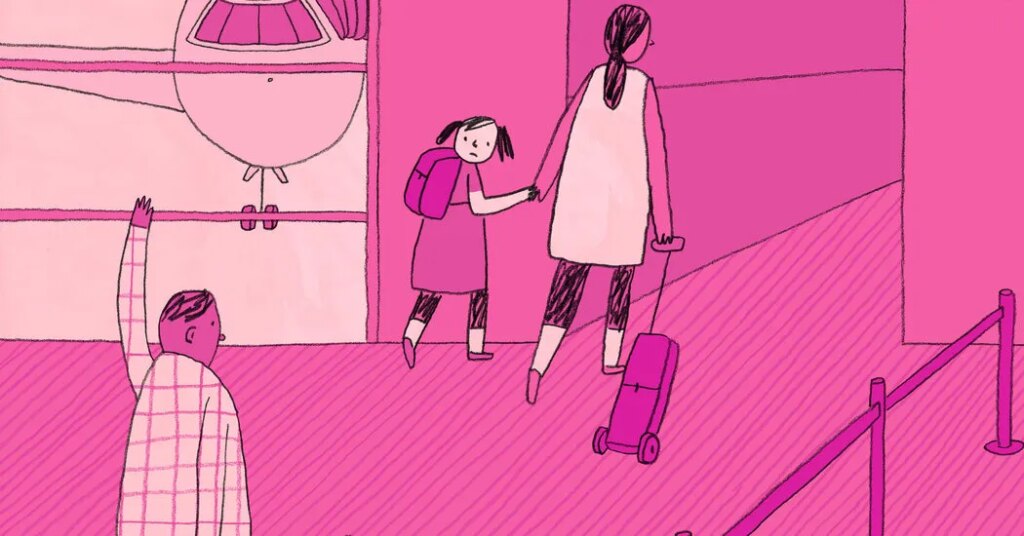
When the Soviet Union collapsed, my mother was already learning English, ready to make her escape. My father saw no future in a country where he couldn’t publish in his native Russian. In 1995, my mother and I moved to Philadelphia; my father stayed in Ukraine. A year or so later, they divorced.
At first, my parents called each other so my father and I could talk, but a year later, when I was 8, the calls stopped. My mother would tell you he stopped showing up for the calls. My father would tell you she stopped calling. I didn’t question why the calls stopped; I took it as a fact of life. Before I knew it, 15 years had gone by.
In 2011, when I was 23, I flew to Ukraine to find him. The smell of his leather jacket, the way his ears stuck out, too big for his head — he was just as I remembered him. We walked along the shore together in Yalta discussing our favorite books, but eventually we ran out of things to say that covered for everything we couldn’t. I wanted to ask: Why didn’t you fight harder to keep me in your life? Why the years of silence?
I didn’t know how. We were strangers now, only the words father and daughter holding us together, which didn’t mean much when that was all there was. Another decade passed, the silence broken only by a handful of awkward phone calls.
When I called him on the first day of the invasion, we talked only for 10 minutes, but the urgency of that day shifted something. We talked again the following week, and the many weeks after that. We talked about the war, my children, the weather — anything but the fact that we had hardly spoken in decades. I helped him flee to Spain, but as the war dragged on, he returned, homesick.
A year and a half into the war, an intercepted missile hit an apartment building near his in Odesa. We agreed he couldn’t stay any longer.
I heard myself saying he should come live with me and my family. After we hung up, I couldn’t believe what I had offered. Talking on the phone was one thing; my father moving into my house was quite another. I had no idea how that would work, how to meet him in the present when I was filled with so much resentment from the past.
Lanky even in his 70s, snow-white hair and those too-big ears, he arrived at LAX with a suitcase the size of something I might take on a long weekend.
He had never been to the U.S.; he didn’t speak English. The man I had spent nearly three decades waiting to need me now relied on me for everything — to translate, see a doctor, open a bank account, buy groceries. On top of my 4-year-old and 1-year-old children, I had gained another dependent.
While we were on the way to the bank one day, my father’s sister sent him photos of me as a little girl — mouth full of baby teeth, dark bangs cut straight across, eyes brown like her father’s. At a red light, I scrolled through them on his phone. One had been made into a pocket calendar. The date on it read: March 24, 1992. I was 4.
“Do you remember anything from that age?” he asked me in Russian.
I shook my head. “Almost nothing.”
He was silent as I pulled into the parking lot. Neither of us had to say it: I didn’t have many memories of him.
In the bank, I dutifully translated, explaining to the associate that my father had just arrived from Ukraine. The woman looked back at us with so much empathy, unaware that my father and I hardly knew each other. I smiled and nodded politely as I answered her questions. My children were whining, pulling at my pants to go; the only thing I could think about was that little girl in the photo.
As we drove home, the children fussed in the back seat, tired and hungry after being dragged on errands for hours. Before I knew what was happening, I was screaming, “Stop crying! Just stop it!” The children cried harder after I screamed at them.
We drove in silence, my hands gripping the steering wheel. My jaw clenched so hard my teeth hurt. I looked at my father and all I saw was the person who never called.
That girl with the dark bangs in the photo was the same age as my son. I couldn’t imagine letting anything keep me apart from him. If we were separated, I couldn’t imagine a world in which I wouldn’t do everything in my power to find him and be the parent he needed.
As I drove, silently seething, my father put his hand on my shoulder and said gently, “It will be OK, Sveta. Everything will be OK.”
I was so caught up in our past, I couldn’t see the person he was now — the one who cooked borscht for our family and then did all the dishes by hand because he didn’t believe in dishwashers. The grandfather who threw a softball to my son for an hour straight so he could practice hitting. The father-in-law who developed an elaborate language of gestures to communicate with my non-Russian-speaking husband.
As the weeks and months passed, I kept driving him around.
He missed my wedding, but we got to drive to Target to shop for T-shirts. He wasn’t there for my college graduation, but we got to sip green tea at the Starbucks waiting for his doctor’s appointment. We never went on vacation together, but we explored the aisles of CVS while waiting for his prescriptions to be filled.
One day, there was a storm coming, and I decided to drive out at night to stock up on groceries. He didn’t need anything but wanted to come, just for the drive.
As the rain came down, he told me how the yogurt he tried at Trader Joe’s reminded him of a Bulgarian cold cucumber soup. Then about his time living in Bulgaria, memories of making wine by stomping barefoot on grapes. I told him about the time I got lost biking through the ruins at Angkor Wat in Cambodia. He told me how difficult life was after we left, of his ambitions and failures: a literary journal and a newspaper he started which both folded, of a struggle for money.
Eventually, I told him how hard it was growing up without him.
I didn’t get the answers I needed about why he didn’t call. We didn’t say all the hard things on those drives, but we began.
One day he said, “Thank you for coming to find me. And thank you for bringing me here. I can be at peace now.”
After nearly a year of him living with us, I asked if he could help me set up my writing desk. It had sat in storage, gathering dust, wrapped in cellophane, the four legs along with the nuts and bolts taped in a Ziploc bag to the top.
We laid the mahogany wood top on the floor and set out the legs next to it. I handed him a wrench.
He knelt on the floor and opened the Ziploc bag, laying all the nuts, bolts and washers into little piles.
My father was no longer an impressive writer at his desk, and I was no longer a little girl sitting at his feet. Neither was he a stranger, unreachable.
Instead, he was sitting on my bedroom floor, more human than I had ever known him. Wrench in hand, nuts and bolts littering the floor, he turned the screws around and around, attaching the legs. He was now an old man, and for the first time in nearly 30 years, he felt like my father. And I was now a woman who could hold the full spectrum of our relationship — the love, the absence, the grief, the hope.
A month later, when he decided to return to Ukraine, I had to let him go.
Sveta Dunn, a writer in Los Angeles, is working on a memoir.
Modern Love can be reached at [email protected].
To find previous Modern Love essays, Tiny Love Stories and podcast episodes, visit our archive.
Want more Modern Love? Watch the TV series, sign up for the newsletter and listen to the podcast on iTunes or Spotify. We also have two books, “Modern Love: True Stories of Love, Loss, and Redemption” and “Tiny Love Stories: True Tales of Love in 100 Words or Less.”
The post I Wanted Him to Need Me appeared first on New York Times.