As we head into Thanksgiving, a holiday dedicated to abundance and sharing, millions of Americans are struggling to afford groceries. Children, in particular, are at risk, their parents forced to choose between listening to their baby cry because they’re hungry or watch them shiver because they can’t pay for heating as the weather turns cold.
Many of us have felt the costs of everyday life getting steeper, squeezing people at the gas pump and the grocery store. But some folks are facing not only inflation but the loss of government benefits: Federal assistance for food has been drying up since the Republicans’ One Big Beautiful Bill Act passed last year. According to the estimates from the left-leaning Center on Budget and Policy Priorities, about 5.5 million people have fallen off of the Supplemental Nutrition Assistance Program (or SNAP) between the law’s passage in July 2025 and July 2026 — a 13 percent decline in just one year. About 2 million of the people who lost benefits are children. At this point, SNAP participation has reached a 17-year low, the lowest it’s been since the Great Recession, and not because people don’t need it.
It is as acute of an affordability crisis as any that Americans are facing right now. Nearly 1 in 4 US adults experienced food insecurity in 2025, according to the Urban Institute; 8 percent said in a recent federal survey that their household often or sometimes did not have enough to eat. When people struggle to afford food, they get desperate: Parents start skipping meals so their kids can eat, they delay turning on their furnace when temperatures drop, they can’t afford gas or other basic household needs.
“People are struggling, and we hear that and see that specifically in what is supposed to be an emergency food system, food pantries. They are reporting that they are seeing more people now than the pandemic. It’s not in a good place for families,” Gina Plata-Nino, director of SNAP policy and advocacy at the Food Research & Action Center, told me. “Every family is really feeling this — and what’s supposed to be a buffer when people hit a hard time is being taken away.”
While Democrats spent more time on the campaign trail talking about the OBBBA’s Medicaid cuts, some of them also criticized the GOP for gutting food stamps. In announcing his bid to be House speaker, Rep. Hakeem Jeffries (D-NY) said Democrats should restore SNAP’s funding during their first 100 days in power. A bipartisan deal has been percolating to delay some of the cuts and stem the bleeding.
Congress says they want to address this burgeoning hunger crisis. Now is their chance.
How Trump and the GOP cut food assistance for millions
When writing the OBBBA, Republicans wanted to prioritize cutting down on social services and alleged “fraud, waste, and abuse,” so they passed several measures meant to restrict SNAP eligibility and limit funding for the program.
The law forced more adults to comply with the program’s onerous work requirements, raising the age of people expected to work from 55 to 64 for childless adults. More parents of younger children were also required to meet certain job-related standards in order for their families to continue getting assistance. The law also required states to contribute funding for the program for the first time if their enrollment “error” rates are too high, which has pushed states to require people to reapply for benefits. It also placed new restrictions on how the assistance money could be spent (rolling back previous allowances for utility and internet costs) and, in a sop to the GOP’s anti-immigration hardliners, the law cut eligibility for migrants who aren’t in the US permanently, even if they are here legally.
“Democrats will scream ‘cuts,’ but what they’re really defending is a wasteful program that discourages work, mismanages billions, and traps people in dependency,” House Speaker Mike Johnson said in a statement last June. He put it even more bluntly in an interview with Face the Nation: “We have not cut SNAP.”
Sign up for the Good Medicine newsletter
Our political wellness landscape has shifted: new leaders, shady science, contradictory advice, broken trust, and overwhelming systems. How is anyone supposed to make sense of it all? Vox’s senior correspondent Dylan Scott has been on the health beat for a long time, and every week, he’ll wade into sticky debates, answer fair questions, and contextualize what’s happening in American health care policy. Sign up here.
And yet, millions of people have dropped from the program’s rolls since the OBBBA became law — again, including as many as 2 million children — and not because they were committing fraud or were too lazy to find work. In some states, the decrease has been very steep: Arizona saw its SNAP participation decline by roughly 50 percent in one year. Another nine states — Florida, Illinois, Indiana, Louisiana, Kansas, Nebraska, Nevada, Oklahoma, and Texas — have had their programs’ enrollment drop by more than 20 percent since last summer.
Not all of this decline can be blamed on the Republican bill; even the left-leaning CBPP acknowledges that enrollment had already started to fall before Trump signed it as pandemic-era provisions expired and the economy improved.
But the rate of decrease has been accelerating in the year-plus since the OBBBA passed, as states crack down on enrollment in order to minimize their cost-sharing responsibilities under the law’s new rules. The legislation penalizes states for paying too much in benefits, and also paying too little, and also if there are any clerical errors in a person’s application. So, for those reasons, states have a strong incentive to simply force everyone to redo the paperwork — and we know from prior experience that more paperwork means more people who should be eligible losing their benefits.
“I think that the thing that is contributing most to the acceleration in the declining enrollment are state-level policy changes related to the cost shift and getting their payment error rate under control,” Lauren Bauer, a fellow of economic studies at the Brookings Institution, told me. It has “prompted states to really tighten their belts and start making it much harder to get on the program, even for people who otherwise would be eligible in the absence of this policy change.”
The new work requirements and other eligibility restrictions have also begun to take effect nationwide, and experts therefore expect the enrollment trends to get worse; Arizona, with its 50-percent decline in SNAP enrollment, could be a preview of what’s to come across the country.
“I do think that we are in the middle of this story… [This could be] the worst-case scenario of states learning from each other,” Bauer told me, “where Arizona starts telling everybody how they’re doing it and we see catastrophic declines in enrollment among people who otherwise should be eligible because everyone is so scared.”
How bad it gets remains to be seen. But what’s clear at this point is that enrollment has not been shrinking because fewer Americans need this food assistance, as Diane Schanzenbach of Georgetown University wrote for Econofact.
As CBPP’s analysts wrote in their own review of the data: “It’s very unlikely that reduced need is driving the decline in SNAP participation.” Instead, people are getting removed because they have trouble with the paperwork, or they may not even know they need to fill out new paperwork, or the state’s social services office may be inundated with a backlog of applications to check. As more people depend on the gig economy to make ends meet, they may be working unusual hours that make it more difficult to prove they meet the new requirements.
“What [the One Big Beautiful Bill Act] has done is that it has increased the time tax on families and the red tape,” Plata-Nino said.
And because children only receive assistance through their parents — as opposed to getting it directly, like they do with survivor benefits after a parent dies — kids are particularly vulnerable to losing access because their parent has lost access.
All this means that people are going into credit card debt just to pay for their basic household needs, or are simply going without. “We hear from families who don’t turn on the heat, who only take one bath a week, that only the baby gets warm water, and even in the winter, they’re getting cold water,” Plata-Nino said. “We hear from families who turn on the heating plates to warm up their house because they don’t have it. It really is incredibly challenging.”
And if more people are struggling to afford food because they no longer receive government assistance, that is going to have consequences for their long-term health. One metaanalysis of the relationship between food insecurity and adverse health outcomes found that not having assured access to food was associated with 22 different negative health effects, including stress and depression, poor sleep, diabetes and hypertension, and anemia.
Kids experience a wide range of negative physical and mental health effects from hunger, which can impact their development for years. And while they have historically been able to rely on getting at least one good meal at school, declining SNAP enrollment also means fewer free school lunches through community eligibility, Bauer said.
“People do turn to the charitable sector. They do turn to friends and family. But there is a reduction in the quantity and quality of food that you intake, and there are consequences to that,” Bauer said. “In terms of your health, both mental and physical, as well as other outcomes — especially for children, in terms of school attendance and school performance.”
In other words, the situation for SNAP is dire as Democrats are coming into power. What now?
What Congress could do to make food more affordable
If there is any good news, it’s that Democrats’ enormous wins in the 2026 midterms are motivating lawmakers to do something about the looming SNAP cuts, potentially even before the new year. Democrats and even some Republicans have been discussing a delay in the new state cost-sharing requirements as part of the larger “farm bill” that Congress wants to pass. And in the past two weeks, a few key elected officials on the right have indicated that they might be willing to agree to Democrats’ preferred two-year delay; House Agriculture Committee chair Glenn Thompson (R-PA) said he is open to negotiating with Dems.
“Every indication is that both sides want to get this done in lame-duck,” Bauer told me. “What the Democrats are going for is a two-year delay to never doing this. That would be the hope.”
The idea is that the two-year delay could, in theory, turn into a permanent one if Democrats can win the White House in the 2028 election and keep control of Congress. Even if the two parties agreed on a two-year delay in the lame duck, Democrats could still include a full repeal of the OBBBA’s SNAP cuts as part of their budget reconciliation bill next year. President Donald Trump won’t sign that bill even if the Democratic-controlled Congress passes it, but Dems could take the opportunity to show voters they are following through on their campaign promises and do a dry run for a bill that could actually become law in 2029.
In theory, if Democrats fully control the government in a couple years, they could not only reverse the GOP’s food-stamp cuts but expand the program. Bauer said they could look at how to make benefits more generous for people and make more people eligible to receive them. And in the long term, a healthier economy that actually lifts up working-class folks is the best way to help people get off government programs; adding a time tax that penalizes the people who really depend on these benefits to get by just ends up pushing them further into poverty.
“People don’t want to be on SNAP,” Plata-Nino said. “They’re just trying. They just don’t make enough because the government has failed in providing those things where people can have enough money to just live on.”
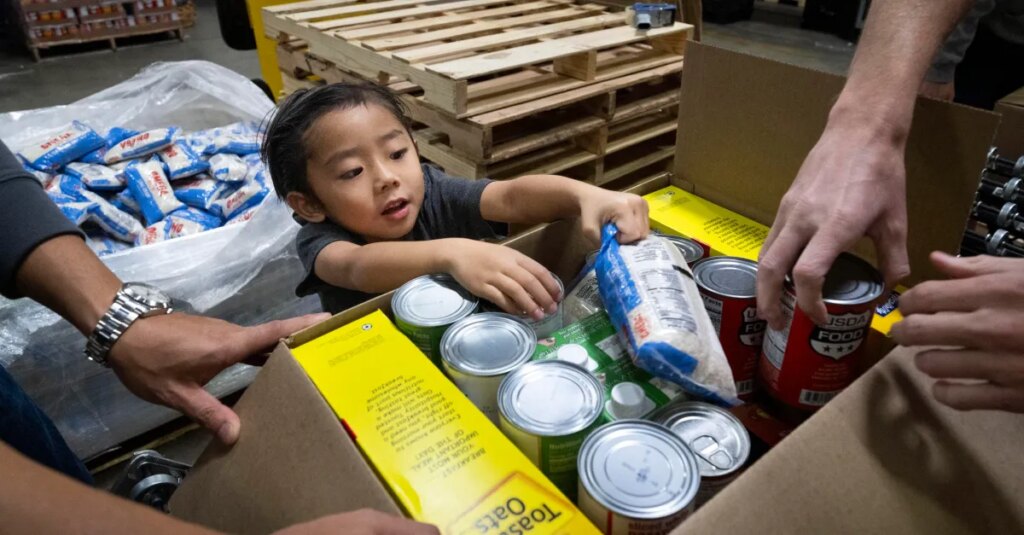
That is still a ways off. For now, the dramatic decline in SNAP enrollment is an emergency happening in slow motion, one that could make the holiday season more stressful and expensive for millions of Americans. But we aren’t powerless: Each of us can call our House representative or senator and urge them to do something about food assistance. And if you have the means, you can donate money to your local food bank and make sure they are well stocked for the winter months ahead. (Recurring donations are ideal, if you can manage it.)
Those are makeshift solutions. A long-term fix to America’s hunger crisis will require Congress to step up and do something.
The post The astonishing toll of America’s food stamp cuts appeared first on Vox.