In a setback for the Trump administration’s campaign against drug gangs, Colombia’s president rejected a plan to allow the United States to conduct joint military operations in his country, according to U.S. officials.
The right-wing Colombian leader, Abelardo De La Espriella, told Washington this week that though he supported working with the Pentagon to target drug organizations, he lacked the votes in Congress to approve such action, the officials said. The officials requested anonymity to discuss a sensitive diplomatic matter.
Representatives for Mr. De La Espriella did not respond to multiple requests for comment before this article’s publication. After it ran, Mr. De La Espriella said on X that it was “false” that his government had rejected a cooperation plan.
“Colombia and the United States maintain a robust and increasingly close cooperation in the areas of security, intelligence, and the fight against drug cartels and narcoterrorist organizations,” he wrote.
But the president also said his military forces were capable and did not rely on “requesting the presence of foreign troops on Colombian territory.” The Pentagon, however, has made it a priority to get Latin American countries on board to accept joint U.S. strikes inside their territories.
Colombia has been key to the Pentagon’s plans to expand military operations across Latin America because it is one of the region’s biggest nations and has one of its most sophisticated military forces.
When Mr. De La Espriella came to office this year, he aligned himself with President Trump, promising a tough approach to drug groups and a crackdown on the violence prevalent in many regions of Colombia.
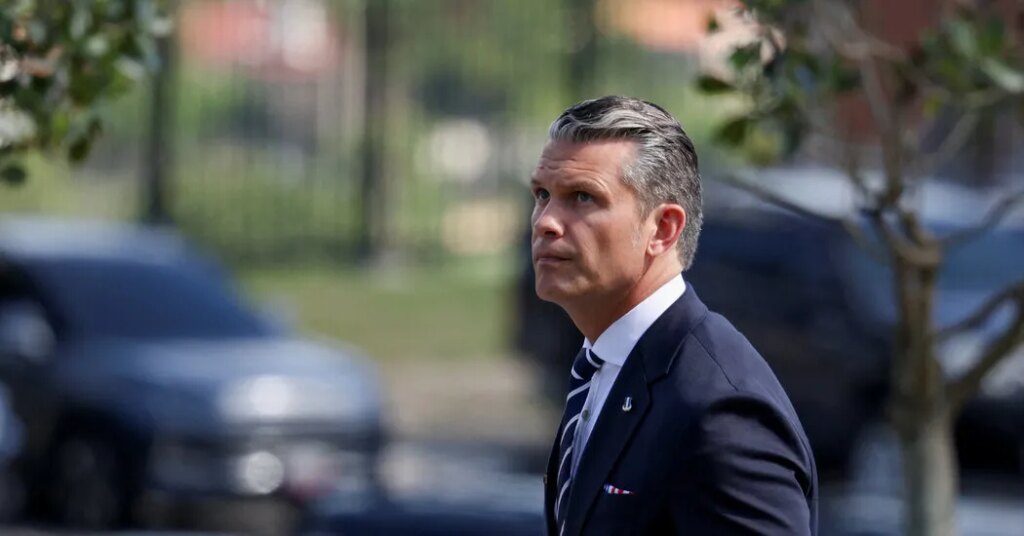
Colombia’s decision prompted the American defense secretary, Pete Hegseth, to alter the four-country trip he is currently making to Latin America. Originally, Mr. Hegseth and his aides had anticipated being able to meet with Colombian officials in Bogotá, the capital, to discuss the bilateral military agreement. But in recent days, it became clear that the Colombian objections could not be readily addressed.
Instead, Mr. Hegseth touched down briefly in Bogotá after stopping in Caracas, Venezuela, where he met with the acting president and other officials. The defense secretary and the interim president, Delcy Rodríguez, signed an agreement that Mr. Hegseth described as part of an “increased defense partnership.”
After the meeting with Mr. Hegseth in Bogotá on Wednesday evening, Colombia’s foreign minister, Omar Bula, urged the country’s Congress to approve increased military cooperation with the United States.
“We know that any decision by the executive branch in this context will have to go through the Congress of the Republic,” Mr. Bula told reporters. “We hope it passes as quickly as possible. We cannot afford to waste time when it comes to fighting crime.”
Afterward, Mr. Hegseth said on X that the Colombia-U.S. partnership was “stronger than ever before.”
The military agreement with Colombia, known as Title 10, would have enabled U.S. forces to operate in that country and carry out joint airstrikes and ground operations.
Despite the setback, cooperation between the two countries remains strong. The United States and Colombia recently completed a major training exercise. And last week, Gen. Dan Caine, the chairman of the Joint Chiefs of Staff, met in Bogotá with top Colombia military leaders.
The White House did not immediately respond to requests for comment.
Mr. Hegseth was also expected to visit Ecuador, whose conservative president has already said he would allow joint military operations with the United States in his country.
Venezuelan and U.S. officials have drawn closer since the American military seized Nicolás Maduro, its autocratic leader, in January. The New York Times reported that the United States had assisted the Venezuelan military in a deadly drone strike on an armed group in Venezuelan territory, and that the Trump administration was negotiating an agreement that would lay the foundation for a potential long-term U.S. military presence in the country.
Mr. De La Espriella’s inability to deliver Colombian cooperation casts doubt on the Pentagon’s plans for the region and its Americas Counter Cartel Coalition, which was announced this year. In March, Mr. Trump met with right-leaning Latin American leaders in Florida, pledging to work together to “eradicate the criminal cartels plaguing our region.”
Central to Mr. Trump’s goal was persuading Latin American nations to allow joint operations inside their territories. The strategy is an aggressive expansion of the Pentagon’s airstrikes on alleged drug boats leaving South America. Many legal experts say those strikes are illegal under international laws forbidding the targeting of civilians, even if they are committing a crime, unless they pose an immediate threat.
Aside from opposition in Colombia’s legislature, U.S. troops on Colombian soil could also face significant pushback from the public. Colombia has a highly experienced military, and many citizens are likely to consider such a move an affront to sovereignty.
“Since the boat strikes began, the Trump administration has signaled a desire for land strikes,” said Brian Finucane, a former State Department lawyer who specializes in the laws of war. “Colombia shows that even in countries where the presidents are supportive of Trump, they still face domestic political and legal constraints on US military actions in their territory.”
Mr. Finucane added, “It should be a reality check for the administration that, unlike with the boat strikes, they aren’t going to have a free hand to do strikes willy-nilly in the territory of other states.”
Simón Posada contributed reporting from Bogotá, Colombia.
The post Colombia Rejects U.S. Drug-Gang Plan appeared first on New York Times.