Earlier this year, social media was flooded with videos by users claiming to have never even heard of Ella Langley’s “Choosin’ Texas,” despite its being the No. 1 song in the United States.
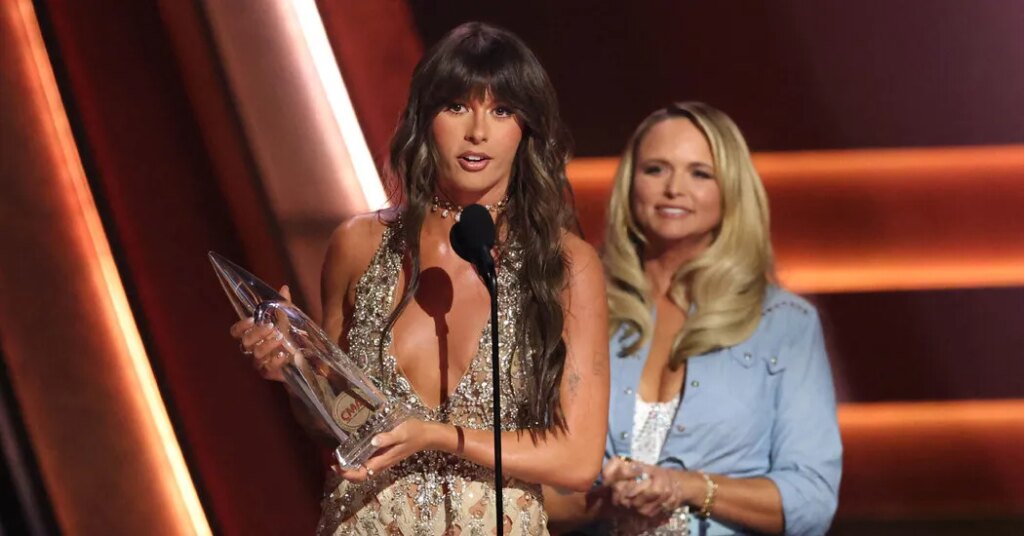
That may be true for some, but you wouldn’t have known it watching Wednesday night’s Country Music Association Awards. Even Taylor Swift, attending the ceremony for the first time in over a decade, seemed like second fiddle in terms of attention paid. Langley has cemented herself as the brightest new star country has produced in many years, with a record six wins and two separate performances. She comes across as stoic at the best of times, but as she accepted the award for entertainer of the year, she seemed downright giddy: “I could quit tomorrow and have the best career,” she said.
Lainey Wilson hosted the awards and performed alongside Langley, Swift, Kacey Musgraves and Miranda Lambert, among others. That the event was so dominated by women felt appropriate during a year in which women have been leading the charge of country’s push into the mainstream.
This week, the groovy, despondent yacht-country track “Choosin’ Texas” notched its 28th nonconsecutive week at No. 1 on the Billboard Hot 100, extending a lead over Mariah Carey’s perennial chart-topper “All I Want for Christmas Is You.” Langley, who has five songs on the Hot 100, is the first female country star to break through to the mainstream with such force in many years, but she’s not alone. At No. 2 is Stella Lefty’s “Boston,” which has been slowly climbing the chart since April.
The chart ascendance of either woman would be remarkable. Country has dominated the singles chart for much of the 2020s, but it has mostly been by male stars like Morgan Wallen, Luke Combs, Jelly Roll and Zach Bryan, all of whom have songs on the Hot 100 right now. Only seven other women have made it into the top 10 in the 2020s with a country track, and most were pop artists with crossover records, such as Tate McRae, who duetted with Wallen last year, or Beyoncé, with three tracks from her country record “Cowboy Carter.”
Key to both Langley’s and Lefty’s rise is that they have each released country songs that appeal well beyond pure country audiences. “Choosin’ Texas” touches on quintessential country subject matter — after being dumped for a Texas girl, the song’s narrator is left alone with her whiskey — and features a fairly timeless country palette (pedal steel; rich, yearning harmonies). It also stands apart from most contemporary country fare, with a yacht-rock sway that makes Langley’s music feel woozier, and less obviously modern, than the songs on, say, “Crisco,” the latest album from Miranda Lambert, one of the writers of “Choosin’ Texas.” Despite its vintage aesthetic, “Crisco” is filled with the high-gloss, tightly wound stuff that receives big airtime on country radio.
The touch of yacht rock might be borrowed from Langley’s collaborator and touring partner Wallen, whose 2025 album “I’m the Problem” repositioned him as a Don Henley-esque inhabiter of glossy, soft-pop soundscapes. After netting a number of hits with a bolshie, anthemic trap-country sound throughout the early 2020s, the more laid-back “I’m the Problem” savvily predicted a broader pop shift toward more soft-edged sounds, evidenced by the success of the rising star Olivia Dean and by the return of Bruno Mars to commercial dominance.
Langley’s LP “Dandelion” also has much in common with the recent work of Kacey Musgraves, who, since the release of her 2018 breakthrough “Golden Hour,” has been exploring a similar kind of ’80s-inflected studio sound, with lyrics that can be sassy but are more often dejected and sound little damaged. Of course, Langley’s debut embraces country’s mainstream, whereas Musgraves has for years ribbed and swerved it.
Langley’s career has hewed closely to the established path country stars tend to take: She signed a publishing deal long before she was inked as an artist, and she espouses a kind of down-home traditionalism in her lyrics. (“There’s things I can’t change,” she sings on the title track of “Dandelion,” “like how I was raised / the Bible in my blood / and the ’Bama in my veins.”)
As Lefty has emerged, her songwriting has revealed the exact inverse: An Illinois-born daughter of a billionaire businessman, Lefty has faced scrutiny over the provenance of parts of her songs, most notably “Boston,” which interpolates elements of Noah Kahan’s megahit “Stick Season.” (Kahan was credited shortly before the release of Lefty’s single.) It is one of the most distinctive songs on her debut album “Long Way Home,” which exhibits flashes of ingenuity but otherwise draws from an uninspiring palette not quite rooted in anything.
Still, Langley and Lefty largely remain ciphers in a field where their recent forebears seemed to arrive with built-in personas: Taylor Swift was the teenage dreamer singing her heart out; Lambert branded herself a “Crazy Ex-Girlfriend”; Musgraves was a small-town stoner without a filter. Neither Langley nor Lefty is as easily pinned down, but that malleability might equal longevity in a world where music quickly cycles in and out of trends.
Of course, a third woman has netted a Hot 100 hit with a country song this year. “I Knew It, I Knew You,” Swift’s tie-in for the “Toy Story 5” movie, spent two weeks at No. 1 in June. Promoted by MCA Nashville, a country arm of Universal Music, the song has given Swift occasion to trumpet her re-entry. When country stars gathered in Nashville to send off the traditionalist Alan Jackson at his final concert, Swift shared a video message placing her among his fans. She performed “I Knew It, I Knew You” on Wednesday night, her first appearance at the CMAs in more than a decade.
“I Knew It, I Knew You” received a Grammy nomination for song of the year, the category in which Swift has gone 0 for 8 despite her success in others. It will be up against “Choosin’ Texas,” one of the nominations for Langley across the “big four” categories of album, song and record of the year along with best new artist. It’s a strong showing for country in general, and a case for the broad appeal of its new hitmakers that counters the genre’s showing at last year’s awards. (Across the big four in 2026, country wasn’t represented at all.) If Langley is even marginally as successful at the Grammys as she was at the CMAs, it will be the kind of mainstream coup that the women of country haven’t pulled off in years.
The post Women Led Country’s Big-Tent Revival This Year appeared first on New York Times.