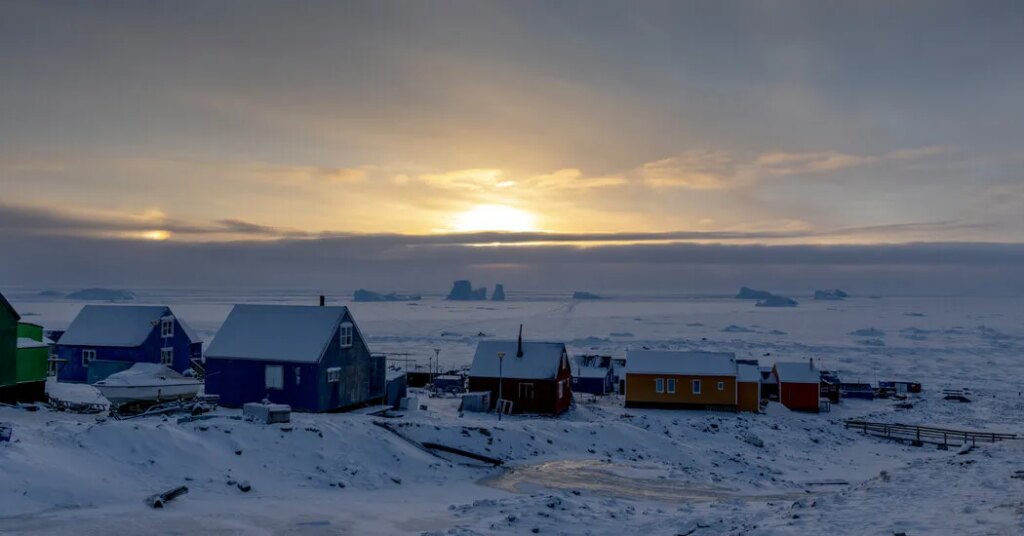
For years, Jens Peter Lange has been annoyed about Greenland’s time zone. As a sometime fisherman and hunter in Ilulissat, a Greenlandic city above the Arctic Circle, it was simply disorienting.
“When we head out to go fishing, it’s dark. And when we come back, the sun is coming up,” he said. “It feels weird.”
So Mr. Lange and many other Greenlanders were pleased this month when Greenland’s government, after a heated discussion but an overwhelming vote in favor, decided to shift its time zone an hour earlier.
Greenland, an overseas territory of Denmark, is three hours ahead of Eastern Standard Time and three hours behind Central European Time, which Denmark uses. Starting next October, Greenland will move its clocks back one hour.
Even though closer ties to the United States were not part of the official reason for changing the time zone, and many Greenlanders remain upset about President Trump’s threats to “get” the island, the time shift could facilitate more opportunities for U.S. trade, tourism and investment in Greenland.
It also stands to distance the giant island from Denmark, which colonized Greenland more than 300 years ago and still oversees its defense and much of its foreign policy.
The time zone decision, made on Nov. 12, reverses what Greenland’s leaders did in 2023. Back then, they moved the clocks forward, striving to be closer to Denmark.
The idea was to facilitate more business and communication with Denmark and the rest of Europe. But the move prompted years of complaints, especially from hunters and fishermen who struggled with darker mornings.
And in recent years there has also been rising sentiment in favor of breaking from Denmark. Two opposition parties in Greenland’s Parliament that support fast-tracked independence spearheaded the vote.
Jens-Frederik Nielsen, Greenland’s prime minister, who is relatively pro-Denmark, warned against turning the clocks back again.
He told parliamentarians that doing so would bring “a lasting negative economic impact on society as a whole, including public finances.”
He also said it could lead to fewer and more expensive flights because most come from Denmark, and create problems for Greenland’s health care services, which are heavily dependent on communication with Denmark.
Despite Mr. Nielsen’s warnings, the proposal passed easily, with support from his own party and no votes against it.
In the new time zone, Mr. Lange said, he will work better and sleep better.
“We will go back to our normal biological rhythm,” he said.
The tensions with Mr. Trump have eased since the United States signed a deal in September with Denmark and Greenland to expand the American military presence in Greenland.
But Mr. Trump’s fixation on the Arctic island has spawned a frenzy of American business people prowling for deals in minerals and natural resources. Some were excited by Greenland’s decision to shift time zones.
“I think it’s brilliant,” said Larry Swets, the executive chairman of Greenland Energy Company, a Nasdaq-listed corporation that does oil exploration. “Every extra hour Greenland and the U.S. share in the workday is an hour we can spend building something together.”
Thomas Dans, the chairman of the United States Arctic Research Commission and one of Mr. Trump’s most active allies on Greenland, said it would help facilitate U.S.-Greenlandic trade and tourism.
“The adjustment recognizes Greenland’s positioning within North America,” he said. “It’s a great move.”
The post Greenland Pulls Closer to the U.S. — by an Hour appeared first on New York Times.