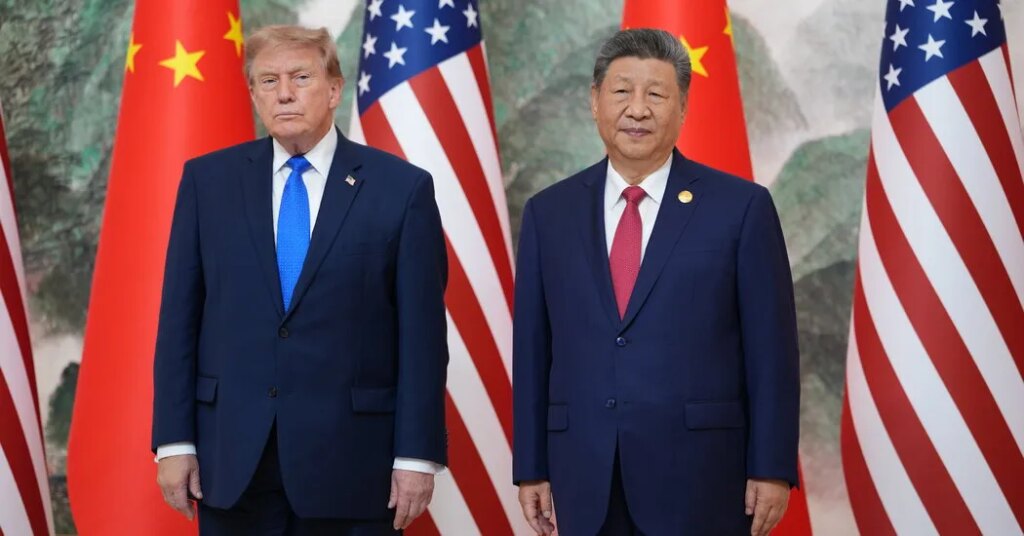
Seated at a long table across from the Chinese leader, Xi Jinping, President Trump had just finished thanking his host when a reporter called out a question: Had Jensen Huang, the former chief executive of Nvidia, been disloyal to the United States?
The president did not answer. Mr. Xi looked toward the gaggle of reporters and then away as a security guard moved in and blocked a camera that had been recording the exchange.
Chinese officials later barred the journalist, Annmarie Hordern, a Bloomberg TV reporter, from covering Mr. Xi’s next major event, perhaps the most important of the day in Shenzhen: a trilateral meeting of the leaders of the United States, China and Russia.
It was the latest example of China’s strict controls on news coverage and how tightly Beijing tries to stage-manage major international events.
When Mr. Trump, Mr. Xi and President Vladimir V. Putin of Russia met in the first-ever summit of the leaders of those three countries, the reporter was prevented from entering the room.
A White House official said that the U.S. side had tried to reinstate the journalist but that Chinese officials refused, according to a report shared among television journalists. Reporters at the summit were told that it was extremely rude to shout a question. The Chinese Ministry of Foreign Affairs did not immediately respond to emailed questions about the reporter’s exclusion. A spokeswoman for Bloomberg News declined to comment.
In the United States, it is routine for the president to answer impromptu questions from the press corps. Over the past week, Mr. Trump has spoken about Mr. Huang several times. Mr. Huang is under investigation for an affair with a woman who U.S. intelligence determined is a Chinese spy. (China has denied the espionage claims.)
When China hosts official events, it tightly controls the access of reporters, often allowing only state media outlets into major events or giving foreign journalists selective access. Over the years, China has expelled many foreign reporters, including most recently a New York Times correspondent. Chinese officials also try to influence international outlets by threatening to not grant them the accreditation that their reporters need to work in the country.
Looking out and seeing a lack of the usual fleet of American photographers and recognizable reporters who track his every move, Mr. Trump seemed to gently criticize the restrictions. In his remarks to Mr. Xi, the president praised the organization of the summit. “It’s too bad the media couldn’t see some of it, because every move was perfectly executed,” he told the Chinese leader.
Mr. Xi, whose comments reach the Chinese public via speeches and remarks carried in state media outlets and rarely has unfiltered moments, does not hold news conferences or directly engage with reporters.
Previous American leaders have used state visits to China to push Beijing to be more open with the news media. During a joint news conference that U.S. officials forcefully negotiated during President Barack Obama’s trip to Beijing in 2014, Mr. Xi took a question from an American reporter about how the Chinese leader viewed Washington’s renewed focus on Asia. When Mr. Xi visited Washington in 2015, he took another question on cybersecurity from an American reporter.
Mr. Trump broke with that tradition when he traveled to China in 2017 and refused to take questions. When he visited again in May, he answered some questions from journalists but did not hold a formal news conference with Mr. Xi. During his trip to Shenzhen this week, the leaders again did not hold a joint press conference.
Peter Baker contributed reporting from Shenzhen, China.
The post China Bars Bloomberg Reporter From Trilateral Talks for Asking a Question appeared first on New York Times.