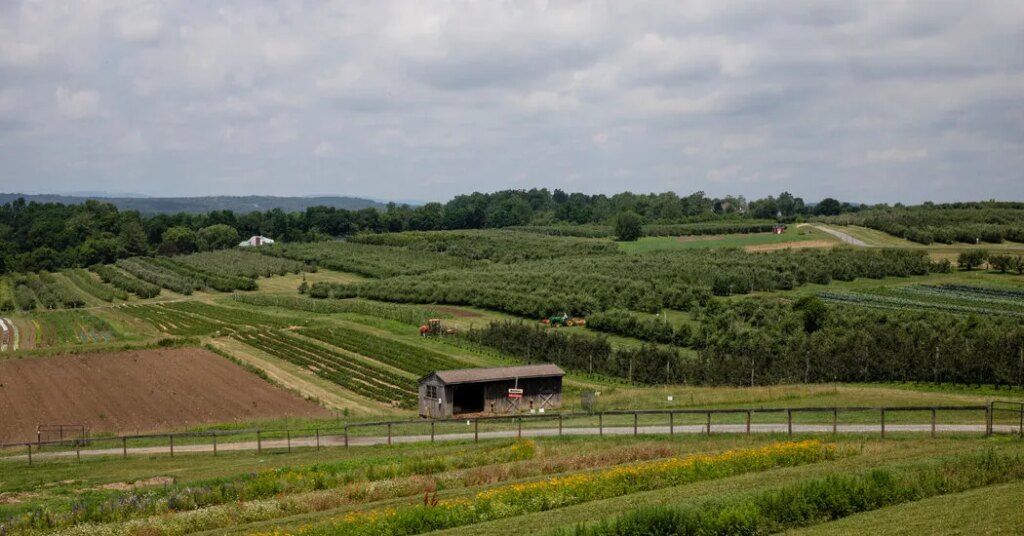
The Appalachian Trail runs through East Fishkill, N.Y., a hilly, bucolic town where people keep to themselves. But this year, residents were activated. Big time. About a data center. And it poured out at a town board meeting, right after the Pledge of Allegiance.
Amid mentions of the Boy Scouts, a fitness campaign and plans for America’s 250th birthday celebration, barks of “We’re here about the data center,” and “When will we discuss the moratorium?” blared from the lobby, where a standing-room-only throng had spilled out from the meeting room.
Similar scenes are unfolding at town halls across the United States. Local governments, better known for spearheading blood drives and playground renovations, are finding themselves on the front lines of the existential crisis of our time: artificial intelligence and the power-hungry data centers that generate it.
After all, it’s small towns that control zoning decisions. And it’s small towns where the battle over large-scale data centers is likely to be won or lost.
That night in late June, five board members sat behind an imposing, wood-paneled dais. The anxiety in the room was palpable. It was time to pass a moratorium on large-scale data centers, or face the pitchforks. But not before the residents spoke.
“East Fishkill has rules about how many chickens you can have,” George Naumann, a retired teacher, said. “That rule is there for a reason, for health and safety.”
His point being: If the town could regulate poultry, it could regulate data centers. The room erupted in applause.
In the end, the town board passed a three-year moratorium. But that didn’t end the tension in East Fishkill.
Residents are clamoring for more transparency from the board, which created a data center task force that many do not trust. And Treetop Companies, which owns the land where the data center would rise, signaled in a court filing that it intends to sue the Hudson Valley town, a tactic that is gaining momentum elsewhere.
“I’ve never experienced anything to this level,” said Marianne Flores, one of the town board members.
No one from Treetop spoke at the meeting, and the company did not respond to a request for comment on its plans for the data center or about the possible litigation.
Dan Diorio, the executive vice president of state policy and government affairs at the Data Center Coalition, a trade association, said that the industry, by creating local tax revenue, jobs and other opportunities, aims to “help build a stronger economic future for every American.”
But most Americans have made clear that they don’t want the buzzing, high-tech behemoths in their backyard. Data centers are full of hard-working computers that propel the A.I. boom. But they are also energy hogs that threaten water supplies, produce noise and air pollution and heat the atmosphere.
Democrats capitalized on this disaffection in right-leaning states such as Ohio and Texas during the midterm elections. And voters approved all but one of 41 local ballot initiatives to limit or stop the development of data centers.
The people of East Fishkill feel similarly. They know something about technology and pollution.
IBM once ran a major manufacturing site in the town, which is about 75 miles north of New York City. Its computer chip cleaning operations polluted the groundwater, the main source of drinking water for the residents, most of whom rely on wells. Many of those wells became contaminated and had to be plugged.
Pamela Henry, who spoke at the meeting, uses water that is shipped to her area from wells in a nearby town. Her bills have doubled to about $235 a month, and she experiences flagging water pressure.
“I’m struggling to pay,” said Ms. Henry, who is retired and lives on a fixed income. And when it comes to a data center? “I want to know where the water is going to come from to generate this system,” she said.
Water quality and quantity in East Fishkill is already precarious. In 2024, a drought dried out a crucial stream and a well at Fishkill Farms, a popular family business that grows fruit and vegetables. The farm had to ship water in by tanker.
Josh Morgenthau, the farm’s owner, fears that between droughts wrought by global warming and the insatiable appetite of computing campuses, his farm will dry up.
Some data centers are investing in closed-loop systems that recirculate cold water to cool computer equipment, which limits the reliance on local water sources.
But the systems are expensive to build and gobble up more power, which brings up problem No. 2: East Fishkill is not equipped for the mammoth amount of electricity that Treetop has said it needs.
According to the New York Independent System Operator, which manages the state’s grid, the amount of energy that Treetop wants would be enough to power up to one million homes. That’s about eight times as many households as in Dutchess County, which includes East Fishkill, 19 other towns and two cities.
It would be a herculean challenge to strengthen the electrical grid for the project — work that residents would subsidize through higher bills. To avoid such an expensive and time-consuming option, many developers are buying old fossil fuel power plants, building new ones or using mobile gas turbines to generate their own electricity. But that exacerbates air pollution and fossil fuel emissions. And often, the data centers still need to plug into the grid.
Hundreds of miles away from East Fishkill, an old coal plant from the 1930s that now runs on gas provides electricity for a crypto mining data center, where computers crunch number sequences to create digital currency, in the town of Torrey. Now, the site’s owners would like to convert it to an A.I. data center.
A.I. computing requires more electricity than bitcoin mining does. Vulcan Infrastructure and Power, which owns the gas plant and crypto facility, has a request pending with the New York Independent System Operator for additional electricity equivalent to what could power 200,000 homes.
Yvonne Taylor, the vice president of Seneca Lake Guardian, an environmental nonprofit, said that the plant had closed when the state phased out coal. It was brought back to life and retrofitted with gas to sell power to the state grid. A few years later, the crypto computers were installed, which meant the noisy and polluting gas turbines would be in continual use.
“Now, we’re watching the next chapter unfold,” Ms. Taylor said. “It will be difficult for Vulcan to make the claim that they’re ‘providing much needed power to the grid’ anymore, now that they’re consuming more power than they generate.”
Dale Irwin, the president of Vulcan, said that the plant would continue to provide electricity for the grid. “We’re simply pivoting what the data center computers will be used for,” he said.
The gas plant has pipes that extend into Seneca Lake, the deepest water source in the Finger Lakes and famous for its trout fishing. The pipes pull in roughly 74 million gallons of water a day to cool the plant, and then return it at hotter temperatures, as high as 98 degrees. Warmer waters are more conducive to algae blooms, and neighbors are concerned.
Laurie Fish, whose parents have a home next to the plant, said the aquatic life in this part of the lake had been destroyed. “It used to be Jesus fishing,” she said. “You put your pole in the water and you pull out a fish.” Now, she said, algae blooms turn it the color and consistency of pea soup.
“Our dogs can’t swim,” she said. “Our kids can’t swim.”
Mr. Irwin said that his company planned to build a closed-loop system for the A.I. operation, meaning that no additional lake water would be needed. He added that his business operates according to its permits and that no studies have linked algae blooms to the discharge from his plant.
Activists and policymakers who would like to stop the proliferation of data centers point to a one-year statewide moratorium on the centers that Gov. Kathy Hochul declared by executive order this summer. They would like the moratorium made into a law. The Responsible Data Center Development Act would do that, plus mandate environmental and financial protections for communities in New York State.
The legislation would increase the number of data centers included in the moratorium, which would be extended upon the bill’s signing; introduce a more stringent environmental review; require data centers to use renewable energy; and establish separate water and electricity rates, with one for residents, and one for data centers.
While the governor considers the bill, Congress is debating federal legislation that would require data centers to pay for their own electricity.
Although the state and federal measures would both help New Yorkers with soaring electricity costs, the state version would slow down and fine-tune the environmental permitting process of large-scale data centers, while the federal version would fast-track it.
Peter Martini, the town supervisor in Torrey, said he would welcome a stronger state law.
“I don’t deal with bitcoin and l don’t like A.I., but it’s a business in my town,” he said. “Sometimes, when the consequences are out of our hands, it makes things easier for us.”
The post A Data Center Was Coming. The Town Had a Message: Stay Out. appeared first on New York Times.