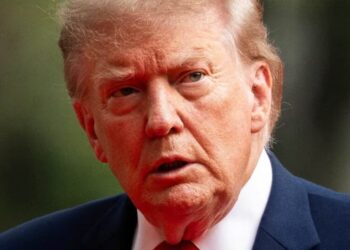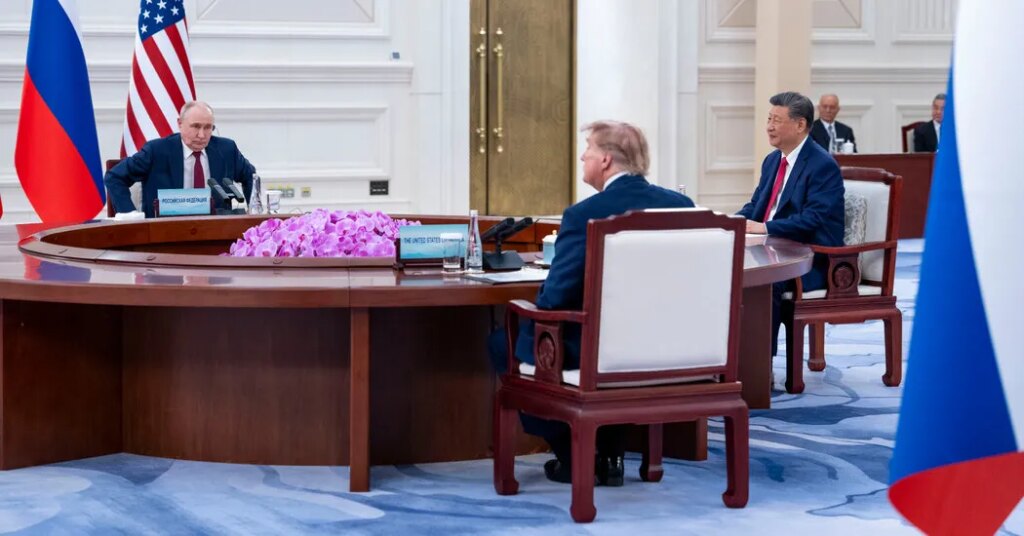
The leaders of China, Russia and the United States agreed in a joint statement after their meeting on Thursday that “a nuclear war cannot be won and must never be fought.”
Just two years ago, the Russian leader, President Vladimir V. Putin, expanded his country’s guidelines justifying the use of nuclear weapons, and his arsenal remains the world’s largest. The meeting on Thursday was not expected to produce any change to that policy.
Mr. Putin’s posturing at the summit in Shenzhen, China, held on the sidelines of an Asia Pacific Economic Cooperation meeting, was being watched closely in Europe, where Moscow’s nuclear calculus has been a major concern during Russia’s war against Ukraine.
Rishi Paul, a nuclear deterrence expert at the European Leadership Network, a research group in London, said Mr. Putin “views nuclear weapons as a tool for coercion.”
“It’s a studied ambiguity,” Mr. Paul added. “He is sowing fear by us trying to decipher, ‘What does he mean, exactly?’”
Mr. Paul noted that Russia had recently changed its nuclear doctrine, which guides when nuclear weapons are developed and potentially deployed during war.
That does not mean Russia is looking to rush into nuclear war, Mr. Paul added. Mr. Putin said earlier in the summit that regional leaders had a “joint responsibility for maintaining international peace and security.”
The statement released after the trilateral meeting on Thursday cited a commitment by China, Russia and the United States to engage in dialogue on reducing nuclear risks. Mr. Putin has sought to avoid a nuclear arms race with the United States that could start if Washington builds up its warheads amid concerns about China’s rapidly growing arsenal, said Nicole Grajewski, a nuclear and Russia expert at Sciences Po, a Paris university.
Ms. Grajewski said that Russia’s expanded nuclear policy largely sought to deter European countries in NATO that have supported Ukraine in the nearly five-year war against Moscow.
“The Russians are very good at being duplicitous and multiple things happening at once,” Ms. Grajewski said after the leaders’ meeting on Thursday.
The commitment announced on Thursday to reduce nuclear risk, she said, “seems very empty.”
“I don’t see this turning into a momentum toward rapid reductions or caps on nuclear forces,” Ms. Grajewski added. “It’s really shallow in nature.”
The post Putin Joins Trump and Xi in Condemning Nuclear War as Europe Watches Closely appeared first on New York Times.