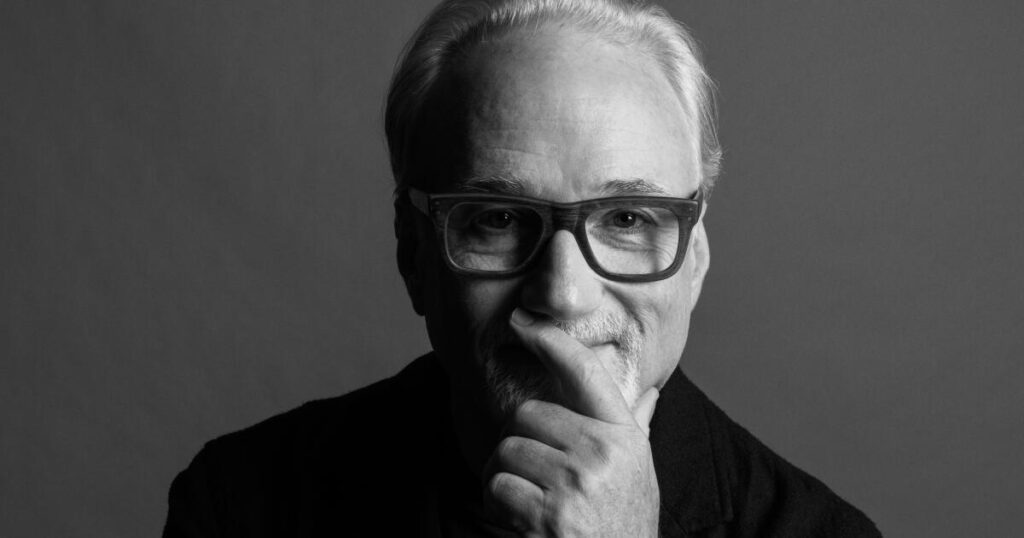
As with everything in filmmaking — and maybe life in general — director David Fincher has a particular process for reading a screenplay for the first time.
“If I read a script that I’m going to consider spending two years of my life making, I come into the office on a Saturday at 8 or 9 in the morning and I turn the f—ing phones off and I sit down and I go, ‘OK, fade up, curtains, here’s what it is,’ ” he says. “And you read it all the way through with the idea that you’re going to see it.”
Fincher, 64, sits in the gray-carpeted editing bay of the Hollywood building where he’s worked for roughly 25 years, a 1930s Art Deco-style building with a tower on top that used to be a bank. By the front desk are 48 neatly stacked boxes containing all the footage he shot making “Fight Club.” (Walking by them, Fincher stage whispers proudly, “It’s not everything.”) This is the place where so many of his features were cut and finalized, including “Zodiac,” “The Curious Case of Benjamin Button,” “The Social Network” and “Gone Girl.”
It’s also where you can imagine Fincher coming on a quiet weekend some time ago and committing a few hours to an early read of “The Further Mis-Adventures of Cliff Booth,” his latest movie, a sequel to 2019’s “Once Upon a Time … in Hollywood.” In a first for its distributor, Netflix, the film, written by Quentin Tarantino, will be released in Imax theaters on Wednesday for a limited theatrical run before launching on the streaming service Dec. 23.
“I wasn’t looking for work and a friend of mine who I adore said, ‘Can I give you something to read?’ ” Fincher remembers. (The friend is Brad Pitt, with whom he’s now made four films.) But something in Fincher hesitated. He wanted Tarantino’s blessing first, so he could read it as more than just a fan.
“Because it’s a different mindset for a director,” he explains. “That first hit is all you have to live off of. That’s the two-year hit. And so you have to trap it in aspic for yourself. That’s the thing you’re always building a tendril back to: Why was I excited about this?”
To watch “Cliff Booth” is to know Fincher found the excitement he needed. Set in the smoggy disco-and-“Star Wars”-saturated Los Angeles of 1977, eight years after the events of the first film, the story is less about a stuntman watching his options narrow than a fixer unafraid to use a little force. (Pitt remains as charming as ever, even if his game has changed.) Some of these characters are glamorous, others less so.
“The body count was high enough that it certainly fit into my filmography,” Fincher jokes, tapping his sneakers. But in a deeper way, you can see two signature American voices fusing on a molecular level into a chimera that shouldn’t survive but somehow does: the chatty, freewheeling Tarantino and the sleek, hyper-ironic Fincher. The project seems to have loosened the latter up, while also bringing into focus so much of what he does well as a technician and a storyteller.
Getting there took some doing. First came the potentially intimidating task of tightening the script of a two-time Oscar winner. Fincher says he cut roughly a quarter from Tarantino’s dialogue-heavy 230-page screenplay, both as a matter of pacing and at his own discretion as the director.
“I knew this was something that was a treasure to its creator,” Fincher says, alluding to conversations with Netflix about the ultimate shape. “They wanted it handled with a kind of deftness. They saw me as the answer to their problems. When I cut 60 pages, I gave it back to Quentin. He was like, ‘OK, that makes sense. I get what you want.’ It was not like, ‘Oh my God, you’re chopping my fingers off with a belt sander.’ ”
Fincher describes his relationship with Tarantino as friendly, dating back to 1991 when he was invited to watch an early cut of “Reservoir Dogs.” Part of what made his edit of the “Cliff Booth” script work, Fincher thinks, was his clarification of a new Tarantino creation: leggy, no-nonsense, Australian-born showbiz agent Karen Crosby, who becomes exactly what an ex-stuntman desires. As played by Elizabeth Debicki, a film-long flirtation with Pitt comes to a blaze.
“It was mostly trying to understand and make room for Karen,” Fincher says, calling her one of the story’s many “Robert Towne women,” a term he uses with the highest praise: broad-shouldered, loose-limbed, turned on by competency. “They’re not quite sure how it’s all going to work out,” he says, “but they’re going to have some say in how it goes down.”
Towne, the legendary screenwriter of “Chinatown,” “Shampoo” and “Personal Best,” who died in 2024, remains a paragon to Fincher. They were close friends and near-collaborators on a “Chinatown” prequel series.
The Towne connection is also a clue into the kind of L.A. that Fincher wanted to imprint on his take on a Tarantino movie: not as romantic as the last film’s, more paranoid and violent (apparently taking out the Manson family doesn’t help matters) and yet still somehow a mid-’70s dream city, both gauzy and rough-edged. That noirish solo trumpet you hear on the soundtrack — just like the one in “Chinatown” — is courtesy of longtime Fincher collaborators Trent Reznor and Atticus Ross, whose original score is decidedly new ground for them.
“You’re not hearing the horn, you’re hearing the echo of the horn,” Fincher says excitedly. “So it’s like the horn is three blocks down and then in the parking lot a block over.”
Meanwhile, who’s the person responsible for adding two needle drops of lordly prog-rock gods Emerson, Lake & Palmer into the movie, including their bouncy version of “Peter Gunn”? “Me,” Fincher says, quietly turning away, though the uncool song choices work beautifully. “Originally we were looking for a lot of King Crimson to try. It was too mathematical.”
There’s a lot of its director in “Cliff Booth,” from the film’s greenish cast to its dark humor. Even when Fincher re-creates some of the city’s most beloved sites of nostalgia — the shuttered Lucy’s El Adobe Cafe on Melrose gets a special resuscitation — his influence is hard to miss, like the pine-tree air freshener that dangles from Cliff’s rearview mirror, maybe a tiny totem to “Seven.”
Capturing the city would seem a prerequisite for anyone attempting a sequel to “Once Upon a Time … in Hollywood,” the masterpiece that has come to eclipse almost all of Tarantino’s work. (Director Steven Soderbergh gave Fincher the idea of adding onscreen mileage distances from Sunset and Vine with every new location.)
“I love L.A.,” says Fincher. “It’s my home. It’s a chosen home. I’ve lived here 40 years. I came in the summer of ’84 after everyone told me, ‘I can’t believe the traffic.’ I was working seven days a week and I was making music videos, so I didn’t know.”
Even though he’s spent much of his career capturing the solid-state thunk of analog tech from 50 years ago, Fincher remains fixated on the future and its potential freedoms. He’s not in thrall of fetishized 35mm prints or VistaVision cameras. His thoughts on AI — “I’m not a Luddite, so I don’t fear the unknown” — would antagonize many.
“Is everyone satisfied that we have figured this art form out enough that what we really need to do is go back to celluloid?” he asks. “How long have people painted? 40,000 years? We’re talking about a thing that’s a hundred years old and everyone’s going, ‘Stop. Pencils down. No more iterating. It’s not necessary to have at your fingertips the ability to change the color of that person’s eyes.’ Well, it exists. Should we not use it?”
Tools, options, tweaks, corrections — these are what he likes, and he has never apologized for taking his time. The whole “David Fincher does too many takes” thing still annoys him intensely.
“I love Amanda Seyfried,” he says of his “Mank” star, whom he directed to some of her greatest acclaim. “But to say that Amanda knows everything that’s going on around her at all times when she says, ‘I must have done 200 takes of that.’ We may have done 200 takes in this entire scene over the course of eight days, but you can’t do 200 takes in a day. It’s not possible.” (Yes, he’s seen “You Can See Everything” and appreciates her all the more.)
But after decades of doing this, is he finally having fun? Pitt and Debicki, arguably two of the most attractive people on the planet, making eyes in a Shakey’s Pizza Parlor, the Bad News Bears running around them — it seems like a fine way to pass a career. He answers me like a true filmmaker.
“No,” he says flatly, “I love this cast. I love my time with them. But I don’t like the ulcer-producing … I don’t like marinating in one’s own anxiety.”
He is most himself when he is solving some daunting problem.
“And I’m not going to say master because I don’t think anybody ever masters cinema,” Fincher adds. “In the beginning, it gets the best of you. In the middle of it, you get the best of it. Sort of at the end: six to one, half a dozen of the other? A coin toss.”
He cut three different full versions of “Cliff Booth,” working the material until it felt right to him. “Went all the way through — ‘That’s not it’ — tore it back to the studs, started over again, built it all again.”
But he doesn’t begrudge the effort.
“That’s not perfectionism,” he says. “It’s tough to care that much.”
To him, that is filmmaking.
The post David Fincher got to make his own Tarantino movie. First he needed to find himself in it appeared first on Los Angeles Times.