It has been called Boston’s “Big Ben,” inked onto the arms of die-hard Red Sox fans and used as a beacon by generations of disoriented Boston University freshmen finding their way back to campus.
So when the giant red, white and blue Citgo sign that towers over Kenmore Square went dark early this year, and then disappeared from the city’s skyline, its absence did not go unnoticed.
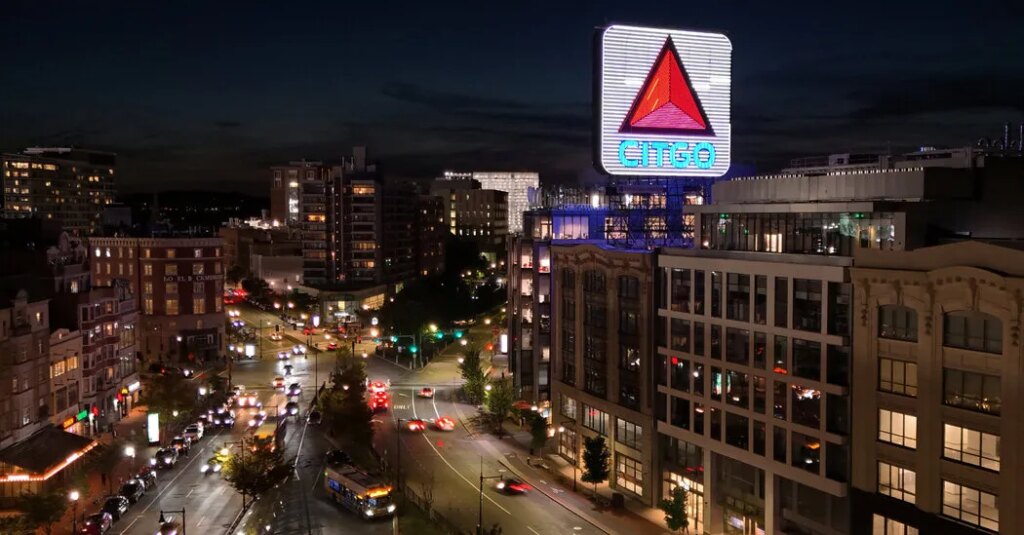
Its demise has often been predicted, in a city transformed by redevelopment. But on Thursday night, the 60-by-60 foot sign will be lit again, kicking off its latest incarnation in a new location 120 feet to the east and 30 feet higher.
“When you drive down Storrow and don’t see it, it’s weird,” said Ian Juras, 24, referring to Storrow Drive, the parkway beside the Charles River that carries traffic into Kenmore Square.
“We need it,” added his friend Meghan MacDonald, 26, looking up toward the soon-to-be- re-illuminated sign from Commonwealth Avenue on Tuesday night. “It’s like the north star.”
The sign will be easier to see on its new, taller perch, atop an addition to the same building on Beacon Street where it has sat for 60 years. Its new location makes the view of the sign less likely to be obstructed by future development, city officials said, ensuring it will continue beckoning runners to the homestretch of the Boston Marathon and baseball fans to Fenway Park.
Technically, the sign is a faithful replacement: After an inspection of its 11-foot-tall letters found severe deterioration, a Texas firm fabricated a shiny new C, I, T, G and O, which were trucked to Boston and raised to the rooftop in late summer. The glowing white square behind the blue letters has also been replaced, and the steel base beneath it rebuilt, an $8 million project paid for by Citgo.
All that remains is to flip a switch and watch the familiar red triangle blink back to life.
“Citgo may think of this as their sign, but in Boston, we think of it as ours,” said Sharon Durkan, a city councilor who represents the Kenmore Square neighborhood.
The first sign installed on the building was for Cities Service, the corporate precursor of Citgo, in 1940, when the company had a gas station on the ground floor. In 1965, when Cities Service rebranded itself as Citgo, the now-familiar logo was raised in its place. Six similar signs once stood in other cities; Boston’s is the sole survivor.
Assuring the sign’s long-term survival was a yearslong saga, marked by legal intricacies and moments when its removal seemed unavoidable. Preservationists saved it in 1983, after Citgo moved to take it down. In 2018, as concerns about neighborhood redevelopment mounted, then-Mayor Marty Walsh vetoed plans to make the sign an official landmark. Controversy erupted soon after, when a towering new sign nearby, for the tech company WHOOP, threatened to upstage the CITGO logo.
To undertake the sign’s rehab and relocation this year, project managers had to first secure federal “landmark sign” status. Because the sign was installed a few months before Lady Bird Johnson’s Highway Beautification Act was enacted, in 1965 — and would violate current federal standards with its size and visibility — any attempt to maintain or replace it without the protected status could have led to its permanent removal.
Every aspect of the sign’s existence seems steeped in complexity. It remains on the building via a long-term lease agreement between Citgo and the building’s owner, the real estate development firm Related Beal. But Boston University — the building’s former owner — still owns the land underneath it. Citgo itself, based in Texas, has been caught in corporate limbo; the court-ordered sale of its parent company, a subsidiary of Venezuela’s state-run oil company, has been on hold..
But to fans of the sign, its appeal is simple. Some have been slightly star-struck to discover that the letter C from the old sign is now enshrined near the pool table at Cornwall’s, Kenmore Square’s oldest continuously operated restaurant. Disbelief is not uncommon. “No one believes it’s the real C,” said Ms. MacDonald.
The sign’s absence for most of this year’s baseball season was unnerving to Red Sox fans accustomed to its presence, a boxy talisman above the left field wall. (At least a few courted controversy, though, by asking aloud if the sign’s absence might have contributed to the team’s 15-game winning streak, which tied a franchise record in July.)
The sign has gone dark for much longer stretches. According to Citgo, the lights were turned off in 1979 at the request of then-Gov. Edward King to encourage energy conservation, and remained dark for the next four years. It transitioned from neon to LED in 2005, cutting its electric use in half, according to the company; in 2010, the technology was upgraded again.
Some have seen the Citgo sign as a symbol of Boston’s less gentrified past, and a way to hold onto that history, in an era when other Kenmore Square institutions — like the Rathskeller rock club, known as the Rat, which closed in 1997, and the historic Hotel Buckminster, which closed in 2020 — have become memories.
When the sign’s devotees rose up in 1983 to stop its removal, Robert Campbell, a longtime Boston Globe architecture critic who died last year, was among them. Mr. Campbell, who made the Big Ben comparison and called the sign a “crown jewel” of the city’s skyline, wrote an ode to it in the style of Oliver Wendell Holmes, who had protested the Navy’s plans to scrap the USS Constitution in 1830.
“Beneath it drummed the disco’s beat/ And burst the Red Sox roar,” Mr. Campbell wrote. “The meteor of Kenmore Square/ Shall sweep the clouds no more!”
In the neighborhood, where restaurants selling $60 steaks coexist with a McDonald’s walk-up window, life did not grind to a halt without the sign. At the Bluemoon Smoke Shop, employee Mac Makwana admitted he had mostly noticed its extended absence “when someone reminds me it’s not there.”
To Mark Handley, 40, a devotee of Kenmore Square who has watched, and embraced, its evolution, the sign matters most as a magnet pulling people to the neighborhood.
“Once you’re here,” he said, “you don’t need it.”
The post ‘Like the North Star’: Boston’s Citgo Sign Returns, 30 Feet Higher appeared first on New York Times.