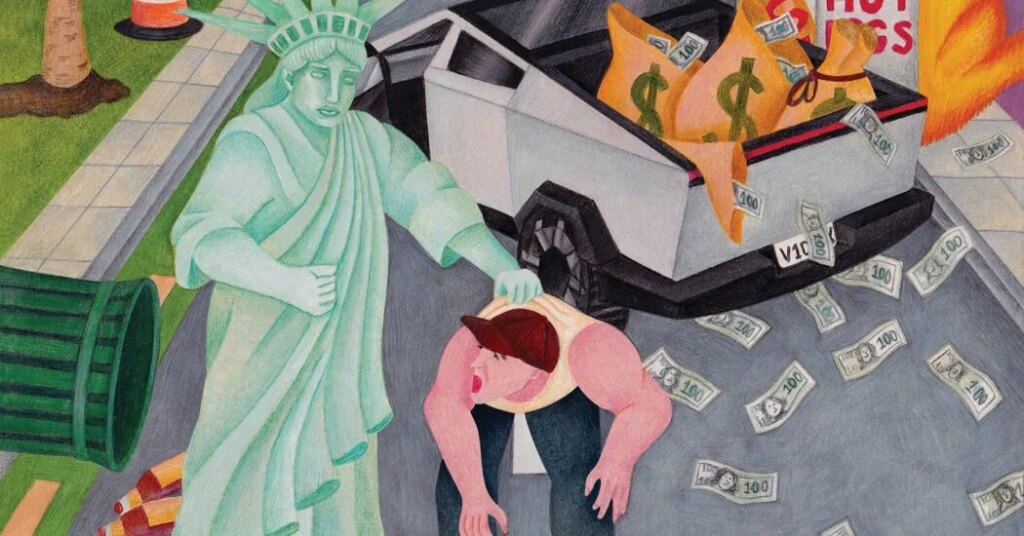
A few months ago, when I started to brag to people that I might be getting an advance copy of Grand Theft Auto VI, an unusual thing happened: Grown men started to invite themselves over to my house for play dates. Some of these men were my friends — but not all. Others were co-workers, acquaintances, the dads of my kids’ classmates. Nor were they necessarily gamers. Some had aged out of the hobby, some had never started and some considered gaming a waste of time. Among them were married men and carefree bachelors and guys leading several other early-middle-aged lifestyles besides.
To understand just how rare it is, in 2026, for one early-40s straight man to ask another for a one-on-one hang in his home, to do something other than watch a ballgame, in the absence of at least an implicit understanding that getting drunk is the point, I suggest a thought experiment: Try to imagine two such men in your life making plans to binge Netflix’s handsome new adaptation of “East of Eden,” sober. You can’t! Yet I felt there was nothing strange at all about these men wanting to come over to partake in G.T.A. VI. It’s just that big of a deal.
As you may have heard, the game was released today. G.T.A. is the Super Bowl of video games, in the sense that it is an extravaganza that attracts even the most casual fans and, out of curiosity and/or obligation, their loved ones. Also like the Super Bowl, it features Bad Bunny (he hosts one of the in-game radio stations). But unlike the Super Bowl, it doesn’t happen every year. Far from it: G.T.A. VI is the first new entry in 13 years.
Let’s take a moment to distinguish between 13 years in the abstract and the 13 years that have just occurred. The presidency went from Obama to Trump to Biden to Trump again; the phone went from bringing long-lost high school classmates together through viral dance crazes to tearing recently reunited high school classmates apart via gamified arguments about, inter alia, Russian intelligence, Chinese laboratories, Honduran migrants and American bathrooms. All that stuff.
Because G.T.A. has been gone for precisely this period — the Gulf of America? — the new game arrives with a rare perspective. What might this visitor from our coherent past tell us about our incoherent present? Long delayed, Grand Theft Auto VI has achieved a messianic status among gamers: a great force that has occulted itself during a time of disarray, whose reappearance has the chance to make the slop-worn present worth living, or at least more legible.
If you care about this game, you are probably already playing. If you don’t care about it, just so we’re on the same page, it’s the one that involves zipping around a meticulously rendered three-dimensional simulation of an American metro area, committing crimes. Sometimes it’s New York, sometimes Los Angeles; in the new game, it’s Miami.
There’s a story to follow, but many gamers opt for the extracurriculars, things like dirt-bike racing, weight lifting and eating hot dogs. Others, in a time-honored G.T.A. tradition, simply cause as much chaos as possible before being killed by the police. It’s this invitation to murderous rampage that has made the game controversial since the first one came out in 1997.
Conspicuously missing from the hype this time around has been much tut-tutting, if any. For years, the games were a symbol of what was wrong with the state of young people and their morals. But over the intervening decades, the nation reconciled itself to G.T.A., or at least developed more pressing concerns. In September, Miami Beach commissioners approved a marketing proposal that would see Vice City (G.T.A.’s version of Miami) logos festooned around town, and last night, the Miami Heat wore special Vice City uniforms in their game against the Milwaukee Bucks. The best outrage Fox News has mustered in the run-up to the release was to lecture men that they should not be gaming past the age of 40. (Disagree.) In other words, G.T.A. now falls into that category of hyperpopular things that many Americans deep down sense might have poorly understood side effects, but that we have resolved to shrug our shoulders at, like dating apps or legal weed.
I like to think of Grand Theft Auto as two different but complementary experiences. The first is more or less what its critics accuse it of being: a hunk of nasty pulp. The second — much less appreciated — is a satire that pulls the nastiness into quotation marks. If most violent video games are grim and airless, the Grand Theft Auto series is in the madcap tradition of Looney Tunes: dumb done smart, lousy with references high, low and in between. Importantly, the experiences don’t work without each other. In the absence of the satire, the playable mayhem would be sort of indefensible. In the absence of the playable mayhem, the satire would find its way to no one.
It is a persistently underappreciated fact that the Rockstar team behind every Grand Theft Auto game is based not in any of the American cities it reproduces, but in Edinburgh. Today the staff is international, and the work is spread among Rockstar studios around the world, but the games retain a donnishly screwy sensibility that owes at least as much to Monty Python as it does to Michael Mann. What I mean is, the feeling of moving through a Grand Theft Auto world is not simply sitting down with an interactive version of “Heat.” It is also inhabiting a quasi outsiders’ fun-house take on the American image.
But which image, exactly? The bulk of the series lines up closely with the global war on terror. Those years gave us “The Daily Show With Jon Stewart,” “Team America,” “Borat” and “American Idiot”: satirical critique of America and Americans, but not a loss of faith in the national project. You can see this in the targets of G.T.A.’s satire between 2001 and 2013, which are all very “What’s the Matter With Kansas?” by way of “South Park.” There’s the gun store, Ammu-Nation (Americans are violent); the burger, the Heart Stopper (Americans are fat); the right-wing news network, Weazel News (Americans are gullible); and so forth.
Those G.T.A. games made the ugly subtext of American life text through puerile exaggeration, a useful register for a product aimed at young men. But the issue today is that there is no longer much subtext to extract from America’s derangements, no distance between the way the country presents itself and any number of acid jokes you could make about it.
Brainstorm the consumer goods released since 2013 that could have been invented for an over-the-top satire of the United States. There’s Ozempic. Liquid Death. Gwyneth Paltrow’s jade egg. Juicero. NFTs. Those big red cartoon meme boots. Or what about the celebrities? MrBeast? Clavicular? Andrew Tate? Rockstar, meanwhile, has placed physical versions of its parodies of Burger King and KFC (Burger Shot and Cluckin’ Bell) in Miami, where you can actually go and eat a meal.
That shadow you see on the ground? It’s a giant cartoon eraser descending from the cosmos, rubbing out the line between reality and satire, to a slide-whistle glissando. The situation now is that the United States resembles a Grand Theft Auto game. How do you represent a world that’s already so detached from reality?
The nondisclosure agreement I signed in order to access Grand Theft Auto VI three weeks before its commercial release stipulated that I was not allowed to let anyone else watch. This meant I had to renege on several homosocial encounters I had really been looking forward to. But it also meant I got to tell my 6- and 4-year-old boys that Daddy was one of the only people in the world who had the coolest video game ever, but they couldn’t watch, because it was against the law.
For Rockstar, mystery has been more than a good P.R. strategy. It has also allowed it to play with audience expectations. For example, you might go into a game called Grand Theft Auto VI — one with a 30-year legacy of letting players immediately perform acts of boisterous criminality — expecting that it will be trivial to steal whichever car you like. But it is not so. You are not playing a simulation of criminal excess. You are playing American Underclass: The Game.
Rockstar’s version of South Florida is a cultural statement in itself, a Boschian landscape of hierarchy enforced by money and technology. The player starts the new game with almost nothing, not a slim jim for cracking doors nor a key-fob cloner to steal something German. Even if you do manage to get inside a nice car and start it, omnipresent tracking devices mean you’ll quickly draw the police. Instead, you might wander around looking for a beater and bust out a window with your elbow. But good luck losing the cops in something that old, and anyway, you’ll have to fill it up with fuel. Try to stick up a convenience store for gas money, and you’re likely to end up on CCTV: police. Or customers will record you on their phones: again, police. Might it all just be easier, as the game seems to suggest, to use the taxi app, RydeMe, on your in-game smartphone?
That is, if you can even afford it. In G.T.A. VI, you play as Jason and Lucia, lovers and partners in crime whose terrible credit disqualifies them from a checking account at the local bank. They must rely instead on BuckMe, a depressingly lifelike mobile payment app. Now in the back seat of your RydeMe, on the way to your destination you may spot a Sahara delivery van. The online retail giant has recently relocated to Leonida (Florida); a decision, we learn in a story on the in-game news app, that “has nothing to do” with the state’s “rare combination of lax regulations on employees’ rights with very tight surveillance of bathroom breaks.” Do not attempt to rob the van. It most likely has armed private security guards. They will light you up.
At night the couple scrolls social media in bed. Jason’s feed is action shots of dirt-biking and brain-rotted political memes. Lucia, the more ambitious of the pair, looks at photos of glamorous yacht parties and yearns for a glossier life. The last G.T.A. set in Vice City was a homage to “Scarface” and, of course, “Miami Vice”; this one is tonally closer to Sean Baker’s “The Florida Project.” You even live, for part of the game, out of a greasy motel. The characters aren’t cartoon supervillains but losers who have turned to petty crime out of necessity.
You can make them snort coke, but this will make you feel like more of a deadbeat. You can make them go to the strip club, but this will make you feel that you are wasting money. You can make them kill civilians, but this will make you feel, weirdly, that you’ve betrayed your fellow prole. One early mission is a quest to find oxycodone that hasn’t been stepped on. One early side activity is laying roof tile. Later, there’s an uncomfortable meeting with a parole officer. No, the setup of G.T.A. VI does not ooze with “gamer thrills” as much as it does “adults coming to terms with difficult things in a crumbling society.”
It all plays as a grim joke: Even the antiheroes of our culture’s foremost purveyor of criminal escapism are no longer having unmediated fun. Their lives, like ours, are shaped by a tech oligarchy that surveils, exploits and narcotizes them. The “South Park” stuff has been dialed way back. Rockstar seems to have decided, in the main, that lampooning the particulars of Trump’s America through exaggeration is like bolding 72-point type. There is no Mar-a-Lago north of Vice City. Though there is an out-of-control Department of Homeland Security: the National Office of Security Enforcement, or NOOSE.
Rockstar has embedded its sharpest commentary in the gameplay. It can’t be an accident how much looser and lighter the game feels after you have cash on hand and can start directing Lucia and Jason toward the old G.T.A. pleasures: picking up a grenade launcher, robbing a bank and escaping on a Jet Ski. Here is Rockstar’s answer to the question of how to capture the American zeitgeist: You can still have the time of your life — so long as you have enough money to put down your phone and engage with the world.
The Rockstar office in Edinburgh is at the foot of Arthur’s Seat, the inactive volcano that looms over the city and that tour guides will dubiously inform you may have been the location of Camelot. But Edinburgh really is a delightful fairy-tale city, actually overlooked by an enchanting castle, whose wee closes (little alleys) helped inspire J.K. Rowling’s Harry Potter universe. It’s amusing to think of it as the place where Rockstar employees spend many hours a day piecing together a sun-blistered American underworld.
About a month ago, a half-dozen of these employees, mostly longtime executives, sat with me in a long room there, talking about their creation. None of them wanted to take too much credit, out of propriety, because nearly 5,000 people worked on G.T.A. VI, but also because it’s hard to say any one person speaks for a blockbuster video game in the way a director speaks for a movie.
There are a handful of auteurs in the industry, but they tend to be pseudointellectual egomaniacs, or Japanese. Rockstar’s president, Sam Houser, is a bit different. He was educated at the posh St. Paul’s School and is the son of the actress Geraldine Moffat. In interviews, he has cited Rick Rubin as an inspiration, and he built Rockstar to be a bit like a cool record label. His mission, to give video games the same cultural clout as music and movies, has both succeeded — in the sense that his studio has created a series that does — and failed, because there isn’t anything remotely comparable to G.T.A. In true visionary fashion, Houser no longer gives interviews.
Each new Grand Theft Auto game starts with a map: an abstraction, a series of choices. And it is in these choices — what exactly in that America of the mind to represent and what not to — that Rockstar’s voice is heard loudest. The maps are overseen by Aaron Garbut, a cheerful Scotsman who has worked on the series for 30 years, since he was fresh out of art school. In that time he has made New York (Liberty City) twice, Los Angeles (Los Santos) twice and now Miami (Vice City) twice. He had the slightly disoriented look of a man who has spent a decade peering through a loupe. He was still refocusing on the scale of the real world. “We sort of just refine and refine and refine,” Garbut said. “Forever.”
Because I’ve lived in New York for almost 20 years, my personal favorite is Garbut’s work on Liberty City in G.T.A. IV. It’s accurate to the image of New York you may have gotten from some combination of movies, music, television and real life — with nods to “The French Connection” and “Carlito’s Way,” but also a recreation of Brighton Beach so authentic you can practically smell the stuffed cabbage. The storefronts in the game’s version of Times Square are actual early digital photographs of real electronics and souvenir shops that Garbut took during research trips. A G.T.A. map lets you inhabit a place made up of the media representations that already define it, and that have just as much to do with how you understand that place as the material thing itself.
There is a Nathan Fielder-esque level of obsessive derangement involved in the construction of a Rockstar game. The company is well known for eschewing procedural generation — using algorithms to produce digital objects with superficial differences — in favor of custom detail. For G.T.A. VI, Garbut said, Rockstar created some 30,000 unique NPCs, or nonplayer characters, the digital humans who roam the game. (That’s about one fake person for every 16 real people who live in the city of Miami. Those actual people, by the way, are now subject to the real-world insult “NPC,” meaning an actual person with the nonexistent inner life of a video-game person, in another troubling instance of game reality invading our own.)
On a recent media tour, the chief executive of Take Two, which owns Rockstar, emphasized the fact that no generative A.I. was used in the creation of Grand Theft Auto VI, and that he (the money guy) gave Rockstar (the creatives) as long as they needed to bring their world to life. That’s a sales pitch. But it’s also an honest reflection on an industry staring down existential change. In recent weeks, A.I. advocates have posted footage from their own enormous “open world” games generated by prompting Claude. The games look stupid, like something a dog would make. But that’s not the point; the point is that Rockstar’s bespoke approach may, in a benighted near-future, strike us as a beautiful through inefficient form of artisanship practiced by a lost civilization.
At this level of tinkering exactitude — the Rockstar execs call it “fidelity” — questions arise, like: Should the main characters have their own, interactive, in-game iPhone? (Yes.) And should that iPhone have apps? (Yes.) And should one of those apps be an Instagram clone with hundreds of its own posts? (Yes.) And should some of those posts be one-to-one satires of common meme formats including the one in which Winnie the Pooh wears a monocle? (Yes.) And should those posts have realistic comments, including horny ones and “6-7”? (Yes.) And so on.
This is all possible because Rockstar has multiple teams dedicated to creating mock media. They make the phone and the television with its own fake TV shows and the fake video game system with its own video games, which are, yes, playable. None of this filigree is necessary, perhaps. But it does create an uncanny tingle of mise en abyme, the vertiginous sense that you are staring into a copy of a world that has recreated all the important bits, but smaller.
“Hand-touched, hand-built, every single part of it is thought about and worked through,” Garbut told me. “I think you can feel that.”
As G.T.A. VI got closer to completion, Houser and Rob Nelson, the game’s head of development, rented a hotel suite in Miami Beach for 10 days. There they drew the curtains and played through the most recent build. At night, Nelson told me, the two would stagger outside blinking, noticing wrong details — not enough tourist shops on Collins Avenue; the quality of the streetlights at midnight a little off — and relay them back to Garbut to be fixed. Hearing this, I was reminded of the one-paragraph Jorge Luis Borges story about an empire that builds a map as big as its territory.
Back in the Edinburgh office, Nelson picked up a controller and began to piddle around in the world he and thousands of other people had spent a decade filling in. He rode a bike; he threw a football; he petted a dog. I hadn’t yet signed the NDA, so the company did not want me to witness anything that rose to the level of spoiler. Each time a snippet of plot-related dialogue played, a man sitting behind a desk at one end of the office turned a knob to cut the volume. I realize this sounds boring, so let me be clear: It was not boring. It was orders of magnitude more exciting to see a state-of-the-art virtual man lollygag in a state-of-the-art Florida simulator than it would be to watch a real guy do it in real Florida. It was thrilling, I realized, to see humans create such an intricate and functional world.
I have something disgraceful to confess: As I played G.T.A. VI, I kept looking at my phone. My actual phone. Not for long periods of time, because you can’t hold a controller and a phone simultaneously. More like the way I check my phone while reading a great novel: too often. After all, I was one of the first people in the world to experience what sure seems like the most anticipated entertainment product of all time, a brilliant cultural achievement that somehow overdelivers on more than a decade of hype. Yet I kept updating myself on the Instagram stories of people I don’t even like, and reading memes on X that didn’t even bother to make an attempt at human syntax.
The question of contemporary attention hovers uneasily over Grand Theft Auto VI. As you play, you sense the designers trying to strike a balance between poking fun at our tattered brains and accommodating them. Along the way, you are encouraged to pay close attention to your significant other. This occurs through things like gamified foot rubs, gamified couch time, pressing a certain button to hold hands and so forth. I know how ridiculous this sounds, and I also know that at various times I had to stop to reflect about why I was buying my virtual girlfriend a gold necklace when my family was sulking in the other room. I then had to reflect on why I was ignoring my virtual girlfriend, for whom I was ignoring my real family, so I could check real Instagram to see if my wife had posted anything.
As my mind wandered, I found myself thinking again of the Borges story about the map as big as the territory. The reason I know this story, the reason most anyone really knows this story, is because of a famous interpretation of it by Jean Baudrillard, the French theorist and America obsessive. It’s a little pointy-headed — oh, well. Basically, Baudrillard found the story useful as an allegory for a traditional order of meaning, in which things in the real world can be represented: say, through a painting or a staggeringly lifelike video game.
But in the new order of meaning, Baudrillard’s one, this relationship has been inverted, and representations give meaning to the world. This doesn’t just mean that life sometimes imitates art. It means that all representations, including video games, advertisements, movies, TikTok videos, you name it, work together to create a universe of symbols that feel realer to us than reality. And that in fact subsume reality altogether.
Baudrillard argued that the characteristic mental disorder of this new arrangement was schizophrenia. Because he was a French theorist, he was being edgy and didn’t mean the actual disease. He meant a state of terrified confusion, brought on by the relentless bombardment of contextless signs. Humans no longer have an autonomous inner self that can point our attention at this or that; we are powerless nodes, receiving and transmitting superficial fragments of media that stimulate our emotions and bypass our understanding.
Baudrillard wrote all this in the 1980s, roughly 20 years before the invention of the iPhone, and it describes exactly how we experience reality today — about 20 years since its release. And as a result, there is no single media product that can compete with the world of fleeting and insane impressions that is always a glance away. Certainly, G.T.A. VI can’t. It will be absorbed into the greater world of fragments and sensations through which most of us now experience culture. There it will be regurgitated in often-garbled forms, sometimes by nonpeople, according to rules written by nonpeople, for a human audience addicted to garbled regurgitation. In another 13 years it will be 2039. You don’t have to work for Anthropic to know that the way humans represent and understand their lives is probably going to look different.
This is the paradox of Rockstar’s grand undertaking: It has crafted a working miniature of the United States during a period in which the American sense of reality has almost completely broken down; a period in which the desire for grand attempts at sense-making have been subordinated to the desire for distraction; a period in which American disorder has moved from the outside world to our innermost selves. It is a coherent map of incoherent territory — maybe the last one.
The post Grand Theft Auto Used to Satirize American Life. Now We’ve Caught Up With It. appeared first on New York Times.