The Federal Aviation Administration’s decision to upgrade communications equipment on Friday afternoon, leading to a halt in air travel during one of the busiest times of the week, reflects the breakneck pace of Transportation Secretary Sean Duffy’s efforts to overhaul the country’s aviation infrastructure.
“The longer we stay on an old rickety network, the less safe it becomes,” Mr. Duffy told reporters Tuesday on Capitol Hill. “So we do have to charge forward.”
But current and former officials say Mr. Duffy’s push to transform the F.A.A.’s slow and cautious culture — including by rapidly installing artificial intelligence systems and finishing upgrades before President Trump leaves office — is a risky gambit that could continue to disrupt air traveland lead to other fallout.
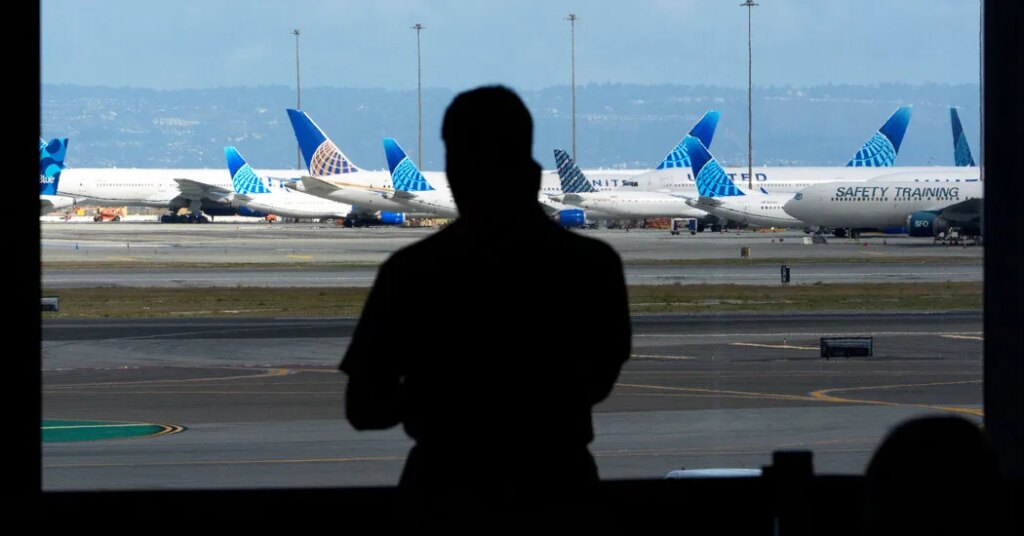
Federal officials are still trying to determine how the replacement of wiring at a remote facility in Arkansas may have led to a data overload in critical air traffic control systems across the country on Friday. As the technical problems caused radio static in communications between pilots and air traffic controllers, the F.A.A. grounded all flights, imposing the longest nationwide halt since the terror attacks of Sept. 11, 2001.
The very fact that such work was being done on a Friday afternoon was imprudent, according to some federal aviation experts.
“During the time that I was at the F.A.A., if we were doing any change, we would try to do it at an off-peak period,” said Katie Thomson, Maryland’s transportation secretary, who served as the F.A.A.’s No. 2 official under President Joseph R. Biden Jr. She added, “It would not be something that we would do on a Friday afternoon at peak travel hours.”
Mary Schiavo, a former Transportation Department inspector general during the first Bush and Clinton administrations, said that while the nation urgently needed to modernize its air traffic control system, performing the upgrade on a busy Friday afternoon suggested that it was moving too quickly.
“That’s not typical. Everyone knows that’s a busy travel time,” she said in an interview. “I would imagine the looming Thanksgiving holiday had them on overdrive.”
The upgrade was done on a Friday afternoon instead of at night or over the weekend in order to meet the project’s ambitious schedule, and because the work was not considered high risk, according to a person with knowledge of the agency’s investigation who was not authorized to speak publicly.
Officials still have not determined the root cause of the failure that led to the ground stop, which was only the third one in the agency’s history. The incident led to thousands of delays ahead of the busy holiday travel season and deepened worries about the safety of the nation’s aviation system, which has experienced a cascade of problems in recent years including last year’s midair collision above Washington, D.C., that killed 67 people.
Mr. Duffy has said no travelers were in danger on Friday and that there is no evidence of sabotage. He has said the incident showed the need for vast new investments in the aviation communications systems. But the situation has raised questions about the transportation secretary’s stewardship of the aviation system, including whether the pace of upgrades was pushing work to be done at times that pose a high risk of travel disruptions.
Mr. Duffy told reporters on Saturday that officials did not anticipate that Friday’s upgrades, which were conducted at a small, remote facility in El Dorado, Ark., could threaten the entire network, and that contractors regularly did such work at remote locations during the day.
“These smaller locations don’t have that kind of impact — or they shouldn’t have that kind of impact,” he said, adding that “there’ll be a re-evaluation of when we do this work.”
The job, in which copper wire used for telecommunications was being upgraded to fiber-optic cable, was performed between about 10 a.m. and 3 p.m., according to the F.A.A.
But shortly after the work, a router that had just been installed began firing a barrage of data that overloaded critical air traffic control systems at locations around the country. As some pilots began noticing radio static in their conversations with air traffic controllers, federal officials moved to ground all planes at 3:54 p.m.
The Arkansas upgrade was being handled by a single technician employed by L3Harris, one of the F.A.A.’s biggest contractors, officials have said. The work had been approved by the agency and was supervised by one of its technicians, Bryan Bedford, the F.A.A. administrator, told reporters on Tuesday. Similar work had been completed many times at other locations with no major issues, Mr. Bedford said.
Mr. Duffy said in a recent interview on CNBC that he could not “guarantee” that future disruptions would now happen without continued investment.
Mr. Duffy has demanded $50 billion in additional funding, a request that caused lawmakers, including some Republicans, to recoil on Tuesday. The F.A.A. has so far spent a small fraction of the $12.5 billion Congress appropriated for air traffic modernization last year. Transportation Department officials say they have committed about a third of the funding earmarked for telecommunications and radar upgrades.
Officials say 70 percent of the network’s copper wires have been replaced with high-speed fiber-optic cables. About half of the cables were upgraded in the past year alone, a considerably faster pace than previous administrations have reached.
But experts previously warned that the faster pace has potential downsides. A report in September by the Government Accountability Office, a nonpartisan federal watchdog agency, noted both advantages and risks of Mr. Duffy’s expedited improvements.
The Trump administration shaved roughly nine years off its timeline to modernize voice radio systems used by air traffic controllers, the report said. It also sped up the replacement of copper wire with fiber by 21 months.
But at the same time, the faster pace carried the potential of “cost increases and potential disruptions to the national airspace,” said Kevin Walsh, the director of information technology and cybersecurity audits for the G.A.O., in an interview with The New York Times.
The F.A.A.’s telecommunications network and its hardware issues were a trouble spot for domestic air travel long before travel came to a halt on Friday.
In April 2025, air traffic controllers handling flights in and out of Newark Liberty International Airport experienced a simultaneous outage of their radar feeds and their radio contact with pilots because of a burned copper wire, a Transportation Department inspector general inquiry found. And as recently as September, a technical glitch at a Philadelphia air traffic hub and the cutting of a fiber backup line interrupted controller communications in the Northeast Corridor.
Given that about 30 percent of the country’s aviation data lines still run through copper wires, additional, and potentially ill-timed, upgrades may be in store.
And as the F.A.A. works through a new and more ambitious operating pace, the Trump administration has tried to bring in fresh ideas and systems to help.
Those attempts have also faced problems.
In December 2025, the F.A.A. used a competitive bidding process to hire the security technology company Peraton to manage the air traffic control system overhaul, for which Congress had set aside $12.5 billion in funding.
The idea was for Peraton’s team to offer expertise and coordinate the network of contractors that would install the needed hardware and software. But Peraton’s team faced resistance from F.A.A. employees, some of whom thought that team lacked the expertise to take over agency work, said a former F.A.A. employee and three other people with knowledge of the matter. The people requested anonymity to discuss confidential processes.
Peraton was under a tight timeline — one that has been strained at times because of limits on access to facilities and delivery schedules, according to one of these people.
Peraton spokespeople did not respond to requests for comment.
Other contractors and timelines have encountered pushback from F.A.A. employees, according to current and former F.A.A. and Transportation Department employees.
An artificial intelligence system meant to optimize the routing of flights in and out of U.S. airports to account for weather, neighboring traffic and other factors has been one such effort, said three people who were briefed on the matter but requested anonymity to discuss confidential proceedings.
Known as Strategic Management of Airspace, Routes and Trajectories, or SMART, the new system was rolled out in September at Washington-area airports by Air Space Intelligence, a Boston tech company that was awarded an $875 million contract in June.
But the system faced opposition from Shawn McClosky, the air traffic manager running the F.A.A. airspace command center in Warrenton, Va., said the four people who were briefed on the matter. Mr. McClosky believed the system was being launched too hastily and without proper review, two of those people said.
His supervisor, LaKisha Price, a senior system operations manager at the F.A.A., backed Mr. McClosky up, the people said, pushing for additional reviews. Both were removed from their positions.
Ms. Price and officials at Air Space Intelligence did not respond to requests for comment. Mr. McClosky declined to comment.
Julie Tate contributed research.
The post Ground Stop Came as Duffy Pushed to Rapidly Upgrade Aviation Systems appeared first on New York Times.