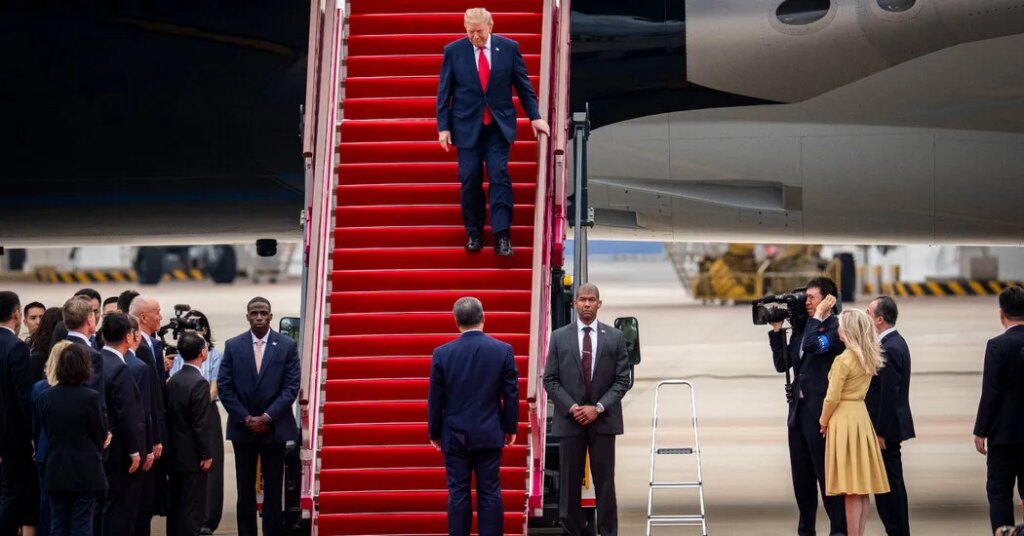
The meeting Thursday between President Trump, Xi Jinping and Vladimir V. Putin marks the first time in history that the leaders of the United States, China and Russia — possessors of more than 90 percent of the world’s nuclear weapons — have sat down together.
But not every first in history results in a significant accomplishment — or any accomplishment. And as Mr. Trump landed on late Wednesday in Shenzhen, the chip-making, telecommunications, software and robotics heart of China, it was already clear that this meeting was unlikely to live up to the many comparisons being made to Yalta, the end-of-World War II conference where Roosevelt, Churchill and Stalin divided up the globe.
Together, talking largely in secret, the Yalta participants laid the foundation for a postwar order that lasted nearly half a century, while leaving millions of people trapped behind the Iron Curtain.
There are many reasons that Yalta is a poor analog when thinking about the Shenzhen summit. Yalta stretched over eight days, with a bevy of diplomats and generals working the back rooms to turn the visions discussed by the three leaders into action plans. The meeting involving Mr. Trump, Mr. Putin and Mr. Xi is set to last around an hour or so — essentially a glorified photo op, by comparison, and not one in which major issues are likely to be settled.
And instead of a conclave of three allies on the verge of a joint victory over a mutual foe, this meeting features three leaders who have not been partners in a great venture, and are unlikely to be any time soon.
The three men have major differences on issues as far-ranging as China’s fast-growing nuclear arsenal, the regulation of artificial intelligence, the future of space weapons, the war in Ukraine and the war in Iran — a conflict that has haunted Mr. Trump, enriched Mr. Putin and angered Mr. Xi.
So they will not enter the room expecting that they will have time to raise, much less resolve, many critical issues.
But even photo ops can linger as important symbols. And the one that may appeal to all three men is the message that they are the true global deciders, engaged in a project to shape world order.
After enduring a resounding electoral defeat this month, that image may be particularly appealing to Mr. Trump, who makes no secret of his admiration for strong leaders who do not have to put up with pesky legislatures or an intrusive press.
For Mr. Putin, the meeting serves to help readmit him to the world community, and to recognize that he remains too powerful to ignore, even after losing half a million soldiers in a nearly five-year-long battle for Ukraine.
And Mr. Xi gets to play the role of global convener, albeit of a gathering with an exclusive list of participants.
Among those not at the table: Japan, India, South Korea, Australia, Britain, France, Germany, Italy, Brazil, Canada, Mexico, South Africa and, perhaps most notably, Ukraine and Iran.
Still, Mr. Trump, Mr. Putin and Mr. Xi clearly have conflicting agendas. Mr. Trump has repeatedly said in recent days that his No. 1 priority is to take on “denuclearization,” his somewhat sloppy way of referring to arms control. Mr. Putin likely wants to talk about Ukraine, potentially figuring that Mr. Trump wants a peace deal and will not be especially picky about the details.
And Mr. Xi, who was wary about holding any meeting without a predetermined outcome, will be looking for ways to leverage his role in the service of becoming the world’s largest military, economic and technological power by 2049 — the 100th year of Mao’s revolution.
The three men have deeply complicated relationships. The Chinese and Russian presidents have met roughly 50 times, and famously declared five years ago a “partnership without limits.” While that partnership falls well short of a true alliance, they are unified in a mutual desire to diminish the scope of American power. That was evident on Wednesday, when Mr. Xi and Mr. Putin met together.
In their one-on-one conversation, Mr. Xi told the Russian leader, who he has at times referred to as his greatest friend, that relations between China and Russia had remained as “steadfast as a rock through wind and rain,” according to Chinese state media. Mr. Xi called for the two sides to advance the “democratization of international relations,” a term he often uses to describe a world order in which the United States is less dominant.
For his part, Mr. Putin appears happy to possibly be perceived as out of the penalty box for his brutal invasion of Ukraine.
“He’s at the big boys table with the other great superpowers,” said Alina Polyakova, the president of the Center for European Policy Analysis. “For Putin, it’s credibility, it’s legitimacy. He sees himself as the tsar of an empire rather than the president of a frankly declining” country.
Spheres of Influence
Mr. Trump’s national security policy refers to an updated “Monroe Doctrine” aimed at keeping foreign powers out of the Western Hemisphere. Mr. Putin talks about restoring much of the empire of Peter the Great, starting with Ukraine — but perhaps not ending there. Mr. Xi has expanded his military operations in the Pacific, building bases out of artificial islands in the South China Sea, confronting the Philippines over ownership of some of its islands, and running near-constant military exercises that encircle Taiwan.
It all feels very much like the late 1800s, the peak of the “spheres of influence” approach to world governance by a few dominant nations. In January, asked whether he believed in a spheres-of-influence approach to the world, Mr. Trump said, “It’s not necessarily where I want it to go.” But he added that as he looked around the world, “it’s where it’s going.”
It is clear that none of the three superpowers want to be limited to their own neighborhoods, even if their maps are expansively drawn. China may be focused on the Pacific first, but it wants access to copper mines in Peru and Ecuador. The United States may talk the talk of withdrawing from the world, but it wants to retain influence across the Middle East, which is why it has kept the bases that Iran attacked in the Gulf in recent months, forcing some to all but shutter. And it is not about to give up its presence in Japan or South Korea.
Russia has ambitions that also reach into space and cyberspace, as well as the Arctic and Africa.
Geopolitical Swagger
Still, there is a serious imbalance among the three nations that will be represented at the meeting. While the United States and China are the two leading global powers, Russia pales by comparison in most respects, other than its residual nuclear arsenal and its energy resources.
While the United States and China are racing to develop artificial intelligence, Russia is at best a bit player in that field. Other than its nuclear capacity, Russia’s military has been shown over the past four years to be far weaker than Mr. Putin projected.
And economically, Russia cannot compete with the other two countries at the table. While the United States and China are the world’s largest and second-largest economies, respectively, Russia places only eighth. Its economy is barely one-eighth of the size of China’s, and one-eleventh the size of the United States’. It manufactures almost nothing of value for much of the rest of the world, other than military hardware — and vodka and caviar.
So for Mr. Putin, the meeting allows him to project the illusion that he and his country are more important than they actually are, to claim a certain geopolitical swagger unjustified by reality.
The meeting is also a way for Mr. Putin to snub Europe and essentially say that he does not need to deal with those countries, because he can sit down with the leaders of the two most important powers in the world.
“Demonstrating Europe’s irrelevance is very important to Putin at this point,” said Michael Kimmage, the director of the Kennan Institute, named for George Kennan, the famed American diplomat who designed much of the strategy around the Cold War.
“I think nothing is going to come of it, and it will be fairly quickly forgotten,” he added. “But still, to go from the Treaty of Versailles to Yalta to this shows that Europe is being erased.”
Ukraine may be discussed, as Mr. Trump indicated shortly before leaving the United States for Asia. But many Americans and Europeans close to the peace talks have concluded that Mr. Putin has no interest in making a deal to end the war. His government’s current proposal largely repeats the same maximalist demands it made before the full-scale invasion of 2022, conditions that were unacceptable to Europe and Ukraine then and remain so today.
Michael McFaul, a former ambassador to Russia, said Mr. Putin had made plain he was not seeking peace. “If he really thought this was an event for peace, the last thing he would be doing would be bombing the bridges in Kyiv that is now crippling the capital of Ukraine,” Mr. McFaul said. “I don’t think he thinks of this as a genuine effort to advance peace. He gets the photo op and he gets to call it Yalta 2.0.”
Still, some foreign policy veterans said that the meeting could not hurt — and in some ways, could probably help — by opening lines of communication among three powers that are crucial to issues around the globe.
“Even if the summit yields no concrete results, it will nonetheless have been worthwhile,” Charles Kupchan, a Georgetown international affairs professor and former national security aide to Presidents Bill Clinton and Barack Obama, wrote in Foreign Affairs. “Trump, Xi and Putin are paving the way for their successors to advance great-power cooperation across ideological lines and stabilize a fragmented world.”
The post Trump, Xi and Putin Will Sit Down for the First Time. It Won’t Be Like Yalta. appeared first on New York Times.