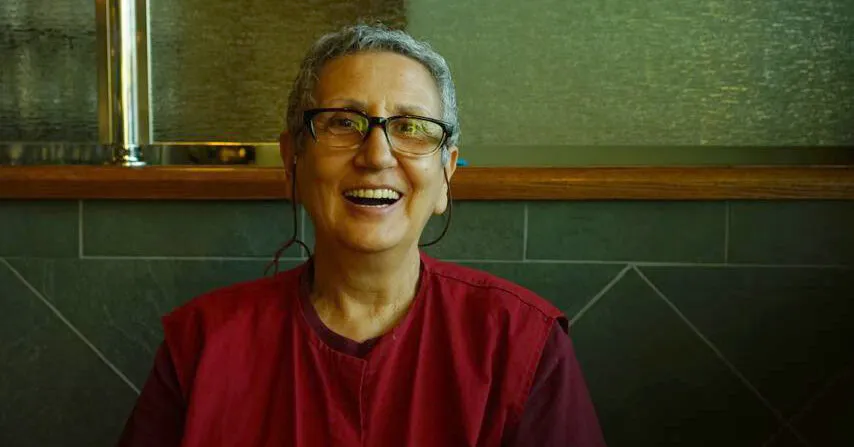
Seta Manoukian is a painter of figures, street scenes, flowers and nature. Other artists living and working today often depict similar subjects. What sets her apart is that she is also a Buddhist nun.
Born in Beirut in 1945 to parents of Armenian descent, Manoukian — who was schooled at a French lycée — grew up immersed in multiple cultures.
Art was an early passion. From the age of 4 or 5, she drew constantly, and later received training from prominent masters such as Paul Guiragossian, a Palestinian Armenian painter.
When Manoukian was 17, she submitted a couple of paintings to an art exhibition at the Italian Embassy, and won first prize: a three-month stay in the city of Perugia.
She then moved to Rome and later graduated with top grades from the Accademia di Belle Arti di Roma (the Fine Arts Academy).
Returning to Beirut a year after graduation, she drew attention as a gifted young artist, and started painting figures in isolated interiors and streets.
At around the same time, she found what would soon become her other lifelong pursuit: contemplation, meditation and spirituality.
Now 81 and based in Los Angeles, Manoukian dedicates her time to art and Buddhism. At Frieze Abu Dhabi, her paintings will be the focus of a solo exhibition at the stand of Marfa’ Projects, a Beirut gallery.
In a recent video interview, Manoukian spoke of her time in Beirut, Rome, and Los Angeles. Hanging on the rear wall was a portrait of her late teacher, a Tibetan spiritual leader who set up a retreat center in California, of which Seta is still a member.
Elsewhere in the room was an altar bedecked with candles, images of deities, and offerings of water, tea and flowers.
The conversation has been edited and condensed for clarity.
Seta, what kind of a child were you?
I was extremely energetic and turbulent. I just calmed down when I was reading.
I was drawing a lot, dancing a lot and clowning around a lot.
How did you find Rome when you studied there in the 1960s?
Rome was paradise for me — total paradise — because Italy is like a museum, and Italians are incredibly open and fun. It’s so sunny there, and there are so many museums and galleries.
I was also going to the movies all the time: watching films by the big directors, Pier Paolo Pasolini, Federico Fellini, Michelangelo Antonioni.
I was going to libraries in the afternoon, and at night I was going to parties. The best life ever.
It sounds like you were living la dolce vita.
It was the time of la dolce vita. Nobody was talking about what had what happened a long time ago. They wanted to forget, I guess.
You mean they wanted to forget World War II?
Yes, exactly.
You then returned to Beirut in the late 1960s. Can you talk about that period?
When I came back to Lebanon, I wanted to start painting, but I thought, “Why will what I’m going to do have any value?”
I walked up to a mirror and started looking into my eyes. Very stupid things came into my mind: “I have to buy these shoes,” or “What is this lady saying?” I thought: This is rubbish. And I emptied my mind of all of it. All of my thoughts stopped. And right away, I knew what I was going to paint.
I continue to do this today. I empty my mind in a state of meditation, and then I paint.
The Lebanese civil war broke out in 1975. How did you experience it?
I have to go back a little bit to the period before the war started.
When I came back to Lebanon, I knew nothing about politics — absolutely nothing. It was la dolce vita for me. At the Horseshoe Cafe in Hamra in West Beirut, all of the intellectuals of the Arab world were gathering: journalists, writers, musicians, etc.
I listened to what was happening in the world. And for two years, I became completely depressed. Why are they killing each other? Why are they pillaging another country, committing atrocities? I was really very emotional.
When the war started, you spent a decade helping underprivileged children in Beirut.
I thought I had to do something, but I could only paint, so I went to an empty school with children playing outside and said: “Look, I brought all of these paints and all of this paper for you. Come.” They came, and they loved it, because the next time, they were all waiting. I did this in different neighborhoods.
You moved to Los Angeles in 1985 and continued painting. At what point did you become a Buddhist nun?
I started studying with a Sri Lankan monk in California. Not far from my house, there was a temple. I then said: “I’d like to become a nun.” It was very natural for me to become a nun. All my life, I had so many boyfriends, but still, I was a nun.
What do you mean by that?
All artists have so many hours and days of solitude and introspection. We are monks and nuns, sometimes. Suddenly, we become extremely extroverted and want to explore everything. Then we go back to being totally introverted.
What kind of painting do you do nowadays?
I paint mountains, because mountains have the shape of us sitting in meditation. When I paint mountains, I put everything I have in them.
Have you reached a place of serenity in your life?
Very much. I live in Hollywood, and I love it.
You live in Hollywood?
Yes — on a street off Hollywood Boulevard. My room is totally silent, and then I go out and Hollywood is so diverse, so crazy. It’s like being back in Hamra in Beirut.
I’m surrounded with so much homelessness, and there are no movie stars. People from every country you can imagine are there. There is a cafe on the corner where they play Arabic music. I sit there with a book about Buddhists, and it’s wonderful.
There is a contrast between what I’m reading — the book talks about total silence — and all of these people and talk and music. It’s a paradox. Everything is a paradox in my life: in everybody’s life.
Self-realization is important for human beings, and you seem to have achieved it.
I have a long way to go.
Why?
Because it’s a long way to have more and more wisdom and compassion.
Would you say that your spiritual side is stronger than your artistic side?
They are totally interconnected.
The post As a Painter and a Nun, She Was Called to the Brush and to Buddhism appeared first on New York Times.