In a font that begged for a magnifying glass, right below the newspaper’s classified ads, there it was: Notice of Public Hearing.
Christine Farmer, a longtime resident of Westborough, Mass., normally skipped over legal notices in the weekly Community Advocate. But this time, she caught it by chance — a public hearing in mid-September on Amazon’s request to build a drone hub for its new delivery service. The project, which involved a staging area and launch zones, would be based at the company’s warehouse less than two miles from Ms. Farmer’s home.
It was the first time Ms. Farmer, a 63-year-old executive coach and business consultant, had heard about plans for drone deliveries in the region.
Like many of her neighbors in Westborough, Ms. Farmer loved Amazon. A few months earlier, she had nearly hugged an Amazon driver to thank him for bringing her a package — by electric van — that she needed that same day.
But the drone deliveries felt startling and unnecessary, she thought — an existential change.
Were delivery drones really something Westborough needed, zipping over its ponds and parks, hiking trails and tall, tall trees?
Ms. Farmer’s decision to attend the meeting eventually led her to a place she never expected to be: in the thick of a growing rebellion against Amazon and its plans for drone delivery dominance across America.
In 2013, Amazon introduced the concept of widespread drone delivery as if it was a fait accompli, with its founder, Jeff Bezos, saying that it “will work, and it will happen.” The reason for it was simple, the company has said: customers demand ever faster service.
Amazon now has 20 drone hubs, and in August, and the company said that it aimed to expand drone deliveries to nearly 500 U.S. towns and cities, including more than 60 hubs, by the end of the year. Some local governments have readily approved the company’s plans.
“As residents learn more about it and see it for themselves, Prime Air is a welcome addition to communities,” said Lindsay Hamilton, an Amazon spokeswoman, adding that the drone program reduces traffic on the road and brings highly skilled jobs.
But some residents, like Ms. Farmer, are dreading an influx of 83-pound flying machines that seem straight out of “The Jetsons.” Zooming across the sky at up to 74 miles an hour, they look to some residents like colossal interplanetary insects and sound like a supersized swarm of locusts.
Opponents of the drones are fuming at the Federal Aviation Administration for ruling that commercial delivery drones would not significantly affect “the human environment” and that each location did not need a full environmental review. (The F.A.A. declined to comment.) And they are furious with local authorities for not doing more to push back against the impending changes to the sights and sounds of everyday life.
If Amazon drones come, Ms. Farmer asked, what would stop Walmart drones from following? Or DoorDash? Target? Home Depot?
“We will be living under a drone highway, and who would want that?” said Ms. Farmer, who raised two daughters in Westborough, a town of about 23,000 people, 30 miles west of Boston.
She continued, “I really just can’t imagine living in a world where the skies just aren’t quiet anymore.”
The Battle Begins
Before the Westborough planning board meeting in mid-September, Ms. Farmer went out of her way to say a prayer at her church. She asked for guidance because she considered the drone issue to be “a tipping point for our country.”
At the board meeting, she found only a handful of other residents, mostly there for other, more quotidian issues. They seemed surprised, Ms. Farmer thought, when Tareq Wafaie, an economic development manager for Amazon, delivered a presentation about Amazon’s Prime Air program. It would be the first drone delivery service in New England.
Mr. Wafaie explained that the drones are about five feet wide and five feet tall, have six arms with propellers, and can carry a single package that is five pounds or less. Customers opting in can get deliveries in 30 minutes or less, he said, with the drones dropping packages onto people’s yards or driveways from 13 feet up, without humans guiding them in real time.
The F.A.A., which governs the nation’s airspace, had cleared Amazon’s drone hub for up to 1,000 flights per day, from “about sunrise to sunset,” Mr. Wafaie said, and the drones can fly as far as 7.5 miles before circling back to their home base.
Ms. Farmer grabbed her phone and started calculating: If there were, say, 600 drone deliveries in 12 hours, that would mean almost one delivery every minute.
Several residents seemed to be thinking along similar lines. “The risk does not match the want,” Jen Parent, a teacher, told the board. “We’re at this point in our human history with technology, just because we can do it, doesn’t mean we should do it.”
One man said he couldn’t imagine the drones being quiet. Another said that drones were “cool,” but worried about privacy because their cameras could peer into yards.
A nervous Ms. Farmer fumbled with the microphone before taking it off its stand.
In a voice gentle enough to read bedtime stories, she explained that she had grown up in Winthrop, a town near Boston’s Logan Airport. Every day, all day long, she heard planes overhead.
“I just want to advise and really just say, you open the door to this and more will come,” she said to the planning board. “I implore that you continue to consider the sounds and the visuals. I love to walk. We love the nature.”
She added, “That’s why I moved here.”
The planning board postponed its decision. When Ms. Farmer got home, she told her husband, “Honey, this is not our wheelhouse. But we can’t stay silent.”
A Growing Revolt
Steeped in the issue for what she called “a whole 30 seconds,” Ms. Farmer began posting about the drones on social media, to tell her neighbors.
At a Sept. 22 meeting of the select board, the town’s policymaking body, the public was allowed to speak about the issue and Ms. Farmer got up — twice — to oppose Amazon’s plan.
Once Amazon begins its service, “there’s no turning back,” she warned, citing communities in Louisiana, Michigan, Nebraska and Texas, where residents say they feel trapped after their cities approved Amazon’s plans.
The next day, Amazon held an informational session at a local hotel. Ms. Farmer sat in a corner to listen to other residents speak, amazed that a coalition against the drones had grown so quickly.
More than 200 people squeezed into the room, including residents from nearby towns that would be affected.
For nearly three hours, Mr. Wafaie, of Amazon, took questions from the crowd, saying that the drones were safe, popular and unobtrusive. He said the operation would start with about six of them (a decrease from the 10 to 12 he had discussed with the town in mid-August).
“We do hear a lot of feedback from our customers that we’re not fast enough, so that is the exact problem we’re trying to solve,” said Mr. Wafaie, who did not return an emailed request for comment. “Our customers are demanding this service.”
A lot of those, he added, are “single mothers who need diapers because they’re home with a sick child, and they can’t go out.”
The crowd groaned.
When Mr. Wafaie compared the drone noise to the sound made by someone holding an electric toothbrush, a high-pitched buzz filled the room. Someone had brought an electric toothbrush, and held it up. “That’s annoying!” said one woman.
“All day long, horrible!” another said.
For a second, Ms. Farmer laughed. Having watched many video posts of Amazon drones flying, she felt that the toothbrush came nowhere close to how loud they were.
Ms. Farmer has been sensitive to noise since sustaining a head injury in a car crash nearly a decade ago. When her neighbors mow their lawns or clear leaves with a blower, she has to run to the other side of her house. But at least those sounds fade quickly, she told herself. The drones would be relentless.
No one in the crowd spoke in favor of the drones. Instead, residents badgered Mr. Wafaie about safety, privacy and home values. Would Amazon would fly more drones and bigger ones? Could residents stop this program if they didn’t like it?
Several times, he said that they would not like his answer.
Amazon backing out of a drone hub wherever people don’t want it, he said, “would probably not happen.”
“We have a program that we are scaling,” he added.
Dan Kline, a Westborough resident, said in an interview that he assumed the company would have that stance. Scaling business, he said, is “what Amazon does.”
“There’s an air of arrogance that, ‘We’re Amazon and we’re going to this no matter what anyone says, or no matter what anyone wants,” he said. “But this is our town, not Amazon’s.”
A Sudden Deadline
The day after that informational session, Ms. Farmer and one of her old Westborough friends, Rod Jané, talked on the phone, in a panic.
It turned out that even before that first public meeting that Ms. Farmer attended in September, Amazon had already received a key ruling from the town.
Westborough’s building commissioner, William Hezlitt, had decided that Amazon’s proposed drone hub — which would replace parking spaces at their distribution center — was allowed by law, because it was an “accessory to the primary use,” as innocuous as, say, adding a carport to a home.
Mr. Hezlitt did not return a request for comment.
Mr. Jané, who works in economic and real estate development, and Ms. Farmer thought Mr. Hezlitt’s designation made no sense because the drone technology was wholly new. They thought Amazon should be required to obtain a special permit to use its property to fly drones. That would force the company to make a case for its drone hub, and the public would have a say.
They decided to contest the decision. By law, they had 30 days to appeal it. And they were on Day 29.
With the town hall closing at noon the next day, Mr. Jané and Ms. Farmer shifted into hyper speed. From their desks across town from each other, they began typing up and tweaking drafts of an appeal, sharing them by email.
By 5:30 a.m., they had an almost final version. They thought it would be smart to show that other residents supported it, so at 7 a.m., Ms. Farmer left home with a copy of the document and began flagging down people — in their cars, after morning Mass, on the street, jogging — to gather signatures. Twenty-five people signed.
Just after 10 a.m., she and Mr. Jané met outside of the town hall and walked together to the town clerk’s office, meeting their deadline with time to spare. “We did it,” he exclaimed, and both let out a long exhale.
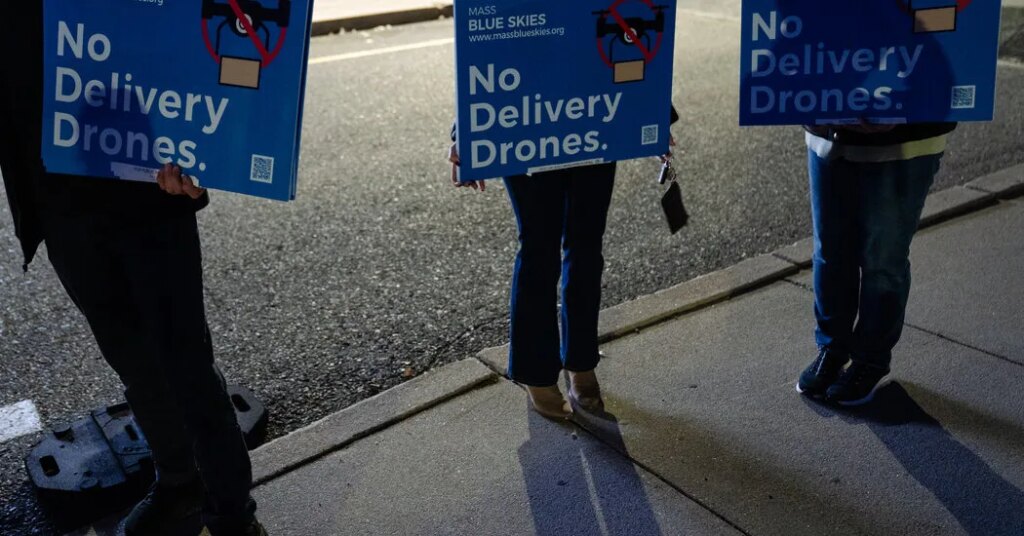
The appeal hearing was scheduled for November, and Amazon’s project would be on hold until then. Other opposition was also gathering. With hundreds of residents now rebelling — many involved with Mass Blue Skies, a nonprofit started by Ms. Farmer and Mr. Jané and about 10 others — the town of Westborough made its own move to stop Amazon’s plans.
Some residents, including Mr. Jané, helped the town draft a bylaw that would restrict ground operations of any unmanned aircraft, “to protect the health, safety, privacy, peace, quiet enjoyment, property rights, and general welfare” of residents. It would bar drone launchpads, staging points and drop zones.
In October, more than 500 people packed the high school auditorium to vote on the bylaw.
There was a retired mechanic in his 70s. A homemaker in her 30s. Tech workers and cashiers. Longtime residents living in houses from the 1800s, and new neighbors in apartment buildings.
In interviews at the meeting, nearly two dozen people said that the vote meant more than just trying to stop Amazon.
The residents said their votes stood for quiet weekend mornings hiking the Charm Bracelet trails that encircle the town. And peaceful afternoons sipping tea on their neighbor’s picnic table. And lolling in the privacy of their backyard, maybe even sunbathing nude.
The bylaw passed, 510-13.
As residents left the high school, Ms. Farmer had tears in her eyes as she grabbed people — some complete strangers — to hug them.
The Massachusetts attorney general said it has until Jan. 20 to decide whether to approve the new bylaw. But the vote already has had an effect.
At the end of October, just days before a hearing on Ms. Farmer’s and Mr. Jané’s appeal of the decision on accessory use, Amazon asked the town to withdraw its application for the drone hub, but asserted the right to come back with a new plan. The building commissioner then withdrew his own decision.
For now, it remains Westborough, 1, Amazon, 0.
The post Jeff Bezos Said Drone Delivery ‘Will Happen.’ This Town Said, Not Here. appeared first on New York Times.