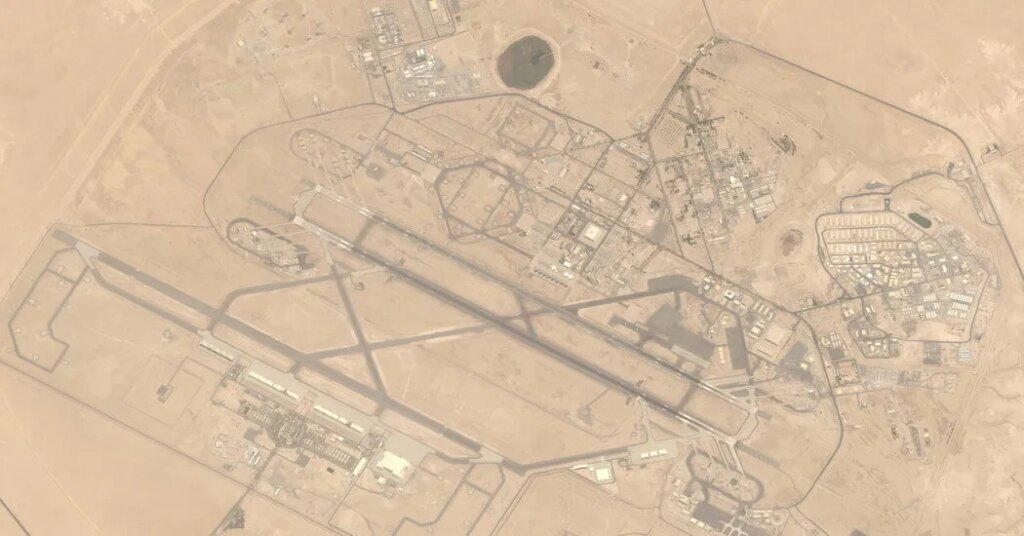
Kuwait and Bahrain said that they had intercepted Iranian aerial attacks on Wednesday as peace talks between the United States and Iran stalled and uncertainty lingered in the region over whether a new round of fighting would erupt.
The Iranian military said that it had fired drones at a Kuwaiti air base, aiming for U.S. air-defense systems and launch platforms, Iranian state media reported. The Kuwaiti foreign ministry denounced the attack, the first Iranian offensive against the country in about two months, saying that it was a dangerous escalation that threatened regional stability. It was unclear whether the attack caused damage.
Bahrain, an island nation in the Persian Gulf that is home to the U.S. Navy’s Fifth Fleet, said it had also been attacked on Wednesday. The Bahraini authorities have reported several attempted Iranian attacks since Friday. On Sunday, Iran’s Islamic Revolutionary Guards Corps said that the Iranian military had targeted a radar system at a Bahraini air base.
The Middle East has been in limbo for months as talks between the United States and Iran have failed to reach a sustainable resolution to the war. Gulf Arab countries, which host vast American military installations and thousands of U.S. troops, have received the brunt of Iran’s retaliatory attacks since the United States and Israel began their war with Iran in February.
Those attacks had largely petered out as the conflict entered a stalemate. But with the war deadlocked and few signs of progress toward a durable peace agreement between the United States and Iran, tit-for-tat strikes have resumed.
Iran has also continued to go after ships in the Strait of Hormuz, the narrow waterway that is a crucial shipping route for Gulf oil exports. On Wednesday, ADNOC Logistics and Services, a subsidiary of Abu Dhabi’s state oil company, said that one person was missing and 11 were injured after one of its vessels was attacked the previous day while sailing through the Strait of Hormuz.
Iran’s leaders have hardened their negotiating position with the United States since President Trump’s setback in the midterm elections, which were partly seen as a rebuke of his handling of the war, according to American, European and Iranian officials.
The United States has sent more military assets to the Middle East in recent weeks, and it struck Qeshm Island in Iran this month in what American officials said was a defensive measure. American and Israeli military officials have also drawn up plans for renewed strikes that would most likely target energy infrastructure and other sites vital to the Iranian economy, according to U.S. officials and other people briefed on the deliberations.
Several Gulf countries have lobbied against another round of fighting and pushed for a comprehensive deal to end the war. Qatar, which is mediating between the United States and Iran, condemned the Iranian attacks, saying that they were “a dangerous escalation.”
“It is not in the interests of the region to go through another round, and indeed not the interests of Iran to go through another round, of confrontation,” Anwar Gargash, a senior Emirati official, said at the Manama Dialogue security conference in Bahrain this month.
“We in the United Arab Emirates are looking for a political solution to this crisis,” he added. “We don’t believe that military solution is viable.”
The post Iran Fires Missiles and Drones at Gulf Arab States as Peace Talks Falter appeared first on New York Times.