Shaqueal Adkins used to look forward to her trips to Trader Joe’s.
At least twice a week, the mom of two would make a pit stop at one of the two Culver City stores before or after work to shop for chicken salad that she’d stuff in Trader Joe’s buttery croissants, plus cinnamon bun oat creamer and special treats for her kids like the crispy rice chocolate bars.
But when her job shifted to remote work a couple of years ago, the South L.A. resident could no longer rationalize making the roughly 30-minute trek across town. She had a Food 4 Less within walking distance of her home, but its quality didn’t match Trader Joe’s’ eggs and produce.
“I realized like ‘Damn, why isn’t this afforded to me?’” said Adkins, who works in special education. “Why can’t I walk down the street with my tote bag like the white girls?”
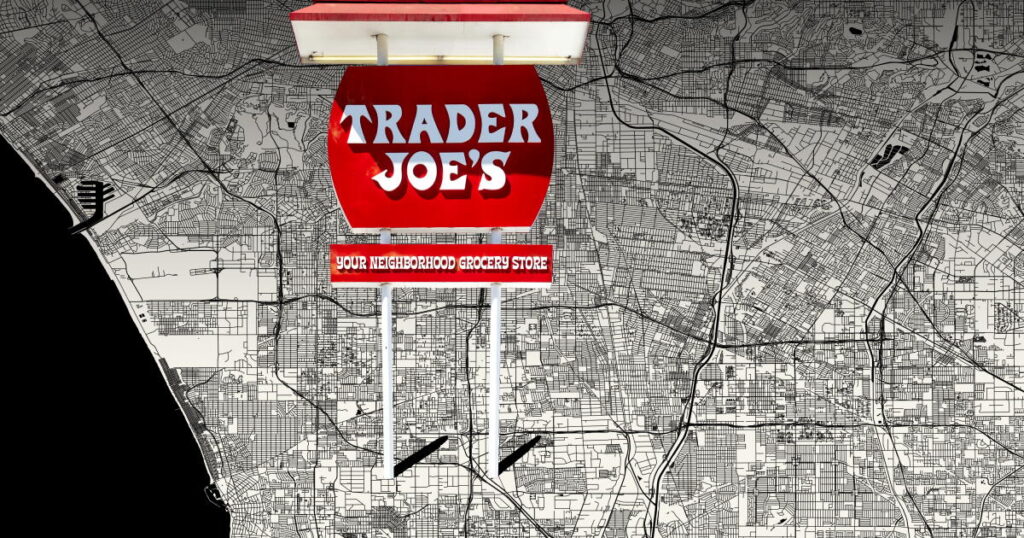
Since opening its flagship store in 1967 in Pasadena, Trader Joe’s has evolved from an eccentric neighborhood market into a cultural powerhouse with a cult-like following. Of its more than 600 stores nationwide, roughly 60 operate across Los Angeles County. Yet nearly all are concentrated along the Westside, coastal enclaves, the San Fernando Valley — where the grocer recently opened a second store directly across the street from an existing one in Sherman Oaks — and affluent pockets of Central L.A. including West Hollywood and Miracle Mile. The grocer is actively expanding, with 30 new stores set to open in 16 states.
Meanwhile, in South L.A. (historically known as South-Central) — a region spanning 51 square miles with more than 810,000 residents in communities like West Adams, Watts and View Park — there is only one, a bustling USC-adjacent store catering to students. In East Los Angeles and neighboring Southeast L.A. — including areas such as Boyle Heights, Huntington Park and El Sereno — there are none.
It’s a long-simmering grievance for some residents living in communities historically designated as food deserts or systematically bypassed by mainstream grocery brands. Now, on the heels of a successful Vallarta Supermarkets opening in Hyde Park and Sprouts in nearby Inglewood, government and business leaders believe South and East L.A. communities should be on the company’s radar for future stores. Much of South L.A. has limited access to affordable food, and Trader Joe’s is beloved for its low prices, international food options and quality prepared meals (its wall of salads stands in contrast to the area’s plethora of fast food). Beyond improving food options, Trader Joe’s could bring more jobs, ease shopping center traffic and have a ripple effect on commercial real estate nearby, real estate experts and government officials say.
Community leaders say past attempts to lure Trader Joe’s have been frustratingly overlooked, but a company spokesperson said while there’s no new location to confirm in the area, the chain is interested in opening in South L.A. “We have been looking in this neighborhood — and hundreds of others across the country — and will continue to look for locations to best serve our customers,” said spokesperson Nakia Rohde in an email.
Trader Joe’s is notoriously tight-lipped about its playbook for picking new locations. But on an episode of the company’s “Inside Trader Joe’s” podcast, marketing executives Tara Miller and Matt Sloan insisted the grocer’s decisions boil down to logistics: population density, accessibility and parking infrastructure. They also shared that community campaigns and petitions don’t influence expansion plans despite having a dedicated “Request a Trader Joe’s in My City” page on its website. (These requests are sent to the grocer’s real estate team.)
“We are excited when people are excited about us, but that’s really not what’s driving the decisions,” Miller said. “We are growing at a pretty good rate right now, adding more and more stores.”
In late October, Trader Joe’s opened its first store in Anaheim Hills. Its website lists three other California stores as “coming soon”: Leucadia and San Diego in Southern California, and Riverbank, in the Central Valley.
As for whether household income plays a role in site selection, Rohde insisted there is no single formula. “The factors are not the same for every neighborhood — each neighborhood is unique, as is every Trader Joe’s,” Rohde said.
A Los Angeles Times analysis found that L.A. County ZIP Codes with a Trader Joe’s have an average median household income of about $120,000 — roughly 30% higher than the countywide median of around $92,000. The average median household income is approximately $60,000 in South L.A. In East L.A. and neighboring Southeast L.A. combined, the estimated income is nearly $71,000.
Real estate experts argue that such income groupings miss wealthy regions in South L.A. Neighborhoods such as View Park-Windsor Hills, Ladera Heights and Baldwin Hills have been historic centers of Black affluence for decades with median incomes ranging from roughly $130,000 to $167,000. These residents are already shopping at Trader Joe’s — they just have to leave their communities to do so.
Arturo Sneider, CEO of the minority-led, community-focused development firm Primestor, has fought to bring major brands to South and East L.A. for more than three decades. His company helped bring the first Ulta Beauty to Southeast L.A.; Nike to Whittier Boulevard; and Starbucks, the Habit Burger Grill and Jamba Juice to Watts.
“It’s easy to think of them now, but I can tell you 35 years ago, we had exactly these conversations that we’re having about Trader Joe’s about every single one of those categories,” Sneider said.
To Sneider, the grocer’s absence isn’t born out of ignorance. “It’s definitely not a lack of clarity on demographics and trade areas,” he said. “They’re very sophisticated in that way. I think it’s that their concept was created around a very particular consumer base and that’s where their expertise is.”
For decades, South L.A. has struggled to bring fresh, healthful food into its communities while fighting to hold onto the few grocery stores it has. Many South L.A. residents were upset in 2021 when supermarket-chain owner Kroger suddenly closed its Ralphs store at the corner of West Slauson Avenue and Crenshaw Boulevard in Hyde Park, leaving a gap for grocery options in the already food insecure community. The announcement arrived shortly after the City Council voted to require larger grocery stores and drugstores to increase their workers’ pay by $5 an hour for a set period of time.
“We had to get another market and we talked to all the American-based companies and they had more excuses than my nephew when it’s bedtime,” said L.A. City Council President Marqueece Harris-Dawson, who represents District 8, including parts of South L.A. Eventually, his team connected with Vallarta Supermarkets — a family-owned Latino grocery chain that opened its first location in 1985 in Van Nuys — which replaced the former Ralphs in 2025. Harris-Dawson said the community, which is primarily Black, has welcomed Vallarta Supermarkets with open arms because it caters to their needs by adding products they like such as Caribbean foods, Southern seasonings and prepackaged meals from nearby Dulan’s Soul Food Kitchen.
A new Costco featuring 800 apartment units on its upper level that is set to open in 2027 in Baldwin Hills is also a win, Harris-Dawson said. He said he has suggested Baldwin Hills, View Park and Ladera Heights to Trader Joe’s in the past — neighborhoods with higher incomes than some areas with Trader Joe’s stores — but he’s no longer trying to persuade the company.
Grocers like Trader Joe’s are sending a clear message by not opening stores in primarily Black and Latino communities, he said.
“It is probably one of the more blatant ways in which people experience racism, because you know the only reason why they’re not here is because we’re brown,” he said. “Even when we make enough money, even when we’re educated enough, even if we buy enough food, they still don’t come, and that’s deeply felt and very hurtful.”
When prompted to address Harris-Dawson’s comments, Trader Joe’s flatly rejected his allegation. “Race and ethnicity are not included in the list of factors that go into finding new Trader Joe’s locations,” spokesperson Rohde said.
Manuel Pastor, director of USC’s Equity Research Institute, said he doubts the owners of Trader Joe’s are thinking “‘how can we exclude certain people from shopping at our stores?’”
“But the question that arises is not so much about intention, but impact and whether or not the result is food deserts and places where healthy food is hard to obtain,” he said.
While Hyde Park resident Nicole Vick said it would be nice to have a Trader Joe’s and other mainstream grocers closer to her home, she thinks the community should turn its attention toward the convenience shops it already has.
“In our communities, we have a lot of liquor stores or even smaller corner stores, but how do we make sure that they have a balance [of food items]?” she said. She points to a 2011 corner store makeover project that UCLA worked on in East L.A. that prominently displayed healthful foods and moved chips, soda and candy to the back of the market.
“How do we make more access to fresh food? Yes, full-service grocery stores, but we understand there’s small profit margins in those kind of stores, they take a lot of money, there’s not enough space … OK fine,” Vick said. “There’s existing corner stores. How do we support them so that there’s more access so people can be like let me walk down the block and get a few things like milk. So I think that’s what we need as opposed to ‘Oh, we need a Trader Joe’s.’”
Although the possibility of a local Trader Joe’s excites Adkins, she also feels conflicted.
“I love Trader Joe’s. I love the aesthetic. I love how I felt when I was shopping there and what they offered me,” said Adkins, who lives in South Park. But “if they were to build it right now down the street from us, I probably would side-eye it,” thinking they did it because the demographics of her neighborhood are changing. Gentrification fears abound in parts of South L.A., particularly in neighborhoods like Leimert Park and West Adams, which are steeped in Black history.
But, Adkins quipped with a laugh, “I’ll still be in there like swimwear.”
For now, she makes do with early-morning runs to Food 4 Less to avoid the chaos, carrying a Trader Joe’s tote bag over her shoulder.
The post Trader Joe’s is rapidly expanding. Why not in South L.A.? appeared first on Los Angeles Times.