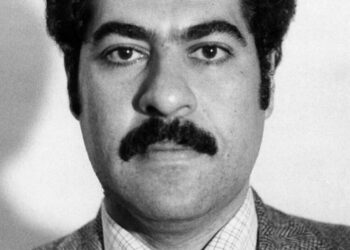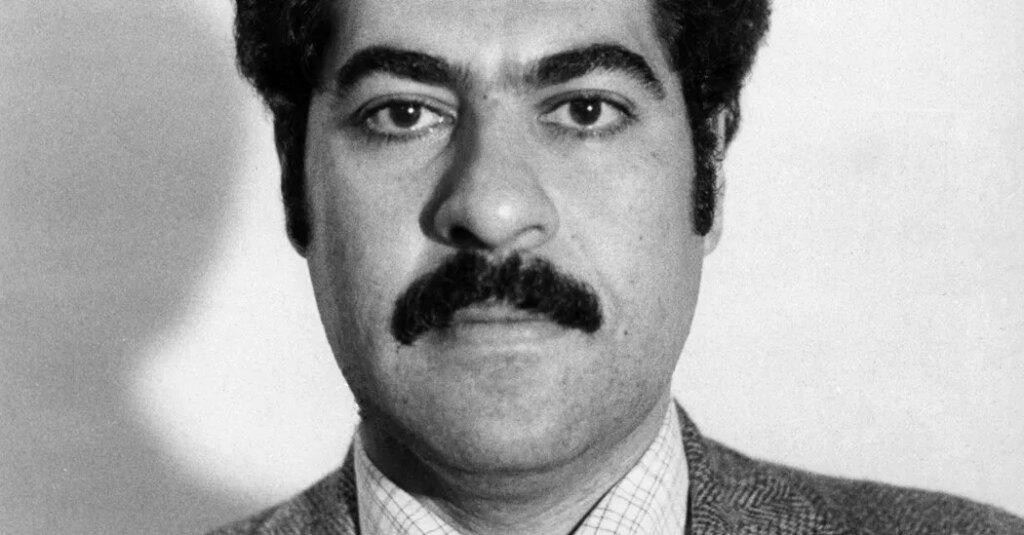
Weeks before he would be expelled from Iran, Youssef Ibrahim covered a menacing event at the United States Embassy in Tehran in the summer of 1979 that highlighted just how drastically the country had changed.
“It was not just another Fourth of July picnic,” Mr. Ibrahim, the Iran bureau chief for The New York Times, wrote in his dispatch.
There were burgers, beers and baseball, but the few remaining Americans in what had been a bustling diplomatic mission were celebrating Independence Day under the watch of dozens of armed Islamic Militia guards, amid trees recently etched with slogans in Persian extolling Islam and pictures of mullahs hanging on the embassy gates.
“Tehran has a sinister air,” Mr. Ibrahim reported. “The nightclubs and the bars are long gone. Only a few movie houses have reopened, playing revolutionary films.”
Mr. Ibrahim, who died on Oct. 31 at 83, began reporting from Iran in late 1978 as demonstrations threatened the rule of Shah Mohammed Reza Pahlavi. The shah, who would be the last in a string of monarchs in Iran over 2,500 years, was a U.S. ally who courted foreign investors while Iranians chafed under repression and reaped little of the benefit.
After the shah’s ouster, Mr. Ibrahim documented Iran’s dizzying transformation into the Islamic Republic of the revolutionary leader Ayatollah Ruhollah Khomeini, who repudiated Western culture.
Mr. Ibrahim’s reporting on the turbulent new era displeased the new Iranian government. Late that July, he was called to the Ministry of National Guidance and informed that he was being expelled.
Exactly why was uncertain.
Could it have been the time he described the revolutionary leader as “a shrewd old man” prone to “delphic pronouncements”? Or was it his stories on nationalizing industry, warring factions, mass arrests, fearful minorities or the imposition of new restrictions?
All he was told was that the government was “unhappy,” Mr. Ibrahim said. And so the correspondent abruptly found himself on a flight to Kuwait.
Mr. Ibrahim went on to report about Iran from London, including writing about the event that helps explain American-Iranian tensions to this day: the hostage crisis. On Nov. 4, 1979, Iranian students broke into the U.S. Embassy and took dozens of diplomats and staff workers hostage. The standoff that followed lasted more than a year.
Even reporting from abroad, Mr. Ibrahim continued to draw the Iranian government’s ire. In a letter to The Times late in 1979, denying his reporting on repression of regime critics, a press attaché for the Iranian Embassy in Washington asked, “Is this reporter simply a political opponent of Ayatollah Khomeini taking revenge for his expulsion?”
For Mr. Ibrahim, Iran was just one war story in career that was full of them as he lived out a dream forged at a movie theater in Cairo.
Born in Egypt, he decided at age 14 that he would be a reporter after seeing a movie about an American war correspondent in Hong Kong, he recounted years later. Defying family pressure to become an engineer, he secretly quit studies that were making him “miserable” to pursue his real goal, said Nabil Ibrahim, his younger brother and only surviving sibling.
He went on to study at the American University in Cairo and then earned a scholarship to a graduate journalism program at Columbia University in 1969. He got a job as a news assistant at The Times starting in 1970.
Over the course of a long career, Mr. Ibrahim met with presidents, interviewed the Libyan dictator Muammar el-Qaddafi in a tent in the desert, and mingled with ministers at meetings of the Organization of the Petroleum Exporting Countries.
On visits back home to Cairo, he would take gifts from around the world and regale his nephews with tales of his travels, said Ramy Ibrahim, one of Nabil’s sons.
His relatives soon learned to appreciate their time with him while they had it, since at any moment a family gathering might be disrupted by a major news event. In 1990, Nabil said, while they were vacationing in France, Mr. Ibrahim got a phone call about Iraq’s attacking Kuwait, hung up and said, “I’ll have to leave you guys.’”
Mr. Ibrahim left The Times in 1981 and joined The Wall Street Journal, where he covered international energy, winning a George Polk Award, an Overseas Press Club Citation and the International Energy Economists Association Award. He returned to The Times in Paris in 1987, writing about oil and the Arab world.
“He was a genial colleague, extremely well sourced at OPEC and on the Middle East,” said Roger Cohen, an international writer at large for The Times who knew Mr. Ibrahim in Paris. He was “kind of the life of the party,” Mr. Cohen said.
Daphné Anglès, a longtime office manager for the Times bureau in Paris, described Mr. Ibrahim as kind and calm, but also “very nonconformist and independent.”
“He wasn’t someone who would bow to any sort of authority or rule if he didn’t agree with it,” she said.
Mr. Ibrahim, whose marriage to Susan Kinsey ended in divorce, later covered business and economics from London.
In 1999, he left the paper, taking a job as vice president and regional manager of public affairs for the Americas at B.P. for several years. He joined the Council on Foreign Relations as a senior fellow for Mideast affairs for a year in 2003, and continued writing about the region and global energy and working as a political risk consultant for multinational oil companies while living in Manhattan.
Youssef Michel Ibrahim was born on June 11, 1943, in Cairo, the eldest of three siblings. Besides Nabil, there was a sister, Mary. His father was Michel Ibrahim, a general manager at the well-known Egyptian department store chain Omar Effendi, and his mother was Adele (Nakhla) Ibrahim, a homemaker.
Earlier this year, Mr. Ibrahim was diagnosed with heart failure. In the final weeks of his life, as his condition deteriorated, he was transferred to a nursing facility for medical care in Waltham, Mass., where he died, the family said.
At the time of Mr. Ibrahim’s death, the conflict between the United States and Iran that he chronicled for much of his career was still raging, and, indeed, had escalated to full-scale war.
The post Youssef M. Ibrahim, Who Covered Iran’s Revolution for The Times, Dies at 83 appeared first on New York Times.