On a recent Wednesday night, 26-year-old Raylene Jimenez stormed the podium during a public meeting in a small city in Los Angeles County. Through tears, she screamed at elected officials seated feet away and inches above her eyeline.
“Shame on you! Shameful!” she screeched, her arms flying in the air. She went on for several minutes. Officials called a recess and exited via a side door.
Just moments before, City Council members in Bell had voted to move forward in a process to potentially sell two mobile home parks.
It’s where Jimenez, her parents and her two children live, packed into a narrow home on space 189 at the rear of Bell Mobile Home Park. They pay $648 a month to rent the land. It’s a veritable bargain in Southern California, where housing costs typically amount to thousands of dollars a month.
City leaders say they can no longer keep up with maintenance and debt payments on the parks and can’t continue subsidizing homes for the roughly 300 residents who live there.
Bell, a working-class city of roughly three square miles, is embroiled in a fight over the future of a type of housing that has long provided affordable living in a state too expensive for many residents. But the city does so with more political baggage than most places.
In 2010, Los Angeles Times journalists revealed that city officials had been clearing municipal coffers to pay themselves outsize salaries and benefits. They used taxpayer money to buy themselves a horse ranch, hair plugs and time at a weight loss camp.
Residents showed up to city meetings to jeer at the leaders who had betrayed them.
“Shame!” they shouted. Seven city officials were convicted of misappropriating public funds. Some went to prison. The “Bell scandal” was so notorious that it sparked investigations of neighboring cities and municipal governments and appeared as a question on “Jeopardy.”
Bell has, in many ways, moved on. After the scandal, the city embarked on a series of reforms in the name of transparency, including posting public records on its website and recording council meetings. It got on better financial footing. In recent years, the city launched a campaign to spur the opening of new businesses.
But in Bell, the discussion over the sale of the mobile home parks has raised questions about the city’s continued commitment to transparency.
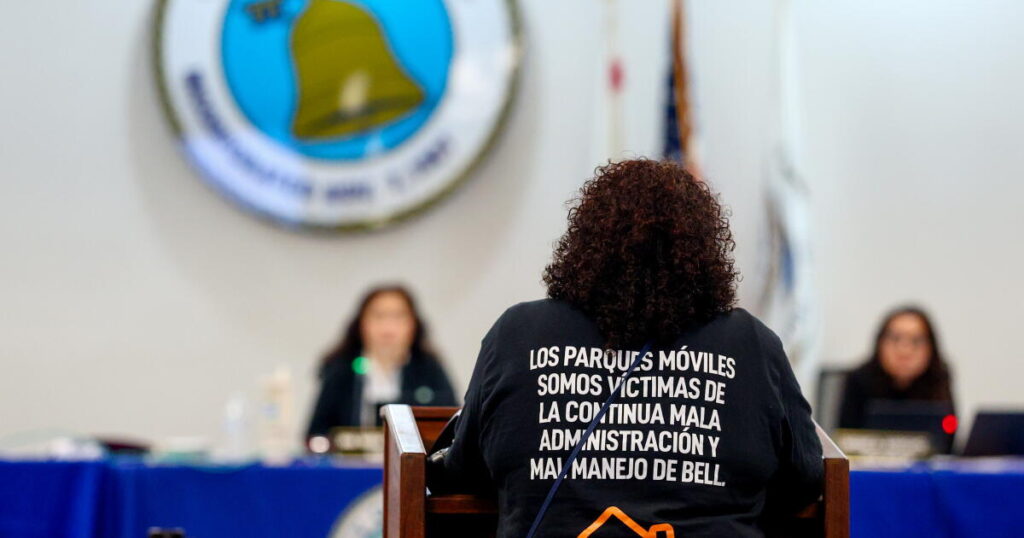
Residents, who have some of the lowest incomes in the area, say they can’t get clear answers on their futures or where they’ll go. At last month’s meeting, two women wore T-shirts that read, in Spanish, “We are victims of ongoing mismanagement and mishandling by Bell.”
The Times reached out to all five elected members of the council, none of whom agreed to an interview or responded to written questions about the parks. The city manager answered questions through a public relations representative.
In the past, these council members, some of whom took office after their predecessors were removed from office, have said Bell has to move on from the narrative wrought by the scandal.
“We’re trying to change that image because it is negative,” Mayor Ana Maria Quintana said at a council meeting last year. “I don’t want us to be seen as victims. However, it needs to be acknowledged that we were.”
Meanwhile, a firm hired by Bell found that because mobile home park residents currently pay such low rents, there is very little housing nearby they could afford if they are forced to leave and, in many cases, they would end up paying twice as much for housing.
The disappearance of mobile home parks
The Bell mobile home parks are part of a long tradition.
In the 1930s, many parks opened as temporary trailer spots for families looking for work during the Great Depression. Decades later, the federal government began funding new parks as manufacturers began building wider, more spacious homes. Transient parks became established neighborhoods, often in the middle of growing cities.
Today, mobile homes in California are the cheapest type of housing. Because residents typically own the homes, they are only on the hook for land rent and utilities. On average, owners spend about $1,200 a month on housing costs, hundreds of dollars less than renters and traditional homeowners, according to U.S. Census Bureau data.
These parks enabled families to find a toehold in the middle of growing cities — from working-class communities like Bell to wealthy enclaves like the Palisades.
But in the face of development pressures and a lack of protections, mobile home parks are disappearing, as elected officials scramble to find ways to incentivize building other affordable homes.
Bell Mobile Home Park and Florence Village Mobile Home Park are separated by three-quarters of a mile of single-family homes and small businesses. The families living in the parks are overwhelmingly Latino and earn on average less than $50,000 a year, according to a limited survey of residents. On average, mobile home owners pay $613 a month to rent the land beneath their homes. Many of them have lived there for decades.
Per state law, Bell would have to pay for relocation costs and the homes which, despite being called mobile, are too old to be moved. In total, a firm hired by the city estimated that this sale could cost Bell $40 million.
Jimenez, who rushed the podium at last month’s council meeting, called the compensation a “little Band-Aid on a big crack.”
Her mother, Maria, bought the family’s mobile home for $40,000 in 2010. An appraiser hired by the city says it’s now worth $140,000. Jimenez said she has been looking at homes on Zillow, but the median home price in the L.A. metro area is $855,000.
One of the most frustrating things, Jimenez said, is that the city has yet to say whether it is definitely selling the parks. The relocation report includes a potential timeline, which states that residents could be told as soon as the end of this month that they have to leave and would have to be out by next summer.
“That is a very specific timeline for someone who doesn’t know,” Jimenez said.
When asked about conversations the city has had with potential buyers, City Manager Michael Antwine, writing through a public relations representative, said: “The city often receives interest from various parties interested in purchasing city-owned properties.”
But at least one real estate leasing firm has started advertising one of the parks for rent. Lewis Retail Centers lists a property called “Bell Retail” on its site, describing it as 52,000 square feet of retail space with “[d]iverse leasing opportunities.” While the listing doesn’t include an address, an outlined plot of the space on a map overlaps the Florence Village Mobile Home Park.
Neither the real estate firm nor Antwine responded to questions about this listing.
“They’re playing with us,” Jimenez’s mom said. “They’re playing with our brains.”
Jimenez lives with her parents while raising her two children, who are 8 and 4. The family has a small backyard beside their mobile home, where the older child, Alessia, spins and flips on a trampoline. Jimenez said the low monthly housing cost means she can afford to pay for cheerleading for her daughter.
When she looks around the mobile home she shares with her four family members, she notices the scuffed paint on the walls and the warped floors.
“It’s not much,” she said, “but it’s ours.”
Saving the mobile home parks
In 1995, Bell, through its affordable housing arm, bought these mobile home parks as part of an effort to preserve affordable housing.
Private owners had been raising rents by as much as 10% a year, so the city issued $13 million in bonds, most of which covered the purchase of three parks. (Two of the parks were eventually consolidated.)
The city, according to The Times, promised to protect low-income residents and agreed to raise rents by no more than 3% a year. “We’re not profit-motivated,” said Robert Rizzo, city administrator at the time.
But Bell eventually started boosting rents, according to park residents and financial documents. In 2010, the average space rent jumped from $495 to $701. Luz Meza and her husband, Alfredo, who moved into Bell Mobile Home Park in 2006, said in four years the land rent on their home rose by roughly 50%.
By this time, the city had made little headway on paying down its debt on the parks. Ten years after the purchase, it went deeper into debt, borrowing $21 million, most of which it used to pay off the earlier bonds.
As it turns out, Bell was about to face a financial reckoning.
In 2010, The Times revealed that Rizzo and his colleagues had illegally raised taxes and used the income to pay themselves hefty salaries; Rizzo was earning $1.5 million a year in salary and benefits in one of the poorest cities in the region.
City officials, including Rizzo, were arrested and convicted of misappropriating public funds. As state auditors picked through the financial mess, one called Bell’s accounting a “rat’s nest.” In one instance, city officials used money set aside for low-income housing to pad their salaries.
During the trial of the assistant city manager, one council member testified that she saw rent money from mobile home park residents go missing. On the stand, Teresa Jacobo said she never spoke to police about the missing money.
The Times, on multiple occasions, called Jacobo and visited her home to learn more about these allegations. She did not respond.
Last year, the City Council agreed to pay a public relations firm up to $180,000 to handle outreach for city issues, including the mobile home parks.
The money for that contract is coming out of the budget for the Bell Community Housing Authority, the city’s affordable housing agency, which owns the parks.
“The City of Bell CANNOT afford to pay”
In 2020, the city first considered selling the parks, but a sale never went through. Since then, the city’s financial outlook has worsened, and Bell is now losing roughly a million dollars a year on the mobile home parks.
Much of that is because of the debt it still owes, which amounts to payments of $1.3 million a year, according to the city manager. In addition, according to budget documents, maintenance and operational costs have risen.
In order to balance its books, the city has been selling off its low-income housing. In June, the city sold a small apartment building and four single-family homes to a private buyer.
These sales would typically be detailed in an annual report housing authorities are required to file, per state law, each year. But Bell has not published an annual report on the activities of its housing authority since 2020; a department head said staff turnover and the COVID-19 pandemic created a backlog.
Meanwhile, the city has been sending mailers to registered voters lamenting its financial woes. It spent at least $18,000 in the last year on these mailers.
“The City of Bell CANNOT afford to pay for Bell mobile home park anymore,” one reads. Another details the costs of the parks, including up to $900,000 a year in maintenance and operation fees, and then asks, “Who’s paying? All Bell residents.”
In the year after the 2010 scandal, residents say the city lowered their rents because they had been raised in violation of city policy under Rizzo. Residents could not provide copies of the letters they say they received, but according to city bond documents, average rents at the mobile home parks fell sharply after 2010 and have largely stayed the same.
The city says it has not raised rents in 15 years. Several residents told The Times that rent has gone up but minimally.
The Mezas have received these mailers. It makes their daughter, Yudith, who lived with her parents in their mobile home for several years, angry.
“You’re saying we don’t pay our fair share, but in reality the rent freeze was because of mismanagement and corruption,” she said. “If we are here now and you’re using that to vilify the people in the mobile homes, you’re not saying the whole truth.”
Antwine, Bell’s city manager, said he was not aware of any policy to lower rents after the scandal. He defended the mailers.
“The mailers were intended to provide factual information and answer frequently asked questions about the parks and their financial challenges,” Antwine, who became city manager in 2022, said in written responses to questions through the public relations firm.
He did not agree to an interview.
“While the issue directly affects park residents, the city’s financial obligations also make it a matter of citywide concern,” Antwine said.
For now, elected officials won’t say whether a sale is imminent. The city manager has met with at least two people interested in buying the parks, according to conversations with these potential buyers.
One works for an affordable housing developer and said he’d like to maintain the mobile home parks. Another is a private owner interested in purchasing one of the parks.
This article is part of The Times’ equity reporting initiative, funded by the James Irvine Foundation, exploring the challenges facing low-income workers and the efforts being made to address California’s economic divide.
The post Ghosts of Bell corruption scandal resurface as city eyes sale of low-income mobile home parks appeared first on Los Angeles Times.