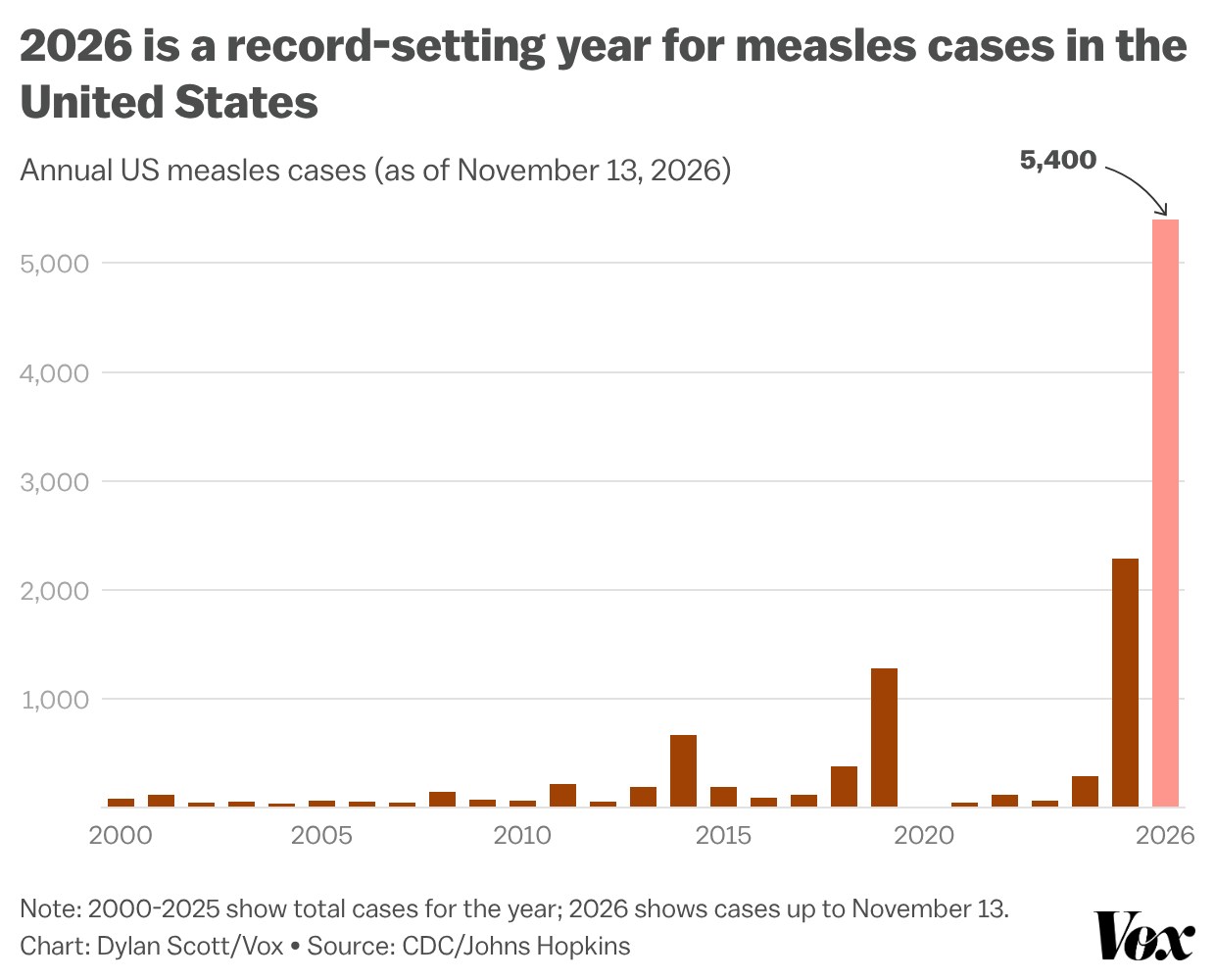
This year, the United States has recorded more measles cases — 5,739 as of Tuesday, November 17 — than in the past 25 years combined. There are active outbreaks in New York, Pennsylvania, and across the Midwest. At least eight people have died with measles infections in the US.
None of this is supposed to happen in the 21st century. In 2000, the United States declared that measles had been eliminated. For years, the extremely rare cases the US saw were from people who contracted the virus in another country and brought it back to America; we didn’t have to worry about measles spreading naturally in our communities.
But that’s no longer true. The Pan American Health Organization, which works with the countries in the Western Hemisphere on ongoing public health threats as well as emergency response, made it official Monday after the annual meeting of its measles and rubella elimination commission: The United States’ measles elimination status has been revoked. The virus is once again endemic in America.
It is an international embarrassment for a country that until very recently was the world’s unquestioned global health leader. And for doctors here in the US who have been practicing for decades, it’s an almost-unthinkable development, putting American lives needlessly at risk. The death of a 7-month-old baby in New York state, who was too young to be vaccinated, has made the consequences of the country’s collective failure hauntingly clear.
“It’s very, very, very surreal,” Dr. Barbara Keber, a family physician in Long Island, New York, told me last week. She’s been practicing medicine for 45 years and is old enough to have gotten measles herself when she was a child. But it was never something she’d had to deal with during her professional career — until now.
“When I had it, my sister had it, my best friend had it — that’s how I saw measles,” she said. “Then it disappeared, and I never saw it as a practicing physician until more recently.”
The reversal has been dramatic. In 2024, there were just a couple hundred measles cases in the US, nothing out of the ordinary. But last year, there were more than 2,000 measles cases and three deaths, and then both of those figures more than doubled in 2026. This year started with a brutal outbreak in South Carolina, and it is winding down with Pennsylvania in crisis and New York state reporting its first measles death in more than 30 years.
It’s impossible to talk about the recent rise of measles without talking about vaccine skepticism. Fears that childhood immunizations cause autism have been growing for years (reminder: they don’t), and the rise of US health secretary Robert F. Kennedy Jr. and a vast network of anti-science activists and politicians has led to widespread distrust in medical science and doctors since the pandemic began. As a result, fewer and fewer American kids are being given their measles shots. Nationwide, the measles vaccination rate is 92.4 percent among kindergarteners, down from 95 percent before the pandemic, which is the threshold public health experts say is necessary to stop the virus from spreading locally. And in some places, the decline has been more severe: In one Texas school district where measles ran wild last year, less than 50 percent of schoolchildren were vaccinated.
Over the past two years, I have spoken with doctors working on the front lines of these outbreaks to better understand what it’s like to face measles, often for the first time, and what they hear from their patients in the midst of an outbreak. I’ve taken away three lessons from those conversations, which serve as both an explanation of how we got here and a guide for what to expect as we try to find our way out of this crisis.
1. Small communities can be the kindling for measles outbreaks
One clear pattern has emerged across the recent outbreaks: They are often sparked in insular communities where anti-vaccine attitudes — sometimes the result of sincerely held religious reliefs — are widespread.
In New York and Pennsylvania right now, for example, measles has taken hold in Amish and Mennonite communities. Last year’s outbreak in Texas started in a Mennonite community as well. A charter school in South Carolina where less than 20 percent of kids were vaccinated against measles was the epicenter of that state’s outbreak. This is a pattern that predates our current measles explosion: When New York endured an isolated outbreak in 2019, it was concentrated in the Hasidic Jewish communities north of New York City.
Even in states like New York, where state officials have actually tried to strengthen school vaccine requirements, some parents in these communities have opted to homeschool their kids; they don’t have to follow those mandates. And when they do go out into the world, where more children may be vaccinated on average, they are increasingly likely to encounter another kid who is also unvaccinated as more families overall opt out of those shots.
That’s the recipe for these massive outbreaks: A lot of unvaccinated kids in one group get infected and then, as they move around the community, they come into contact with those other kids, who are also unprotected.
“These are groups that we have to work very carefully with because they have their religious beliefs. When you speak to them about vaccines, they’re just going to tell you no,” Keber told me. “But the issue there then becomes, well, they might not be being exposed during the school day, but they go and play baseball and they do dance and they do other activities where they’re mixing with other kids.”
In some of these communities, skepticism has remained stubbornly high even in the aftermath of an outbreak. But some people do take the threat of measles more seriously after people get sick around them. Keber told me that fear is not really the most effective message for convincing previously skeptical people to get themselves or their children vaccinated; relationship building over time — even if it takes a couple of conversations — is more effective.
“We’re not trying to scare people. That doesn’t really help anything,” Keber said. “If they get to trust the physician, that’s the biggest bang for the buck. This is somebody that you trust with the health of yourself and your family.”
2. Doctors are still figuring out how to deal with measles in the wild
Measles may be one of the most well-known diseases given its high infectiousness and signature rashes, but because it had been eliminated for so long, many doctors have had only an academic understanding of the virus — at least until these past few years.
“Almost no physicians that are currently practicing medicine have ever seen measles,” Keber said.
When I spoke last year to Dr. Ada Stewart, a family physician in Columbia, South Carolina, who has been practicing medicine for more than 20 years, she told me the same thing. At the time, she and her colleagues were reviewing their old medical school materials to make sure they knew all the signs and symptoms.
“We learned those things in medical school, but we never saw it,” Steward said. “We never had to worry about seeing it.”
When both doctors and patients are a step behind because they’re unfamiliar with measles, the virus can flourish. As Keber told me, somebody who’s not immune to measles has a 90 percent chance of catching it if they are exposed. And people can be contagious up to four days before the telltale skin rashes appear.
The early symptoms can resemble lots of other conditions: high fever, cough, runny nose, or red, watery eyes. Until very recently, Americans and their doctors didn’t have to worry whether those might be signs of a measles infection. But now they do.
“That makes it a little more dangerous than some other things where you know right away if somebody’s sick,” Keber said.
3. It’s going to take a long time to get measles under control
One of the observations that has stuck with me most came from Dr. Andrew Carroll, a family physician in Chandler, Arizona, a suburb outside of Phoenix. He told me there were two groups of people who seemed most fearful about measles when it began to spread locally: The older generation, who remembered what the disease was like, and the youngest patients for whom it was an entirely foreign and frightening pathogen.
The people in the middle, who grew up at the time the US was successfully stamping out measles and knew it only as a public health victory, were less bothered. It is one of the great dilemmas in public health: When you eradicate a disease, people become less concerned about it — and that can create the conditions for its return. We’re seeing that with measles: a swath new parents, for whom the virus was never a serious worry, are choosing not to vaccinate their own children, and that has helped the virus to surge back.
“It only takes one generation to forget the progress we’ve made on certain things — and one of those is measles,” Carroll told me. “Twenty-five years ago, we were a measles-free nation. Now we’re back one generation later because we forgot how terrible it was.”
And that may mean that, ultimately, it will take another generation coming of age and having their own kids — who, having been chastened by the outbreaks we’re experiencing right now, help vaccination rates recover to the point that we can eliminate measles a second time.
“We’re going through a cycle, and there will be casualties. There will be needless deaths and illnesses,” Dr. Jason Terk, a pediatrician in north Texas, told me last year. “I think that the only generation that is going to learn from this will be maybe the next one.”
The post The US has officially lost control of measles appeared first on Vox.