At work, 24-year-old Hunter Dickinson lives on the frontier of technology. He’s the head of growth for Whop, an e-commerce startup backed by Peter Thiel and Sequoia Capital.
In his spare time, Dickinson lives a more bohemian lifestyle in Brooklyn’s Williamsburg neighborhood. He buys his meat from a local butcher, ice skates at the neighborhood rink, and once tried salsa dancing at a local club. He’s very proud of a rug that he purchased from a local Azerbaijani merchant. “I literally have not left this four-block radius in four years,” Dickinson says.
One of America’s artsiest neighborhoods is attracting a new generation of tech workers. Dickinson calls it “San Fran transplant” energy. Between 2020 and 2024, Census data says nearly 9% of Williamsburg’s employed residents worked in computer and mathematical occupations, more than twice the citywide share of about 4%.
Walk down Bedford Avenue, and you’ll hear debates over coding agents. Take the Manhattan-bound L train, and you’ll see commuters texting Instinct. These aren’t the scrawny, shut-in, hoodie-clad engineers of a time when Meta was still Facebook. This generation wears chore coats and Japanese basics, their muscles bulging beneath tight-fitting tees. They talk about “taste” and techno.
It’s an unlikely hub for an industry that has historically clustered around universities, seeking talent and research. In the age of artificial intelligence, tech companies have a new interest in the language their models imitate, the society they reshape, and the larger meaning of life they may be bringing to an end. You see it in the AI companies hiring ethicists and philosophers and hosting intellectual salons. Williamsburg, with its galleries, street art, and concert halls, offers that.
We spent months studying the signs of Silicon Valley in Williamsburg to see what they could tell us about life in the neighborhood. We worked out of cafés, drank at local bars, saunaed at the Bedford Equinox, attended an AI demo night, and spoke with over two dozen people in and around New York’s tech scene.
Daniel Chesley, a 31-year-old principal at the venture capital firm Workbench, lives in Park Slope and often travels to Williamsburg for meetings. He says he can spot tech workers by their thrifted clothes, Salomon sneakers, and Patagonia backpacks. You can hear their chatter walking up and down Bedford, he says: “AI, Anthropic, compute credits, Nvidia. Things like that.”
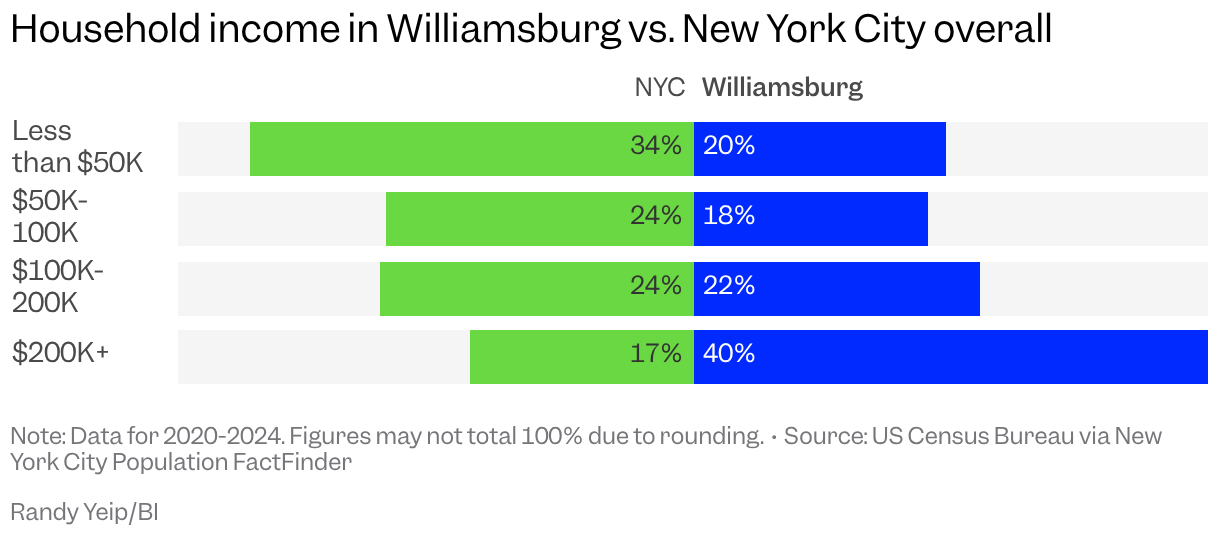
While Manhattan still employs the most tech workers in New York, Brooklyn’s rise has been fast and concentrated in Williamsburg. Real estate developers, especially along the East River waterfront, coaxed startups with post-pandemic office deals and city tax benefits. It helped that the neighborhood had long been gentrifying, slurping up all that disposable income with $8 lattes. Between 2020 and 2024, the neighborhood’s median household income was roughly $149,000, compared with $80,500 citywide.
Paul Butler, a 36-year-old engineer at Modal Labs, left San Francisco for New Yorkin 2010 after thinking, “I can’t even go for a coffee without hearing about JavaScript.” He moved to Williamsburg after rents dropped in 2020 and worries it’s Silicon Valley all over again. “I’m not saying ‘I want all the techies out of Williamsburg,’” he says. “I am one. I just wish that we would take the weekend off and not talk about work at coffee shops.”
If human creativity is the last bastion for AI to conquer, then part of Williamsburg’s appeal lies in its rich artistic legacy. The neighborhood has long been home to Polish, Jewish, Puerto Rican, and Dominican communities, and it still contains one of the largest Hasidic hubs in America. In the 1990s, it earned the title of “new Bohemia,” and gave rise to a new school of art called Immersionism.
In the aughts, indie rockers took refuge from skyrocketing Manhattan rents. The edgy digital media brand Vice established its headquarters. Music venues took over the warehouses that lined the East River. Twee hipsters shopped at American Apparel’s brick-and-mortar on 6th St.
By the mid-2010s, the hipster haven had grown up. Vice took over out-of-business music venues. LCD Soundsystem’s James Murphy opened up an upscale wine bar. Luxury condos moved in.
Ronen Givony, who documented the era of indie music in Brooklyn in his book “Us v. Them,” often finds himself back in the neighborhood. “I try not to be the grumpy old man who’s like, ‘this is how it used to be,’” Givony said. But the difference is “night and day.”
By the 2020s, Williamsburg’s tech scene was starting to sprout. Web3 bros moved into the neighborhood’s coworking spaces. The crypto startup Rainbow threw late-night parties — like “tweetups” — at its office; a fresh-out-of-prison Martin Shkreli showed up to its loud, dark basement one night in 2022.
Some of Williamsburg’s artists are still in the neighborhood, attempting to marry art and tech. Williamsburg-based VC firm Asylum Ventures’ website proclaims “the best founders are artists.” A few blocks away, the AI design startup Flora hosts digital art shows in the Domino building. Come next spring, a new music venue from a member of the hipster soundtrack band Mumford & Sons will open downstairs at the Domino development.
Many of the techy Williamsburgians say they moved to the neighborhood because they thought it was less corporatized than Tribeca or SoHo. And yet, the gritty bars and artists’ lofts have been replaced by luxury condos and private equity-owned retail. Today, shoppers can ping-pong between athleisure brands Vuori and Lululemon. Around the corner is Hermès; down the road is a smattering of slop bowl stops.
The transformation centered on real-estate attractions like the former Domino Sugar refinery, a once-crumbling shell that Two Trees Management converted into a luxe office space. Alyssa Zahler, the developer’s managing director of commercial leasing, says 75% of occupants are tech companies; half are in AI. Startups have good reason to move in: Two Trees advertises the city’s tax incentives for tech companies crossing the river, as does 25 Kent, an office complex that conveniently houses a sauna downstairs.
Specifically, this “stretch of Williamsburg” — along Kent Avenue and north of the Williamsburg Bridge — has radically evolved from its music-and-counterculture past, said Givony.
“It looks like Harvard Square, basically,” he said. “You would have no reason to know that something was happening there.”
In addition to the anchor developments, techies have their favorite hot spots: Radegast Hall for beers, Devocion for coffee. At Vital, a climbing gym by McCarren Park, habitués also take out their laptops to work. Techies love their steams, crowding into Bathhouse, Othership, and the locker rooms of boutique gyms. Sam Ragsdale has spotted one-on-ones in the Equinox sauna of the Domino development, where he works as the CEO of the AI startup Merit Systems. You can spot them in their swim shorts, he says, sweating as they talk about evals and fundraising. The 28-year-old prefers to take his meetings outside in Domino Park, where he sees the same two or three engineer-manager pairings looping the park, getting their steps in.
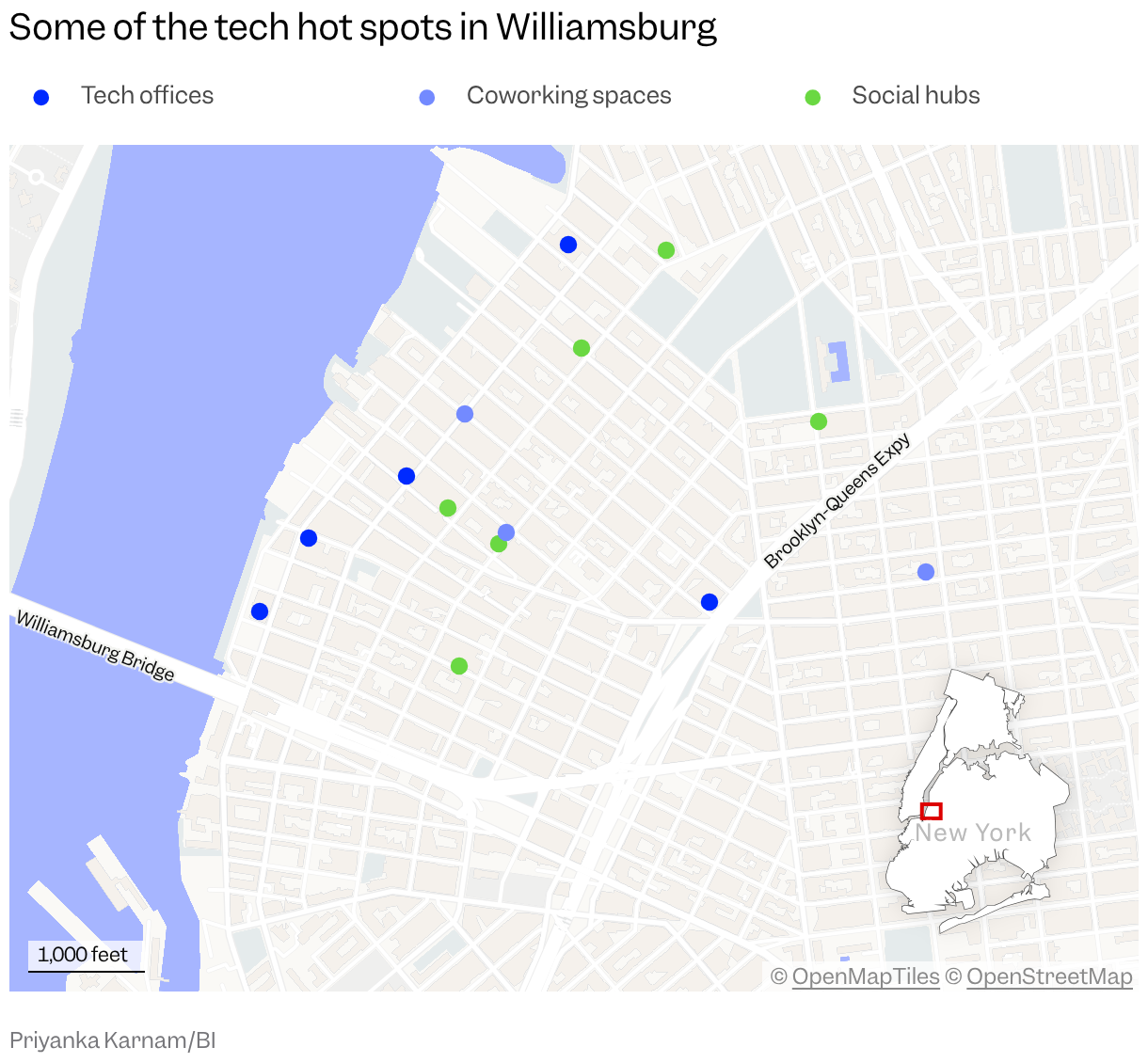
Others walk around the neighborhood with their laptops half-open to keep their AI agents running. Cornelius Schramm, a 28-year-old who moved his startup, Avallon AI, to Williamsburg in 2025, called it “the most San Francisco-esque part of New York.”
Dhruv Chopra was part of Williamsburg’s creative class in the 2010s. He arrived in 2009, at the dawn of music streaming and the blogosphere. New genres ricocheted through semi-legal basement clubs. His contribution to the scene was opening Elsewhere, a long-standing nightclub just down the L train in Bushwick.
Now 39, Chopra has left Elsewhere for a cushier, techier lifestyle. He cofounded Third Space, an insurance broker for nightlife venues backed by Andreessen Horowitz’s Speedrun accelerator, and made friends with the neighborhood’s other founders. He didn’t have to leave Williamsburg; tech came to him.
He sees the irony. “I started living in the high-rises that pushed our old business out,” he says. Chopra’s Elsewhere cofounders also ran the warehouse club Glasslands, which neighbored the Domino Sugar building before closing in 2015. Vice took over the property until the media outlet filed for bankruptcy in 2023, and now it’s being reimagined as a 17-story building complete with apartments, offices, and retail space.
And yet, Chopra’s content with it. “The reality is, particularly in a place like New York, the only constant is change.”
Read the original article on Business Insider
The post Welcome to New York City’s Tech Bro-hemia appeared first on Business Insider.