In the wake of the midterm elections in which Democrats won control of both the House and the Senate, a growing number of politicians and activists have begun calling, publicly and privately, for Congress to seize the moment and pass the first federal minimum wage increase in 17 years.
After running campaigns centered on the cost of living, Democrats and their allies say raising the $7.25 federal minimum closer to a “living wage” — i.e., enough for a full-time worker to cover basics like rent, food, and healthcare — is the obvious next step for their affordability mandate. A minimum wage increase also has a political advantage because businesses, not the government, cover the cost, meaning it has little effect on the deficit and doesn’t compete with other priorities for federal dollars.
“I’ve been talking with a lot of different Democrats on the Hill and they’ve been calling it a first 100-day issue,” said Jared Bernstein, who chaired President Joe Biden’s Council of Economic Advisers and is now at the liberal Center for American Progress.
Rahm Emanuel, who is widely expected to run for president in 2028, has been urging Democrats to act, and it was a top issue for the party when he ran its campaign arm in 2006. “Pass a minimum wage $20 by 2030,” he said on Vox’s Today, Explained podcast after the election. Sen. Bernie Sanders (I-VT) has also been making media rounds calling for raising the wage to “at least $20 bucks an hour.” On Thursday, Hakeem Jeffries, who’s expected to be the House speaker, identified raising the wage as a priority, but ducked press questions about specifics.
Key takeaways
- Many Democrats want to raise the federal minimum wage from $7.25 to about $20 an hour by 2030. Sen. Chris Murphy’s bill would go to $25.
- Most research finds past increases raised pay without costing many jobs. But few places have set a minimum that high relative to local wages, so economists don’t know where the limit is.
- Critics warn a high national minimum could hurt lower-wage states the most and lead employers to raise prices or cut hours, benefits, and training.
- Raising the minimum wage is popular across party lines, and because the cost falls on businesses and their customers rather than taxpayers, it adds little to the federal deficit.
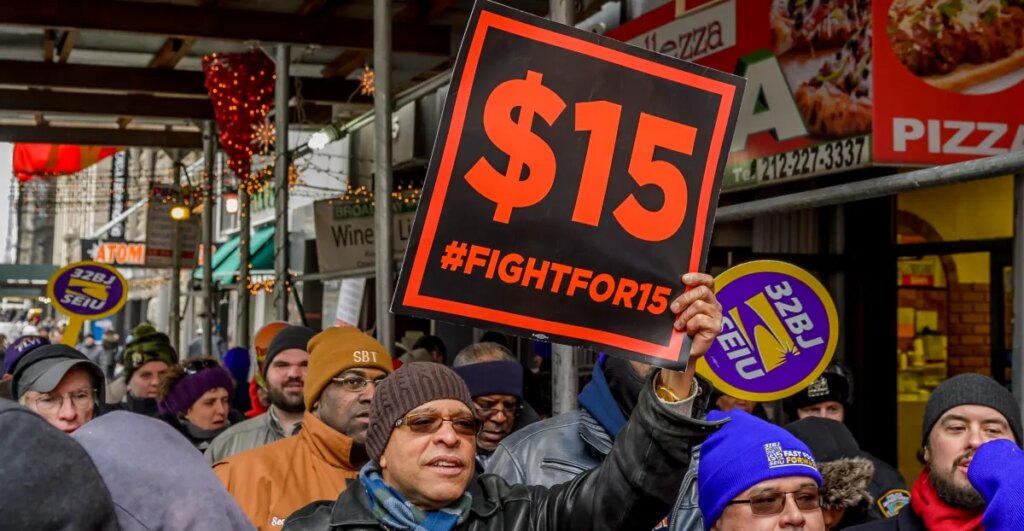
A decade after the party rallied around the “Fight for 15” movement, how high to raise the minimum wage — and how fast — is becoming a defining economic question for the new Democratic majority, as well as in states where they have new governing trifectas. In Pennsylvania, Gov. Josh Shapiro has pledged to sign a $15 minimum wage bill, while in Wisconsin, Gov.-elect David Crowley has targeted a gradual increase to $20.
In recent years, a wave of research built on the 30 states that raised their own minimums has convinced many economists that modest increases cost few, if any, jobs. That evidence, plus voters’ anger about the cost of living, has rallied progressive experts around a new federal benchmark equal to two-thirds of the hourly median wage, or roughly $20 by 2030.
But that threshold is also near the upper end of what researchers have actually studied, and even economists who support it acknowledge that no one knows how high the minimum wage can go before it starts costing a significant number of jobs or increasing prices at a time when inflation is a major concern. Skeptics warn that a national minimum that high could hit the country’s lowest-wage places hardest, just as AI introduces new threats to the jobs young and less-experienced workers depend on.
Still, raising the minimum wage is popular with voters, and even some Republicans have expressed openness to cutting a deal. “You want to raise the minimum wage? I’m for that,” Sen. Josh Hawley (R-MO) told reporters last week. The last wage increase was signed by a Republican president after Democrats won both chambers of Congress in the 2006 midterms, much as they did this month. Trump, who has previously called the $7.25 minimum wage “a very low number” recently told Politico he doesn’t want to “just be sitting there for two years vetoing everything.”
Some Democrats want to go even further, like Sen. Chris Murphy of Connecticut, whose bill introduced over the summer would require big companies to pay $25 within about five years and smaller ones by the late 2030s. Murphy makes the case for his bill less on labor-market research and more on economic fairness.
“It’s not like we can’t pay a $25 minimum wage,” Murphy said after announcing his legislation. “We just choose not to.” And in New York City, Mayor Zohran Mamdani ran on a $30 minimum wage by 2030, though the plan hasn’t gotten traction in the state legislature, which would have to approve it.
As Democrats look to act in 2027 and beyond, the empirical debate over how high the minimum wage can safely go is getting entangled with the populist one over how high the party should aim. These debates are especially important because the party may have far more power to raise wages than they expected before their midterm wins, both in Congress and in states and cities around the country. While previous efforts in Congress have been stymied by procedural barriers, Senate Democrats are now within reach of a filibuster-proof majority as soon as 2029.
Far from a messaging exercise, the question of how high wages should be at the bottom is now a live policy issue that the party needs to take seriously — with potentially severe consequences if they misstep. How Democrats work through these tensions will shape both how much low-wage workers might gain, and what they might lose, and how much of the party’s answer to the cost of living rests on the minimum wage at all.
From $15 to $20 (and beyond)
Beginning in 2012 and backed by the Service Employees International Union, fast-food workers walked off their jobs, demanding $15 an hour and the right to form a union. The Fight for 15 became a national movement, spreading to other sectors like academia, airports, and childcare, and it pushed past the position of President Barack Obama and congressional Democrats, who were calling then for a $10.10 minimum.
In 2015, congressional Democrats introduced the Raise the Wage Act, which would have increased the federal minimum wage to $12 an hour by 2020. Hillary Clinton campaigned on a $12 minimum in the 2016 primary, while Sanders leaned into the $15 standard. By the time the general election rolled around, even with Clinton as the nominee, the Democratic Party platform had embraced $15, and by 2017, Democrats, now with Sanders as the Senate’s lead sponsor, updated the Raise the Wage Act to a $15 target.
The House passed the $15 bill in 2019, but it died in the Republican-controlled Senate. In 2021, the Senate parliamentarian blocked Democrats from adding it to Biden’s pandemic relief package, though it’s possible a future Congress might feature a different parliamentarian with a different perspective. In July 2023, Sanders and Rep. Bobby Scott raised the bill’s target again, this time to $17 an hour.
But while progress in Washington stalled, leaders around the country took action. Since 2014, 28 states and Washington, DC, have passed laws raising their minimum wages, and nearly 70 cities and counties now have minimums higher than their state’s. Some of the increases came through legislation, while others came from ballot measure campaigns, including in red states like Arkansas, Florida, Missouri, and Nebraska. Eighteen states and DC now have minimums of $15 or more.
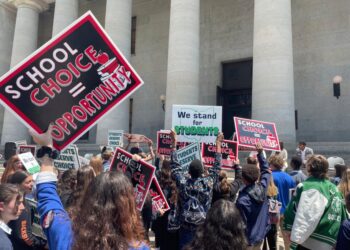
Though raising the minimum wage has long drawn support across party lines, in June, Oklahoma voters decisively rejected a measure that would have raised the state’s minimum from $7.25 to $15 by 2029. Opponents argued that the raise, plus automatic yearly increases tied to inflation, would have driven up prices and hurt small businesses. (The vote also came during a low-turnout June primary, when only about a quarter of registered voters cast ballots.)
That same month, Murphy introduced the Living Wage for All Act, outflanking Sanders’s Raise the Wage Act from the left. Murphy, who is also widely expected to run for president, has argued that Democrats should lean harder into economic populism to win back the working class. A $25 minimum wage is “the bare minimum of what workers deserve — and of what workers should expect from their leaders,” he declared in an essay accompanying his bill’s release. “It’s also what’s best for the health of our economy and country.”
Murphy and Sanders discussed the Living Wage for All Act earlier this year, a Murphy spokesperson told me, adding that “conversations among the caucus are ongoing as to how best raise the minimum wage across the nation.”
What the research says
A generation ago, efforts to boost the minimum wage ran into a recurring problem: a widespread consensus among economists that increases came with serious trade-offs, like fewer jobs and higher prices. And not just free-market conservatives, but more liberal economists like former New York Times columnist Paul Krugman, who in 1998 chastised activists who believed wages “can be set based on considerations of justice, not supply and demand, without unpleasant side effects.”
But that consensus quietly shifted over the years as more states and cities experimented with ambitious wage increases — and ran into fewer difficulties than expected. Proponents of a federal minimum wage of $20 or more often point to the work of Arin Dube, an economist at the University of Massachusetts Amherst and one of the most widely cited researchers on the topic. In a 2024 meta-analysis co-authored with Ben Zipperer from the left-leaning Economic Policy Institute, Dube reviewed nearly 90 studies and found that most showed minimum-wage increases raised workers’ total pay with little job loss.
Critics still point to places like Seattle and California as warnings, where studies have found that Seattle’s minimum-wage increase cut hours for low-wage workers and California’s $20 fast-food wage cost jobs, though other researchers dispute those findings. But in general, there were few glaring cautionary tales in a sea of state and local increases.
Dube says years of minimum-wage research, including comparisons of the 30 states that raised their minimums with the 20 that didn’t, have changed how economists understand the labor market. Economics 101 would suggest that raising labor costs means employers hire fewer workers. But many employers have enough power in their local job market to pay less than workers would earn elsewhere, so a higher minimum can raise pay without making those jobs unprofitable. “The idea is employers have some choice when it comes to setting pay,” Dube told me.
Paying workers more can also make it easier to hire and retain staff, and workers tend to be more productive when they’re paid more, he added. Dube said this helps explain why pay has grown faster in the 30 states that raised their minimums than in the 20 that didn’t, while job growth has been “virtually identical” across both groups, including in low-wage industries like restaurants and retail.
Some of the higher cost does get passed on to customers, Dube acknowledged, but not by much. “Maybe middle-class and higher-income families pay a little bit more for the burger,” he said.
In light of the research, progressive economists have begun rallying around a new federal target, to raise the federal minimum to two-thirds of the median hourly wage, or roughly $17 today and about $20 by 2030.
That would be “a fairly reasonable but strong minimum wage policy,” Dube told me, meaning a big enough increase to help millions of workers, but not so high that it would go “far outside of our evidence base.”
I asked Dube about Murphy’s bill, which mostly tracks the path he describes but would require big companies, those with at least 500 workers or $1 billion in revenue, to pay $25 an hour within five years. He said that could push their minimum above the two-thirds benchmark for a while, a “temporary overshooting” before it eventually lines back up with two-thirds of the median.
Murphy’s $25 figure is drawn from MIT’s living wage calculations, and his office also points to what the minimum would be worth if it had kept pace with inflation and productivity since 1968. “A minimum wage in the United States of America should be a living wage,” Murphy said when he introduced the bill.
In an interview, Patrick Oakford, the director of the Worker Power and Economic Security program at the Roosevelt Institute, a progressive think tank, told me supporters of a $20 wage were not working backward from a clear number, but instead chose the target based on the available evidence.
“Any rational person who looks fairly at this body of research can really only come to one conclusion, which is that raising the minimum wage does not lead to significant job loss,” he told me, even at two-thirds of the median.
Earlier this year, though, in a report Oakford authored, he also grounded the two-thirds target in what the minimum wage should accomplish: At that level, he wrote, a full-time minimum wage would get much closer to what it actually costs a single adult to live, and it would match the target the United Kingdom set and reached in 2024. As for critics who note that most US studies looked at minimums well below two-thirds of the median, Oakford argues that the studies that went higher, including of California’s $20 fast-food wage, haven’t found a cliff, a point where job losses suddenly spike.
“My read of the research is that two-thirds of the median is a legitimate upper bound, but more cautious approaches are also defensible,” Bernstein, of the Center for American Progress, told me.
How high is too high?
Other economists I spoke with were less supportive.
“Two-thirds of the median makes me pretty nervous, and numbers like $20 and $25 an hour are entirely ungrounded,” said Jason Furman, who chaired the Council of Economic Advisers in the Obama administration.
Furman agrees that small increases in the minimum wage haven’t cost many jobs, but in his view there’s little good evidence on bigger increases, and the federal floor should be built for the lowest-wage states, like Mississippi, since higher-wage states can always go further on their own. In lower-wage states, the concern is that the same $20 minimum would be a much bigger shock to employers, who would have to raise pay for a far larger share of their workers, and that’s where economists worry job losses are most likely to show up. Employers also may cut back on worker benefits — a major concern at the moment as health premiums soar — and job training. With AI threatening entry-level jobs, past evidence about whether employers turn to automation to replace low-wage workers may be a poor guide to what comes next.
Every economist I spoke with said there’s a point at which a federal minimum wage could be increased too much.
“To me all of this doesn’t say don’t do it, but to be careful and moderate,” Furman said.
Michael Strain, the director of Economic Policy Studies at the American Enterprise Institute, a conservative think tank, told me he thinks the employment effects of the minimum wage are “genuinely contested,” and he’s “skeptical of excessive certainty,” both from those who insist higher minimums cost no jobs and from those who warn of a surge in unemployment. Strain favors expanding the Earned Income Tax Credit — which costs the government money, but doesn’t affect employers — to help workers with the least experience and fewest options, and argues that the minimum wage is “counterproductive” for those individuals, since it can price them out of jobs.
Ryan Bourne, an economist at the Cato Institute, a libertarian think tank, would prefer no federal minimum wage at all, but says that if there has to be one, it’s best set locally, where policymakers have a clearer sense of their own labor markets. He argues that even if some employers do have the power to hold down wages, that power varies by industry and region, so it doesn’t justify one national number.
“If you’re talking about Eagle Pass, Texas; or Hot Springs, Arkansas; or Gadsden, Alabama, this is going to be a really, really big deal,” he said of a $20 or $25 federal standard.
There are examples abroad, too. In 2018 and 2019, South Korea raised its minimum wage nearly 30 percent, taking it from 53 percent to 63 percent of the median wage, close to the two-thirds benchmark. A Kansas City Fed study estimated the increases cut employment at manufacturing firms by about 3 percent. But the United Kingdom, by contrast, moved more gradually to around two-thirds of the median, and research has found no robust evidence that it hurt jobs, suggesting the pace of an increase may matter.
Every economist I spoke with said there’s a point at which a federal minimum wage could be increased too much. “There would definitely be a point where if the minimum wage is high enough, you would start to see more substantial changes on employment,” Dube told me. When I asked Dube what that too-high point is, he said no one knows, because no state has raised its minimum high enough to find it.
One option is to build guardrails into the legislation, like New York did. Under a 2023 law, New York’s minimum wage law has been indexed to rise with inflation, beginning in 2027, unless the economy shows signs of trouble. Earlier this fall, a small decline in jobs triggered that “off-ramp” for the first time, freezing the state’s minimum at $17 downstate and $16 upstate for 2027. (Gov. Kathy Hochul now calls the trigger too sensitive, and has proposed loosening it.)
Bernstein of the Center for American Progress summed up the dilemma. “It’s hard to know where the line is,” he said, “until you cross it.”
The post Democrats could raise the minimum wage next year. How high should they go? appeared first on Vox.