Jakob Jordan never thought he would star in an opera. Jordan, an actor, is autistic and has apraxia, a condition that makes it difficult to regulate his speech. In daily life he communicates with a keyboard and voice synthesizer, and he uses a wheelchair. In 2025, he became one of two nonverbal actors to star in the world premiere of Paola Prestini’s sci-fi opera “Sensorium Ex” at the Common Senses Festival in Omaha.
The opera gives its disabled protagonist a voice with help from custom-built technology, Sensorium AI, that not only allows Jordan, 24, to control what he says, but also how and when he says it. Using this technology in “Sensorium Ex” was the first time Jordan heard his own voice clearly, an experience he described as “pure happiness and unbelievable relief.” He can even sing. Or sound like a bird.
This week, Jordan will revive his role in excerpts from “Sensorium Ex” presented at National Sawdust, along with two other works that consider the past and future of opera and disability, for the inaugural Makemake festival. The festival, Tuesday through Thursday, lays bare the challenges — and possibilities — that arise when making disability-inclusive opera.
Limited rehearsal time, tight budgets and inflexible spaces create serious obstacles for companies seeking to make inclusive productions.
But these aren’t the only reasons that opera lags behind other performing arts in adapting to disability access. Joseph N. Straus, a professor of music theory at CUNY and a leading scholar in music and disability studies, said one problem was how classical music places the score’s demands over “human fragility.” Such thinking, he said, can result in “impoverishment, because the full range of human experience is denied.”
Prestini, though, said she saw it as an extraordinary opportunity when the poet Brenda Shaughnessy presented her with the libretto for “Sensorium Ex.” “There is a character who doesn’t speak in the opera,” Prestini said. “He communicates in a different way. How was I going to do that?”
Kitsune is inspired by Shaughnessy’s son, who was born with cerebral palsy and cannot speak or walk. Prestini and Shaughnessy insisted from the beginning that Kitsune be played by a disabled actor. To make it work, they needed an alternative to existing voice synthesizer programs, one that would work in time with the score and produce a voice with nuanced inflections and a unique timbre.
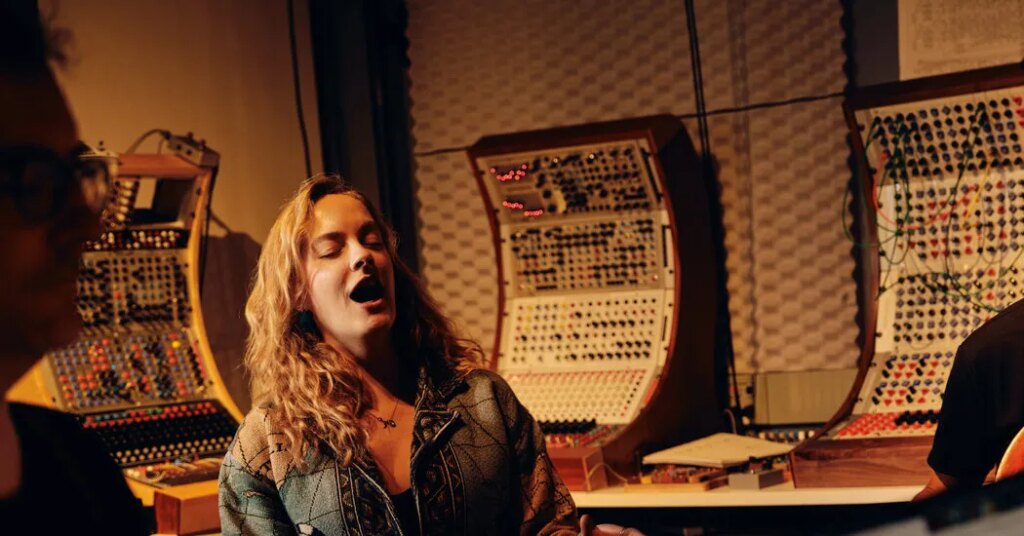
Developed in collaboration with R. Luke DuBois at the N.Y.U. Ability Lab, Sensorium AI converts the sonic signatures of an actor’s available vocalizations into a fully realized, expressive voice program. While the algorithms involved are complicated, the onstage mechanism is commonplace: The sensors that trigger the actor’s line delivery are the same ones that power backup cameras on automobiles.
“I have three sensors on a stand,” Jordan said in an interview. “When I have a line, it has my voice preprogrammed. I wave my hand over one sensor that trips my line. The other sensors control the pitch and speed of my line. So, I have a lot of autonomy in how I deliver my performance.”
How to give disabled people vocal autonomy is more than just a practical question. It is at the center of “Sensorium Ex.” Kitsune and his mother, Mem, are faced with a difficult choice. The corporation that employs her and provides for Kitsune’s care wants to extract his genetic material to develop a humanoid AI program. To refuse means Kitsune would lose access to medical care. Mem insists that the choice must be Kitsune’s.
“That’s really the whole essence of the plot,” Shaughnessy said. “How can we get to a place where the person who has the least say gets to choose what they do?”
Developing “Sensorium Ex” required seven years of work and significant institutional support. The festival is presenting excerpts; mounting a full production — and making it accessible — in New York City would cost around $500,000, but Prestini said she was working to secure the funding.
Centering disability in all aspects of an opera’s production can transform how audiences see canonical works. Instead of something to be overcome, disability can be a “creative, generative force,” said Greg Moomjy, the artistic director of Opera Praktikos, whose “La Sonnambula” is part of the Makemake festival.
This version of Bellini’s “La Sonnambula” highlights the story’s issues of misunderstanding and discrimination. Amina (Aja Nile-Brimm) comes under suspicion when her sleepwalking lands her in compromising situations. Opera Praktikos’s production makes Amina’s narrative one about coming to terms with disability.
By further retooling the libretto to make Amina’s romantic rival Lisa (Treshelle Edmond) a deaf character, the production brings opera into conversations about varying experiences of discrimination — a big shift for the usually silly “Sonnambula.”
The presence of a deaf character also asks audiences to rethink the nature of the operatic voice. Could voice be visible, as well as audible? ASL has grammatical parameters. How signers use those parameters, “that is our intonation,” said Brandon Kazen-Maddox, who serves as the onstage interpreter in “Sonnambula.”
Some of the difficulty in making opera more inclusive comes down to an often-rigid vision of what opera “should” look like. Artists fear that disclosing an invisible disability could derail their careers, while visibly disabled performers may not be cast in the first place.
Hailey McAvoy, a mezzo-soprano reviving her role as Mem in “Sensorium Ex” and starring in her own music-theater piece, “Wholly Unwinding,” for Makemake, has cerebral palsy. When she expressed access needs early on in her career, she said she was sometimes met with resentment or assumptions about her capabilities — even with requests as minor as asking to wear a different pair of shoes.
Going to the opera, she said, should be about “the unique voice that is intrinsically connected to the heart and soul of an artist.” And those, she added, should be “maximally free.”
McAvoy found that freedom studying the Alexander Technique, a practice that emphasizes mind-body attunement. It was then that she began to write her pop-meets-chamber-music memoir detailing how she claimed her identity as an artist with cerebral palsy. “Wholly Unwinding” is designed for maximum accessibility. (New performers can transpose the songs or rewrite the libretto to suit their experiences.)
Change is slow, but for the artists involved in the festival, opera is the ideal space to consider disability. Opera “hits hardest,” Prestini said, “because the instrument is the body. It’s a direct line of communication.”
Makemake festival, Nov. 17-20, National Sawdust, 80 North Sixth Street, Williamsburg, Brooklyn, (sliding scale tickets from $5); nationalsawdust.org.
The post A New Festival Embraces the Possibilities of Disability-Centered Opera appeared first on New York Times.