The cascade of failures that led to the grounding of U.S. air traffic on Friday began with what officials say was supposed to be a routine router upgrade at a radio facility in El Dorado, Ark. The station was remote enough, they figured, that they could do the work without causing undue harm.
But that swiftly proved to be a gross miscalculation.
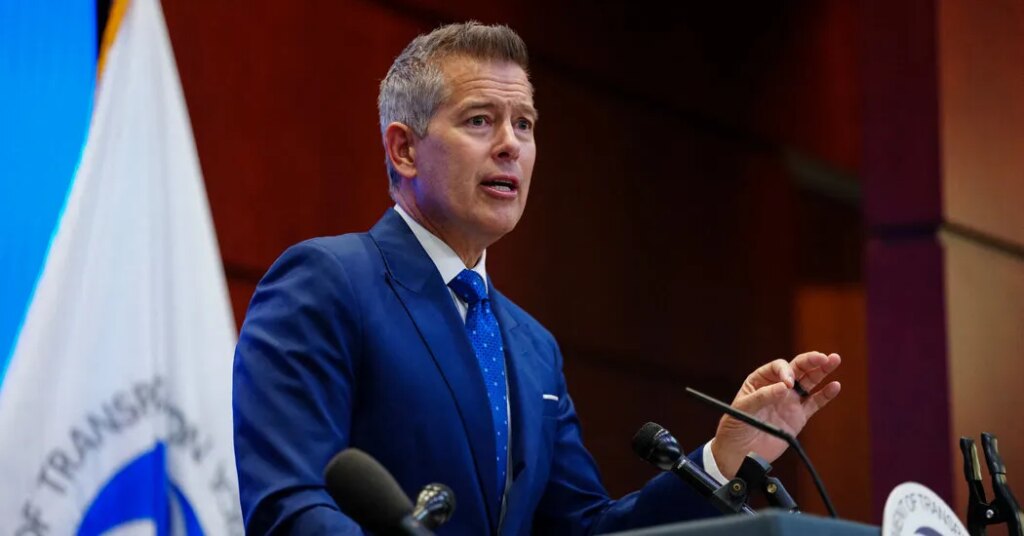
The effort to upgrade the Federal Aviation Administration’s antiquated copper-wire-based system to fiber optic cable in Arkansas occurred as the agency officials noticed a second issue with a radar facility in Amarillo, Texas, where such work had been done weeks before, Transportation Secretary Sean Duffy said Sunday morning during a blitz of appearances across network and cable television.
Officials took the two facilities offline shortly after, but not before each had pinged the network with an abnormally high rate of connections. That prompted failures in other parts of the air traffic communications network that forced officials to declare a rare nationwide ground stop, Rebecca Guy, the F.A.A.’s chief technology officer, told reporters on Saturday.
But agency investigators still have not determined whether a faulty part or an error on the part of L3Harris, which owns the telecoms system in question and is responsible for upgrading and maintaining it, caused the initial problem in Arkansas. And Mr. Duffy said they are equally unsure why the facility in Amarillo failed on Friday when no upgrade work was being done there at the time.
The protracted crisis, from which airlines have yet to recover, and the lack of clarity from Trump administration officials about why things went wrong, have revived questions about whether the F.A.A. is equipped to carry out its plan for modernization without creating more risks for the nation’s air traffic control system.
The crisis has also heightened concerns about durability and the lack of backups in the nation’s critical air traffic infrastructure, if a failure at one small facility is enough to bring the functionality of the entire network down.
During an interview Sunday on NBC’s “Meet the Press,” Mr. Duffy said he could not guarantee that a meltdown like Friday’s would not happen again.
“First we have to figure out what happened,” he said, adding, “We’re going to figure out what was the root cause and then move forward from there, fixing how we do business at the F.A.A.”
He also deflected when asked if he was ultimately responsible for the meltdown and owed air passengers an apology.
“I can’t apologize for what was passed on to us,” he said, accusing prior administrations of having failed to tackle known infrastructure problems.
“I don’t apologize for shutting down the airspace and keeping people safe,” he added.
Skepticism surrounding how the F.A.A. has been carrying out its air traffic modernization plan is not new.
In September, the Government Accountability Office, a nonpartisan watchdog agency, issued a report raising concerns that the F.A.A. was in danger of “prioritizing speed over costs and air traffic disruptions” as it pursued its modernization plan. The report also criticized the agency for not having coordinated the schedules of 11,389 upgrade projects and not having conducted life-cycle cost estimates of existing technology, noting that “without them, the agency could end up causing air traffic disruptions or prolonging reliance on severely outdated systems.”
But such questions are especially pertinent since Mr. Duffy chose to seize on Friday’s meltdown by demanding that Congress give him $50 billion in new funding for air traffic control upgrades by the end of the year. That is a drastically larger sum than he has asked for before — and one that many lawmakers say he has not shown he would responsibly spend.
“It’s really rich to hear the secretary pointing the fingers at Congress when Congress has given the administration what they asked for,” Senator Chris Van Hollen, a Maryland Democrat running to become majority leader, said on CNN’s “State of the Union.” “If they need more, they should come up and justify it.”
On Saturday, the White House put its weight behind Mr. Duffy’s ballooning demand for funding, and on Sunday, President Trump weighed in on social media to claim that his administration could build the “BEST SYSTEM anywhere in the world,” urging Congress “to give the money, FAST!”
But Mr. Trump dedicated more of his attention to blasting the Biden administration for the F.A.A.’s air traffic infrastructure problems than detailing what $50 billion more would pay for.
Mr. Duffy also has yet to itemize his $50 billion request. For several weeks, he has been calling for a $30 billion influx in F.A.A. funding, but only about $10 billion of that request was specifically for air traffic modernization. Another $10 billion of the funds was envisioned for airport beautification, and the last $10 billion for improvement projects at towers, terminals and airports.
Last year, Congress appropriated $12.5 billion for air traffic modernization, nearly two-thirds of which lawmakers dedicated for telecoms upgrades and radar replacements.
On Saturday, Bryan Bedford, the F.A.A. administrator, told reporters that his agency would need “about $10.1 billion to finish modernization,” on top of the $12.5 billion Congress already appropriated.
On Sunday, Mr. Duffy said that while the money his department has requested will go to pay for needed radio and radar upgrades, it will not cover all the costs of upgrading a telecom system reliant in some places on 1980s wiring and routers from 2001 that have long been obsolete.
“What I don’t have money for is the new telecoms system; I don’t have money for new software,” Mr. Duffy said on CBS’s “Face the Nation.” “Those are critical pieces to the new infrastructure and it’s been historically underinvested in.”
The post Duffy Offers New Details on How One Fix Spiraled Into Nationwide Ground Stop appeared first on New York Times.