Trash everywhere. Graffiti-covered storefronts. Muggings on the subway. This version of New York is how moviegoers came to understand the city in the 1970s, prompting following generations of filmmakers to put their spin on the crime drama in Gotham, from the Oscar-winning “Anora” to the frenetic films of the Safdie brothers.
Two new films in theaters now, “The Only Living Pickpocket in New York” and “Paper Tiger,” find clever ways to navigate familiar thematic territory: Both follow small-time crooks and confidence men encountering a shifting landscape of organized crime that ensnares their families, built on acclaimed performances by John Turturro and Adam Driver, respectively.
James Gray, who wrote and directed “Paper Tiger,” remembers New York as a city in decay. Born and raised in Queens, the 57-year-old filmmaker will tell you about burning garbage cans and dirt caking everything. It was a time when Times Square was somewhere you “didn’t go if you had your head about you.”
The characters in Gray’s films, such as his 1994 debut, “Little Odessa,” and 2007’s “We Own the Night,” don’t have to look far to find New York’s seedy underbelly. Corruption and bribery are commonplace; the New York Police Department is at best broken, at worst bent. By focusing on the world of criminals, Gray said, filmmakers examine the extremes of human behavior.
“The limits, the line of our behavior — what is tolerated and what isn’t — is an unending source of fascination because it becomes an object or an idea of our fetish,” Gray said in a video interview with The Washington Post. He noted that audiences sometimes fantasize about living outside of governing rules. “We obsess over it: You can do that, but you can’t do that.”
New York’s lawbreakers have been movie subjects since the earliest days of Hollywood. Such films provide a peephole into a world unfamiliar to most moviegoers, helping the New York crime movie remain evergreen while recycling perennial appeals and tensions.
Even as New York’s homicide rate has dropped over the decades, millions of residents still have a fragile economic existence. “Paper Tiger” and “Only Living Pickpocket” portray members of different social classes crossing paths after they’re caught in unseemly circumstances — a working-class engineer and a Russian mob leader in the former, an aging pickpocket and his mark, a Wall Street businessman, in the latter.
“Maybe the criminals change and the crimes themselves change,” said Noah Segan, the 43-year-old who wrote and directed “The Only Living Pickpocket in New York.” “But to deny the hard-boiled nature of New York is to deny its history — that means yesterday and a hundred years ago.”
Moviemaking in the city changed dramatically in the mid-1960s. By reducing the number of permits needed to shoot in city-owned locations and helping the film industry secure rights to shoot at private locations, Mayor John Lindsay ushered in a wave of films shot on location.
These new rules, according to Jason Bailey, who wrote the book “Fun City Cinema: New York City and the Movies That Made It,” helped filmmakers add a layer of authenticity to their works.
Lindsay’s adjustments also meant that the “cleaned-up version” of New York on the silver screen went out of style as the city faced financial crisis and rising crime rates, Bailey said. “There was much more freedom to reflect the reality of daily life.”
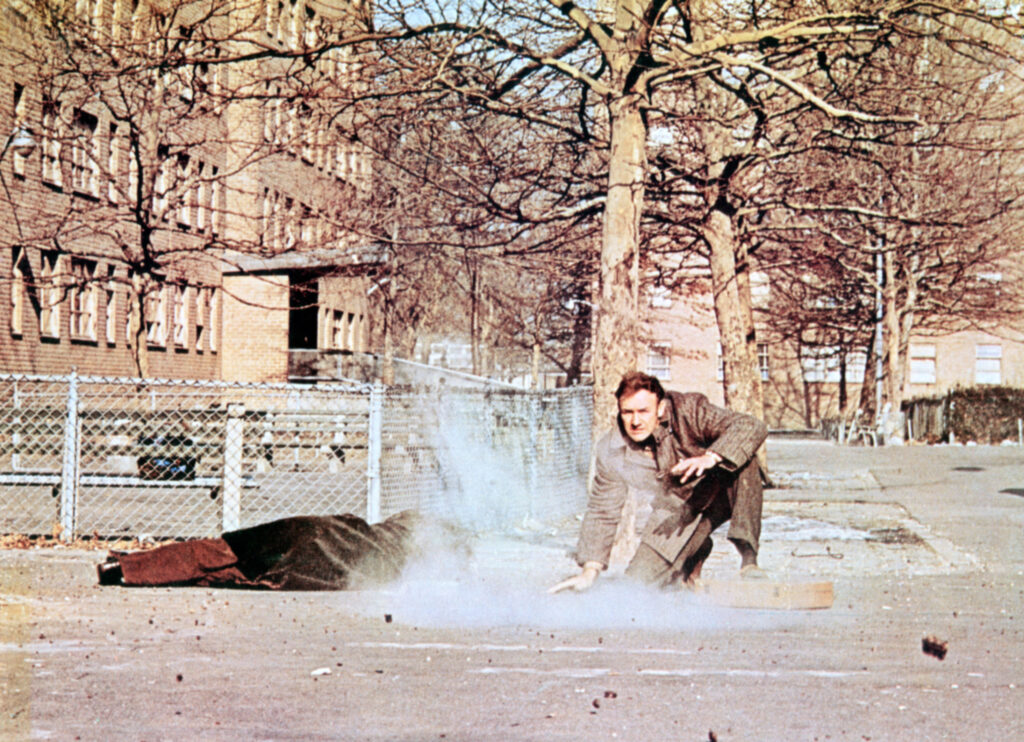
In the 1970s, a new image of New York took over cinemas — and the imaginations of the rest of the country. A grimy, dangerous, gloomy city existed in “The French Connection,” “Taxi Driver,” “The Godfather” and other crime staples of that era. It’s a perception of the city that persists, Gray said, recalling a conversation with his brother, who still lives in New York.
“I’ll call him and I’ll say, ‘How’s everything going? Did you go into the city today? How’s New York?’ And he’ll say, ‘Well, today’s a “French Connection” day,’” Gray said. “And I know exactly what he means. It’s cold. It’s blue. You can see the water vapor out of your mouth.”
“Paper Tiger” is Gray’s seventh film set in New York — and fourth crime feature among that set. It’s an almost explicitly autobiographical work: Filmic counterparts for Gray’s father and uncle (Miles Teller and Driver, respectively) try to launch a consulting business and end up embroiled with the Russian mob.
Gray returns to the New York crime movie because he relishes exploring who holds power in an economic system — and city — where everyone is desperate to get ahead. “Crime films allow you to do that with some level of majesty because it’s the closest thing we have to kings and queens today — mafia dons, drug kingpins,” Gray said. “That’s the extremes of royalty, the layers and the strata of class.”
In “Paper Tiger,” there’s a sense that the New York of the silver screen, full of criminals and mafiosi, has somehow arrived at the home of a well-intentioned family living in Queens in 1986. “It feels so much like real people encountering the criminal element that they’ve seen in the movies,” Bailey said, “and finding it genuinely terrifying.”
“The Only Living Pickpocket in New York” charts the shifts and changes of the present-day city through Harry, a longtime pickpocket who struggles in a cashless era. The role is taken on with a weary, old New York sensibility by Turturro, a veteran of Spike Lee’s films.
One of the genre’s timeless allures, Turturro said, is their depictions of the standards that these crooks live by. “They have their own moral code: A pickpocket doesn’t rob a drunk, or a handicapped or a really old person,” he said. “They look for a mark who has money.”
When first reading the script, Turturro instantly recognized the lineage of films that “Pickpocket” follows. But he also appreciated how Segan found ways to circumvent familiarity. “It has a radical delicacy to it because the violence is off camera and the cost of it is on camera,” Turturro said.
To assist with the film’s verisimilitude, Segan built a cast of familiar New York actors, including Turturro, Steve Buscemi and Giancarlo Esposito.
“These people are as New York as the Flatiron building, as A&H hot dogs, as the subway token, as Air Force 1s,” Segan said. It doesn’t hurt that Harry ends up traveling through all five boroughs in one day, either.
Still, working in a style as easily recognizable as the New York crime film, you only have to subvert the tropes so much, Segan said. That image of New York — where backroom deals and shadowy figures reign supreme — is still compelling on its own.
“The biggest departure — no pun intended — that we engage in this movie is that he always makes his train on time.”
The post New York’s mean streets are still a big attraction at the movies appeared first on Washington Post.