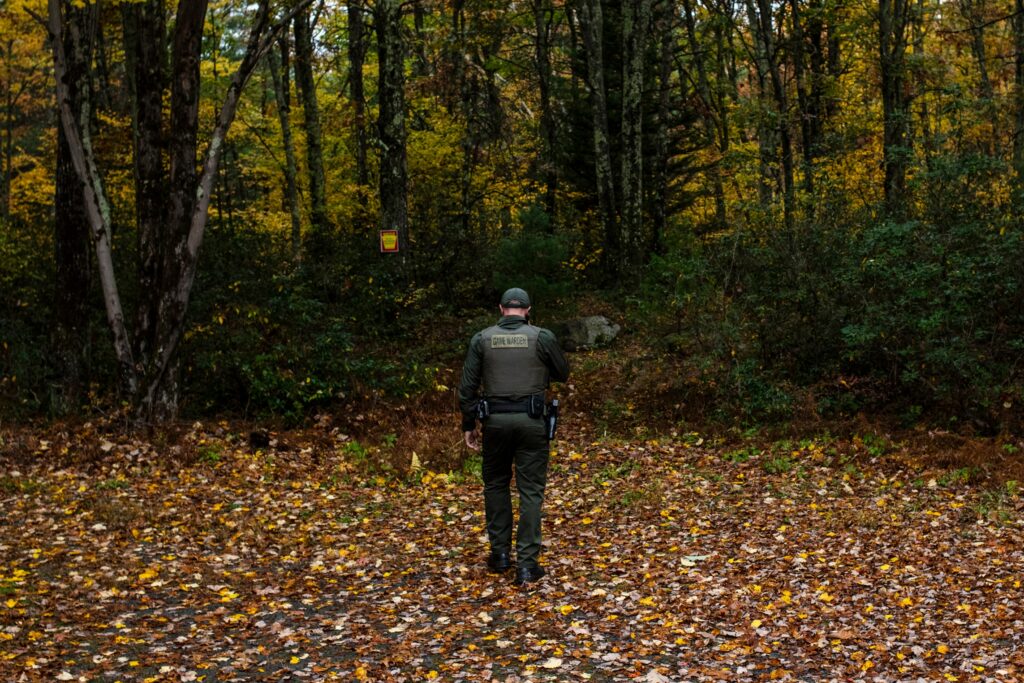
MILFORD, Pa. — Sgt. Bryan Mowrer flipped open his computer so he could navigate the boundaries between public and private land as he drove. Maps on the screen showed property lines changing multiple times within a half-mile.
As a state game warden, Mowrer is tasked with protecting wildlife and enforcing hunting laws in this rural swath of the Pocono Mountains. After the state Supreme Court issued a landmark ruling this summer restricting game wardens from searching private property without warrants, Mowrer said the job has changed.
The new limits empower property owners but could weaken game wardens’ ability to monitor vast stretches of nature — resources Pennsylvania and many other states enshrine in their constitutions as belonging to all residents, whether they live in an inner city high-rise or a mountaintop cabin.
Across Pennsylvania, Mowrer and about 240 State Game Commission wardens feel constricted and confused as a growing property-rights movement tests the limits of privacy protections against warrantless searches. The dispute pits some hunters and property owners against wildlife officials, dividing communities over how to police hunting in a region where the sport is deeply embedded in the culture.
For decades, game wardens in many states had relative free rein to enter forested private land to try to protect wildlife that doesn’t yield to property lines. The concept — known as the Open Fields Doctrine — has been upheld twice by U.S. Supreme Court decisions that determined the Fourth Amendment does not grant a right to privacy on open, outdoor land.
Yet in a rapidly expanding legal campaign, a Washington-based libertarian organization is moving state-by-state to try to uphold landowners’ rights against game wardens it believes are responsible for government overreach.
The Institute for Justice has successfully challenged the practice under state constitutions in Tennessee and Pennsylvania, with lawsuits pending in Louisiana and Alabama. Idaho passed similar restrictions this year, and the group expects more state challenges next year.
“We are going state-to-state trying to get state courts to interpret their constitutions in a way that protects private property owners from unfettered search and surveillance power,” Joshua Windham, an Institute for Justice lawyer, said in an interview. “There are a lot of states where we will be eager to see this issue move forward over the next few years.”
Those conflicts are now playing out in rural communities like Milford, a town of about 1,100 on the Delaware River surrounded by rocky and forested land that has been a haven for generations of sportsmen.
Local residents said the area has a persistent problem with hunters who flagrantly violate wildlife laws, including poaching and luring game animals with food.
Two hunting clubs in central Pennsylvania sued with the Institute for Justice’s support, accusing game wardens of entering their property without permission and harassing members. At the century-old Punxsutawney Hunting Club, the plaintiffs alleged that the game commission set up a camera that captured members’ activities without permission.
“You think you are free from an invasion of outside people, but no you are not,” said Jeff Fink, president of the 4,400-acre Pitch Pine Hunting Club in Punxsutawney, which also joined the lawsuit. “They just wandered on whenever they wanted to.”
Col. Richard “Rod” Danley, director of the Pennsylvania Game Commission’s Bureau of Wildlife Protection, denied that state game wardens were entering the Punxsutawney properties uninvited and said no one had been spying on hunting club members.
He said the unanimous ruling by the Pennsylvania Supreme Court in July had put the game commission in an uncomfortable position, raising doubts about how effectively wardens can protect wildlife.
Before the ruling, game wardens could generally enter private property without a warrant to regulate hunting and research and care for animals. The policies did not extend to areas of curtilage — loosely defined as private residences, porches or property that was mowed or maintained by homeowners.
Wardens now need warrants to enter any private land that is clearly marked as off-limits to the public with signs, paint, fences or gates. There are exceptions in cases of life-threatening emergencies or if wardens can clearly observe illegal behavior from a public position.
“The inability to go onto properties that are posted is really going to curtail how effective our officers can be at making sure everyone is following the rules,” Danley said. “There are now a lot of questions about what we can do.”
Pennsylvania has one of the highest concentrations of hunters on the East Coast, and about three-quarters of the state’s land is privately managed.
Archery and muzzleloader hunting season started last month. Rifle hunting season for black bears and deer starts this month.
Public lands including the Delaware State Forest occupy much of the area that Mowrer patrols in his state-issued Chevy Tahoe, but private cabins and campgrounds, neighborhoods with active homeowners associations and sprawling hunting clubs dot his maps.
When a call for an injured deer came over the radio on a recent morning, Mowrer wondered whether game wardens would need to get a warrant to enter the property to euthanize the deer.
“Before, I could go onto land, posted or otherwise” and euthanize the deer, he said. “Now, what if the deer is on private property?”
As Mowrer turned down a bumpy, unpaved road, he noted that state game wardens spend considerable time investigating complaints that hunters are using food to lure animals.
Hunting with bait is illegal in Pennsylvania. Previously, Mowrer said he could investigate tips on private property by walking into the woods to look for food that was used to attract animals. He would then frequently return to the location to see if he could spot anyone hunting.
Now, he said, he likely can’t do that without presenting evidence to get a warrant.
Mowrer checked to make sure a group of archery hunters on state land had valid licenses. From there, he headed to a game commission facility where hunters must register any bear kills.
Within minutes, a man arrived with a female bear he had shot with an arrow. It was the seventh bear killed by archery hunters in Pike County this year.
At the check-in stations, hunters report where they harvested the bear. Mowrer said game wardens would sometimes travel to that location to investigate the kill. Although he stressed that the vast majority of hunters adhere to game laws, occasionally they’ve found that hunters have gone as far as using “cotton candy flavored vapes” to attract bears.
“Now, if it’s posted private property, we can’t go look,” Mowrer said.
Game wardens also track tagged animals for research or help them when they are injured. Without consent from a property owner, Mowrer said disputes can arise over whether game wardens can conduct such research on private land.
“What are our wildlife team’s rights to recover … a $3,000 telemetry collar?” Mowrer asked.
The night before, wardens got a call about a suspected hunter using a spotlight to find and shoot deer at a golf course. They were able to investigate the complaint, but Mowrer wondered what would have happened if the call had come in hours later.
“What if that incident happens at 12:30 at night?” Mowrer asked. “How long is it going to take me to get a warrant for that?”
Last year, the Pennsylvania Game Commission responded to about 219,000 incidents and arrested or cited 5,540 people.
As they assess the impact of the court ruling, Pennsylvania officials have looked to Tennessee, where a similar decision was issued in 2024. Emily Buck, director of the Tennessee Wildlife Resources Agency, said the data is preliminary but “there is a very real likelihood that there are poaching cases going on that are not caught because of this change.” She also said officer morale has declined due to a widening divide between wardens and the property owners who supported the lawsuit.
“They care deeply about this work,” Buck said of her state’s game wardens. “A lot of the commentary we saw from the public and the media was that our officers had been doing something wrong … So it was definitely challenging.”
In Milford, debate over the Pennsylvania Supreme Court ruling also divides residents in a town with deep ties to the conservation movement. The town was home to former Pennsylvania governor Gifford Pinchot, known as the “father of the U.S. Forest Service.” Pinchot’s 100-acre property here is now a federal landmark.
But at Patriot Arms and Munitions, owner Theo Balu said many local hunters welcomed the ruling, believing game wardens had been “trampling on rights” by entering private land.
“It was almost coming down to people feeling like they were being entrapped,” said Balu, a hunter who lives on 400 acres of land. “People feel like they are getting some of their rights back.”
At Old Mill Tactical Outfitters, another gun store in Milford, owner Bob Kraus said he has mixed feelings about the court ruling.
Kraus, 64, likes to shoot “machine guns” that can fire more than 1,000 rounds per minute. But Kraus, who doesn’t hunt, “loves animals” and wants wildlife to be protected. He said he’s even heard stories of hunters who will sneak up to hibernating bears, detonate fireworks to scare them out of their den, and then shoot them as they flee.
“So how do you catch these guys?” Kraus asked.
Still, Kraus said his own experience with a game warden about 25 years ago makes him sympathetic to landowners concerned about their rights.
He recalled how a game warden once accused him of riding his ATV on nearby state game lands and arrested him in his driveway after he refused to show his identification.
“He came onto my property and demanded my driver’s license,” Kraus recalled. “He proceeded to cuff me … Why should game wardens have more authority than the state police?”
August Metz also values his privacy on his eight acres along the Delaware River, where numerous trees are marked with “no trespassing” signs.
Metz, 81, said he has known since childhood that some in Milford hunt illegally, including at night or without valid hunting licenses, and he supports efforts to protect wildlife. But he said wardens should “have a practical, viable reason” to enter private land.
“They can’t just decide, ‘Oh, I am riding past, and there is Metz’s house, so I think I will walk all over his property,’” he said.
But Mowrer noted that the incidents he and his colleagues encounter are not always “black and white.”
At the check-in station, Mowrer inspected the slain bear as game warden Patrick Sowers returned from a call. He had just cited a man for shooting a deer from his vehicle in a nearby neighborhood.
Just then, another call came over the radio. A resident suspected the same man was once again shooting deer.
“You get these individuals who are just looking to thrill kill,” said Sowers, 35. “Sometimes people can’t help themselves.”
As Sowers left to find the man, he referenced the court ruling.
“We will adapt and overcome,” he said. “But on its face, this change is going to make our job harder and it’s going to take time to figure out how we do our job to the same level that we did before.”
Mowrer knows even a short-term disruption to the work will have consequences.
“Whenever you kill something, you can’t get it back,” he said.
The post Game wardens once crossed property lines. A legal movement is stopping them. appeared first on Washington Post.