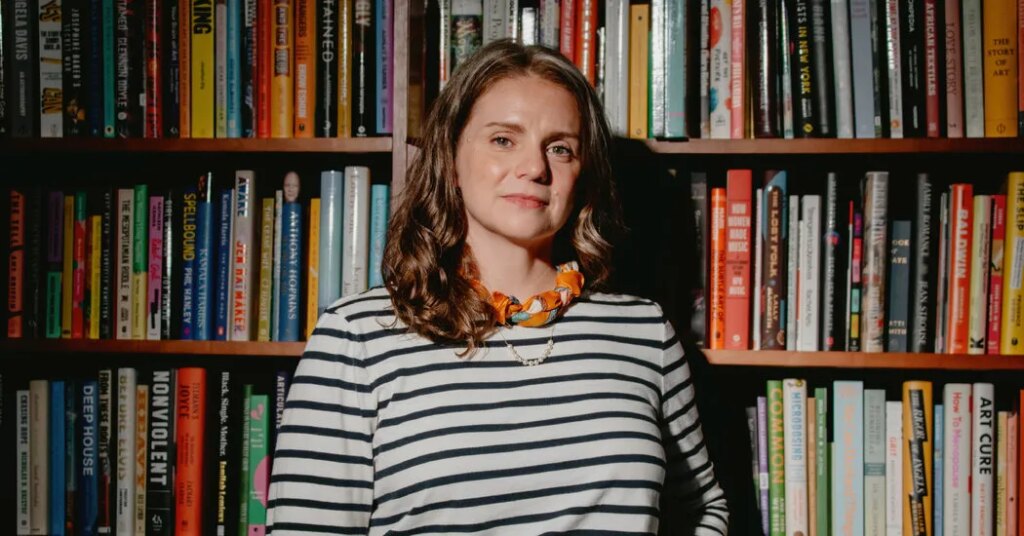
Ahead of the release of “Write Through It,” her publishing guidebook, in 2025, the literary agent Kate McKean began hosting Q. and A. sessions at Liz’s Book Bar in Carroll Gardens, Brooklyn.
The aspiring authors who attend these sessions are keen to pepper McKean with questions: How does one make a submission stand out from the rest? How important is a social media presence? When should you query a manuscript? How do you rise to the top of the stack?
At an event earlier this year, McKean heard from one writer who had received nearly 800 rejections, and another who had submitted her manuscript to agents for years without success.
McKean didn’t hold back. Publishing is a business, she explained, and book deals happen because publishers need to make money.
“If you’re mad at the system, I’m sorry,” she said. “But you don’t get a book deal because you deserve it.”
Since 2019, McKean has doled out candid advice about publishing in her newsletter, “Agents and Books,” which has around 34,000 subscribers. Its name is on the front cover of her book, just below her own.
As long as there have been literary agents, those agents have coached writers through their careers as much as they have brokered their deals. Now, more agents are embracing public platforms to offer tips on how to navigate a notoriously opaque industry — and to build their own brands.
It isn’t unprecedented for agents to harbor literary ambitions, though historically, their contributions to the publishing world have mostly been behind the scenes. But in an overcrowded literary market where it’s increasingly difficult to ink a traditional book deal, they have taken on a new role alongside broker and coach: influencer.
“It feels weird when the light gets shone on us, even if we’re the ones shining the light, because it’s not what the job is,” said Laura Zats, who founded Headwater Literary Management with Erik Hane in 2019. The two agents also host a publishing podcast, “Print Run.”
Alia Hanna Habib, an agent at the Gernert Company, asked her colleague Meredith Kaffel Simonoff to represent “Take It From Me,” her book about building a nonfiction writing career. The two shared a passion for helping authors decode the industry, Habib said. (They met on a panel devoted to the subject.)
Habib knew that a public platform would be a useful marketing tool for her book. In 2024, she started the Substack newsletter “Delivery and Acceptance,” for which she interviews editors, agents, authors and booksellers.
“The impetus wasn’t primarily building a platform for myself, but rather wanting to demystify an industry to make it a little more inclusive and accessible,” said Habib. “It’s also to make the world of books not seem like it exists up on Mount Olympus.”
A few months after Pantheon bought “Take It From Me,” Habib sold a book for a client, the scholar Laura B. McGrath, that was also about literary agents. Called “Middlemen,” it studies how agents have shaped the literary canon since the 1950s. Both books were released this year.
McGrath, whose own book explains things people might not know about agents and their work, thinks it’s good that agents are showing more people what’s behind the publishing curtain.
“Few writers can actually succeed at making a living as a writer,” she said. “Writers need to be really cautious of the advice that they’re getting, because there are so many people who are willing to monetize their desperation.”
A decade ago, many agents found clients and built personal brands by offering advice on Twitter. The more professionalized formats of nonfiction books, podcasts and newsletters allow them to reach more dedicated audiences — and can be lucrative second lines of business for agents, who work on commission.
It makes sense for some agents to turn their often-invisible work — which includes everything from editing early drafts of manuscripts to coordinating with publishers’ marketing teams — into content, and then into an income stream. But those who find ways to monetize their expertise beyond their clientele say it’s important to be mindful about how that could be perceived.
“I want to make sure what I’m doing is not presenting myself as the talent versus the helper to the talent,” said the agent Anna Sproul-Latimer. “I don’t want to be somebody who’s seen as spending more time on herself than her clients.”
Sproul-Latimer founded Neon Literary with Kent D. Wolf in 2019, and she writes the agency’s newsletter, “How to Glow in the Dark,” on Substack. She said she spends about five to 10 percent of her time working on the newsletter each week — and that its subscription revenue pays for most of Neon’s operating expenses.
Zats and Hane have a Patreon where writers can pay to receive access to “premium episodes” of their “Print Run” podcast, which is otherwise free to listen to. They also host free office hours for any writer or “book person,” subscriber or not.
“We’re trying to work against the gatekeeper role,” Hane said. “We can’t help everybody by representing them. What we can do is spend an hour a month to talk you through a thorny situation.”
The writer Jessica Liese used McKean’s newsletter to guide her through submitting her novel to agents. She was rejected 94 times, but, buoyed by McKean’s advice, she kept going — and recently signed with McKean herself.
“If I didn’t know how it worked and to expect that much rejection, I might have given up,” she said.
For Habib, it was illuminating to go through the process of publishing a book not as an agent, but as an author worrying about meeting deadlines and whether anyone would show up for her book events.
“It’s made me even more empathetic to how vulnerable publishing a book makes you. I get that in a bone-deep way now that I probably couldn’t have without having done it,” she said. “When you’re behind the curtain, it’s different.”
The post Literary Agents Have Something New to Sell: Themselves appeared first on New York Times.