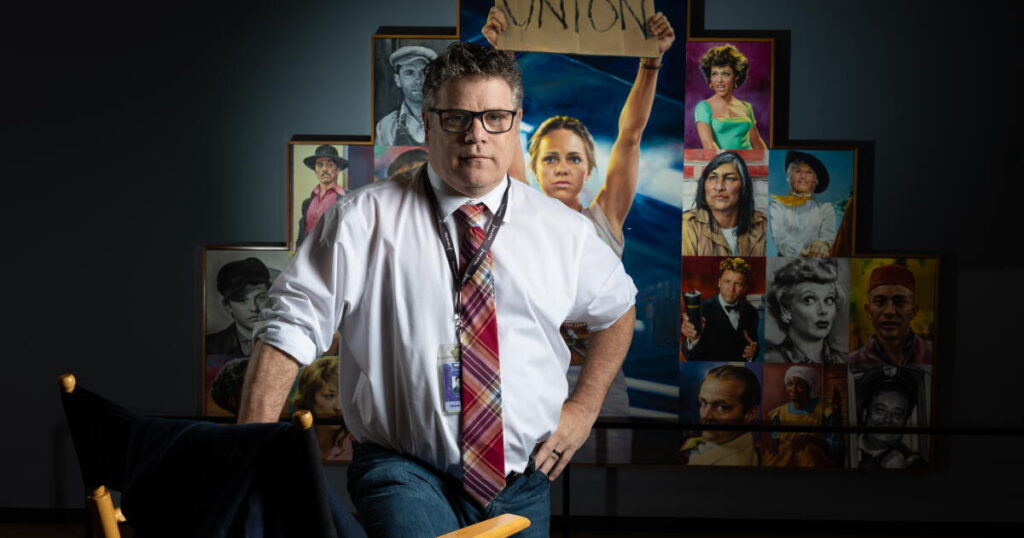
Sean Astin rested on the couch of his spacious office at SAG-AFTRA’s national headquarters high above Wilshire Boulevard. He glanced at a wall lined with movies posters from his most popular films and gestured to one from the 2007 sports movie “The Final Season,” in which he plays a high school baseball coach who gives an important pep talk to his team before they win their last game.
“I go, ‘It’s final season,’” Astin said. “‘How do you want to be remembered?’”
It’s a question Astin asks of himself, having completed his first year of a two-year term as the union’s national president, succeeding Fran Drescher.
He’s following in the footsteps of his late mother, Patty Duke, the former president of the Screen Actors Guild from 1985 to 1988 who won an Academy Award for playing Helen Keller in the 1962 movie “The Miracle Worker.” As a child, he recalls walking the picket line with his mom. To honor her legacy, he also keeps photos of her in his office along with a framed copy of her SAG business card.
“She always seemed to believe that she could make a difference in people’s lives,” Astin said in a recent wide-ranging interview with The Times.
Astin, 55, is best known for playing underdog characters in movies such as “Rudy” and “The Lord of the Rings,” who overcome great odds.
Now, he’s in one of his most challenging roles yet as leader of about 160,000 SAG-AFTRA members, many of whom are alarmed about diminishing work, industry consolidation and the rise of artificial intelligence. A central focus as president is to bring jobs back to the U.S. — a tall order given the steady exodus of film work to other countries.
Astin met with lawmakers in Washington in September to support the proposed bill creating a federal tax credits for movies and TV shows filmed in the U.S. He also spoke out against Skydance’s $111-billion acquisition of Warner Bros. Discovery, which was finalized last month.
“Any time big companies like this merge, it costs jobs,” Astin said. “It’s bad for labor. Period.”
In a recent speech to the union’s national board, Astin acknowledged the tough climate for members.
“There’s … a palpable disconnect between the work of this union and the lived experience of too many of our members,” Astin said in his speech. “For many, the question is no longer how to advance their careers, it’s whether they can afford to continue pursuing them at all.”
Despite the rhetoric, Astin is less of a firebrand than Drescher, who led the union through a 118-day strike in 2023 following a work stoppage by writers.
In June, SAG-AFTRA members overwhelmingly approved a four-year TV and film contract with major studios, without the union asking for a strike authorization vote. The contract boosted minimum wages and contributions to the union’s health plan.
But a streaming bonus fund that the union pushed for in its 2023 negotiations has generated less money for members than some expected. Many actors have struggled to find enough work to qualify for the union’s healthcare after the guild raised income thresholds to qualify for coverage, partly to shore up funding for the health plan.
Many actors have taken to Instagram to share their plight.
Among them was L.A.-based actor Alejandro Cardenas, who until recently was short $3,394 of qualifying for SAG-AFTRA health insurance.
“If we are paying dues every year to be part of the union, I think the union should respect and validate more the needs of every working actor, starting with health insurance, which is a huge problem in this country,” said 50-year-old Cardenas.
In the interview, Astin acknowledged the economic pressures facing members, including those in Los Angeles, where he made his career as a child actor in such movies as “The Goonies” and later attended UCLA.
He said that the trustees of the union’s plan are responsible for protecting and maintaining “the quality and stability of our plan,” but added, “it seems obvious that something is going to have to change at the state and national level.”
Alarm over Tilly Norwood
Perhaps Astin’s biggest challenge is helping performers navigate the upheaval caused by AI.
The recently ratified contract did impose some additional restrictions around the use of the technology, including a requirement that producers notify the union if they decide to use a synthetic character in a role that could be done by a human.
“There was a big moment where the cry from within our membership was, ‘Stop AI at all costs,’” said Astin, who served on the union’s negotiating committee in 2023. “No way were we going to be able to stop it because structurally none of the companies would be willing to agree to a provision that would put them at a competitive disadvantage. We got what we did. We slowed it down.”
Astin has made frequent trips to Washington to rally support for the “No Fakes Act,” a bill that would give individuals the right to control digital replicas of their voice and likeness and create a path for accountability.
“We don’t want to stop progress, we need to civilize it,” Astin told a congressional subcommittee in June. “Surely we can all agree that no one else should be permitted to commercially exploit our identity without consent.”
So far, the bill has yet to be voted on.
“I can say without any hesitation that the federal government has performed miserably so far in terms of addressing the threats that artificial intelligence poses,” Astin said.
Many were alarmed last year when a Dutch actress and producer announced plans to feature an AI-generated character named Tilly Norwood. SAG-AFTRA raised concerns that Norwood was trained on works done by other actors without compensation or permission.
Astin met with Norwood’s creator, Eline van der Velden, at SAG-AFTRA’s headquarters in January to air their differences. Van der Velden defended Norwood and said AI models are available to everybody.
“It’s available to everybody the way stolen jewels are available to everybody,” Astin replied. “It’s stolen material.”
In an email, Van der Velden disputed the claim and said she supports giving creators consent over how their work is used in AI models.
Channeling Samwise Gamgee
Those who work with Astin say he sometimes channels the earnest qualities of some of the characters he has played, especially Frodo’s loyal Hobbit friend, Samwise Gamgee.
Duncan Crabtree-Ireland, the union’s chief executive and national executive director, said Astin often recites lines from Samwise’s motivational speech in “The Lord of the Rings: The Two Towers” to rally his colleagues.
“When you’re in a tough moment and he delivers that, it’s almost like you’ve been transported into the journey to Mordor and that hero’s journey and you’re seeking to fight your way to the conclusion that you know is the right place to be,” Crabtree-Ireland said. “His ability to do that and to inspire people is probably one of his greatest strengths because none of this can be done alone.”
Elijah Wood, who portrayed Frodo in the “Lord of Rings” movies, also sees echoes of the resilient character in his friend.
“He’s the kind of person that, with any endeavor that he pursues, he really dives in and tries to understand the mechanics of it in full, and really commits himself and his time to that thing fully,” said Wood. “For someone to be in that position to be the president of the union, I think it’s pretty admirable to have those qualities.”
The post He played Samwise Gamgee and Rudy. His toughest role yet: trying to tame AI appeared first on Los Angeles Times.