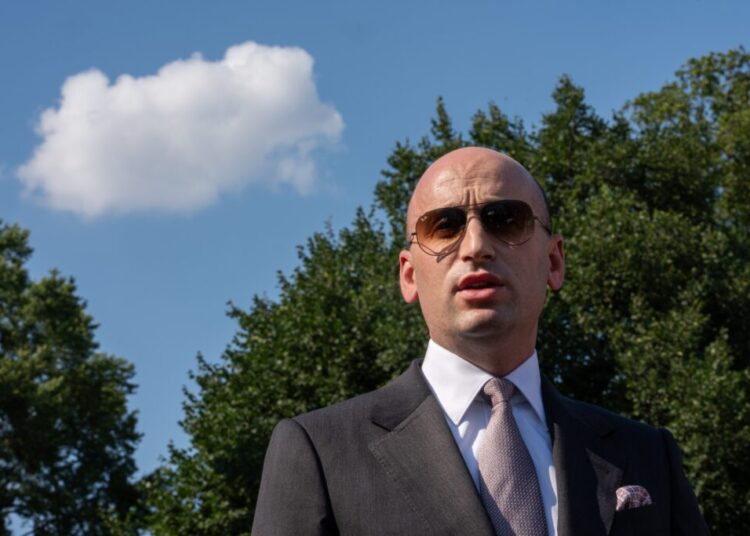
For years, Zhang Liang warned that powerful people in his former homeland, China, would try to drag him back. Then one Saturday morning in July, it happened.
In Panama City, two police officers on motorbikes pulled alongside his black Mercedes-Benz and motioned him to stop. A check of his identification turned up an Interpol red notice from the Chinese authorities, who wanted him extradited on charges of embezzling around $300 million.
Mr. Zhang, a 44-year-old dealmaker, barely had time to remove his gray suit jacket and wrap it around his head before officers handcuffed him and paraded him before cameras at Interpol’s National Central Bureau in Panama.
He has been behind bars ever since.
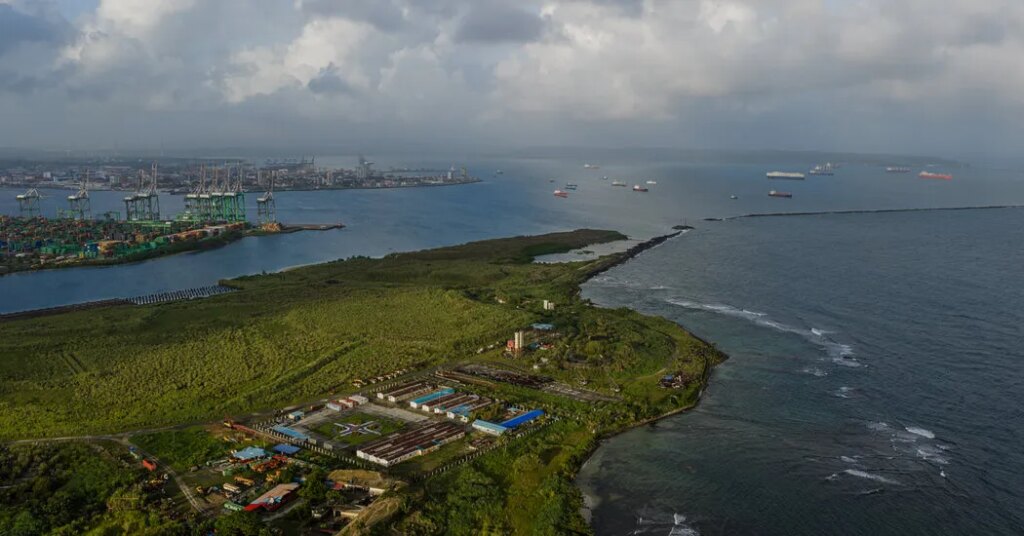
It was a remarkable fall for Mr. Zhang, one that traces the arc of China’s dealings with the West. He went to Panama ready to make deals and help China extend its influence. He oversaw a port project that promised to turn a former U.S. military base near the Panama Canal’s Atlantic entrance into Latin America’s largest container terminal, establishing a base for Chinese interests near one of the world’s busiest trade routes.
Today, China’s ruling Communist Party holds much tighter reins on entrepreneurs like Mr. Zhang. At the same time, Panama has been caught in a showdown between the United States and China: President Trump claims that China exercises too much control over the Panama Canal.
Mr. Zhang believes he is a pawn in a larger political game — a way for Beijing to regain direct control over key infrastructure he helped build in Panama.
“China is seeing its influence in the Panama Canal slipping away and is now putting pressure on Panama,” Mr. Zhang said from prison in a letter responding to written questions from The New York Times.
To his aggrieved former business partners, though, Mr. Zhang is a corporate fugitive who used offshore jurisdictions and other people’s money to enrich himself. He wooed Panama’s elite with promises of deals and funding that never materialized. He continued to earn a salary of $6,300 a month, his lawyers said at a bail hearing, a substantial sum in Panama.
His tailored suits, A. Lange & Söhne wristwatch and black Mercedes all pointed to a lavish lifestyle. Mr. Zhang has faced lawsuits, criminal complaints and judicial proceedings in multiple jurisdictions. He is also pursuing an international arbitration claim against Panama.
The competing accounts of victim and culprit are difficult to reconcile. The ownership of the port is disputed, and the financial dealings behind it are opaque. After reviewing the case, Panama’s Foreign Affairs Ministry agreed last month to proceed with Mr. Zhang’s extradition to China, according to a document seen by The Times.
The Foreign Affairs Ministries of China and Panama did not respond to emailed questions.
For a decade, Mr. Zhang had used China’s growing interest in Panama to expand his influence. Now, as Beijing and Washington battle over the canal, his business empire has unraveled, and the political connections that once helped him prosper offer little protection.
This account, with previously unreported details, is based on official documents, legal filings and interviews with lawyers and associates, including a former colleague who has accused local authorities in China of harassment, coercion and the falsifying of records in Mr. Zhang’s case.
China Moves In
Mr. Zhang arrived in Panama in 2016 to oversee investments for a wealthy Chinese financier. A lawyer licensed in New York and China, he had been named a “leading talent” by China’s Justice Ministry.
From an 18th-floor office overlooking Panama Bay, Mr. Zhang secured Panama’s approval to build, own and operate a major container terminal in a free-trade zone on Margarita Island.
Chinese state-controlled media celebrated the deal as a diplomatic coup, advancing investment interests in Panama. Mr. Zhang also secured a deal to build a gas-fired power plant. He promised officials that the project would create 1,000 jobs and lower energy costs.
As deals were made, Mr. Zhang became a go-between for officials in Beijing and Panama City.
His success coincided with Beijing’s courtship of Juan Carlos Varela, who was Panama’s president. In 2017, Panama severed diplomatic ties with Taiwan and aligned with China. It also became the first Latin American country to join the Belt and Road Initiative, China’s signature global infrastructure program.
Washington watched the growing relationship with alarm. Mr. Zhang’s proposed terminal would sit beside the Panama Canal, a strategic artery for the United States.
“Margarita Island gave them a lot of access and intelligence value,” said Isaac B. Kardon, an adjunct professor at the Johns Hopkins School of Advanced International Studies who specializes in Chinese maritime strategy.
But the political opening started to close.
Mr. Varela left office in 2019, and his successor was far less receptive to Chinese investment. The Panamanian government began moving against the Margarita Island project.
Mr. Zhang sought Beijing’s help. Tingyun Han, his former assistant and translator, said she had gone to the Chinese Embassy in Panama City, hoping officials could persuade the Panamanian government to reconsider. The plea went nowhere.
The new Panamanian government “no longer wanted any Asian faces or Chinese enterprises involved,” Ms. Han told The Times from China.
Mr. Zhang’s problems deepened when his backer, a wealthy property financier named Gao Tianguo, lost his fortune. Mr. Gao’s lending businesses in China collapsed under billions of dollars of debt. He was arrested in 2020 and died two years later.
In 2022, Mr. Zhang agreed to transfer the port assets to Notarc Management Group, a Bahamas and Florida-based private equity firm. Within months, the deal incited an ownership dispute. Ye Cheng, a politically connected Chinese businessman who claimed a controlling stake in the project, accused Mr. Zhang of illegally seizing the company.
But Panamanian authorities declined to bring charges, concluding that Mr. Ye’s allegations amounted to a commercial dispute. Mr. Ye’s company, the Landbridge Group, did not reply to requests for comment.
China took a different view.
In 2023, police officers pulled Ms. Han, Mr. Zhang’s former assistant, off a plane in her home city of Xian and drove her 12 hours to Rizhao, where Mr. Ye’s company has its headquarters, she said. Officers interrogated her so intensely about Mr. Zhang and the port deal, she said, that she vomited and was taken to a hospital. She later accused the local police of torture.
Mr. Zhang became convinced that his adversaries in China were coming after him. In court filings in 2024, he described being followed to work by a white Nissan and chased through Panama City. He requested and received police protection.
Panama in the Middle
By the time the police stopped Mr. Zhang’s Mercedes in July, Panama had become the focus of tensions between Washington and Beijing.
Shortly after starting his second term, President Trump demanded that Panama loosen China’s grip on the Panama Canal. He accused a Hong Kong conglomerate that operated two major ports at the canal, one at either end, of being controlled by Beijing. In January, Panama’s Supreme Court declared the company’s port contract unconstitutional.
China vowed to “take all necessary measures” to defend its interests in Panama. Chinese authorities started detaining hundreds of Panamanian-flagged vessels in China for inspection, disrupting trade.
Mr. Zhang was arrested the same week that China’s new ambassador arrived in Panama — and just five days before Panamanian officials were due in Beijing for talks to defuse the diplomatic standoff.
Panama’s foreign minister later said China had renewed a key maritime agreement that grants Panamanian-flagged ships preferential access to its ports.
“From the moment they arrested him — and that is no coincidence — the disputes between China and Panama disappeared,” said Guillermo Cochez, a Panamanian diplomat and one of Mr. Zhang’s lawyers.
No evidence links his arrest to the diplomatic negotiations. But relations between China and Panama improved afterward. Extradition documents revealed that Beijing wanted control of Mr. Zhang’s assets in Panama without explicitly asking for the port project.
On Aug. 21, a Panamanian court denied Mr. Zhang bail and ruled that the seriousness of the charges outweighed his claims of personal roots in Panama. In September, Panama’s Foreign Ministry said China’s extradition request was “appropriate.”
Mr. Zhang was moved from La Gran Joya, a high-security prison outside Panama City, to another detention center nearby, while his lawyers pursue a final appeal.
China has said Mr. Zhang is a Chinese national, although he said he had renounced his Chinese citizenship and obtained citizenship from Saint Lucia in 2020. The Times reviewed copies of his permanent residency card, his Saint Lucia passport and his Chinese passport.
Chinese authorities said Mr. Zhang’s transfer of the port terminal to Notarc had constituted embezzlement. He dismissed the allegations as a “sham.” (Notarc also sued him, seeking compensation for losses it says it incurred in the dispute.) Notarc did not respond to requests for comment.
Mr. Zhang said the criminal case was a pretext for Beijing to seize the Margarita Island project and “get back into the canal.”
But, he warned, “what Panama doesn’t realize is the pressure won’t stop with extraditing me.”
The post He Was China’s Man in Panama. Then He Became a Wanted Man. appeared first on New York Times.