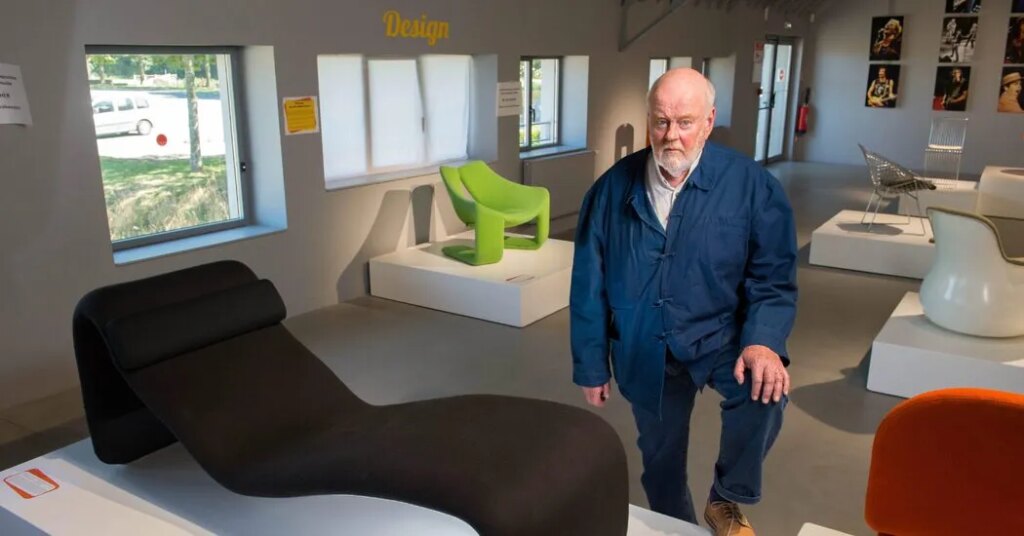
Olivier Mourgue, the French designer whose playful, anthropomorphic furniture reflected the pop sensibilities of the 1960s and ’70s, and whose futuristic red Djinn chairs made a memorable appearance in Stanley Kubrick’s 1968 movie “2001: A Space Odyssey,” set off by the antiseptic interiors of a fictional Hilton hotel, died on Oct. 5 at his home in Plouguiel, France. He was 87.
His son Armel confirmed the death.
Mr. Mourgue was 25 when the first piece of his Djinn collection, a chaise longue, was produced by Airborne, a French manufacturer, in 1964. A companion lounge chair, ottoman and love seat followed the next year.
With their tubular steel frames encased in polyurethane and sheathed in bright wool-jersey covers, they looked like furniture analogues of the flexible action figures Gumby and Pokey.
An Airborne publicist named the low-slung collection after shape-shifting genies, perhaps because the undulating ribbon forming the seat and legs of each piece suggested a flying carpet skimming the earth. “Personally, I have always enjoyed living close to the floor,” Mr. Mourgue told the French newspaper Le Monde in 2021, by way of explanation.
After seeing the chairs in the British lifestyle magazine Queen, Mr. Kubrick approached him about using them to decorate the lobby of the Hilton hotel in the space station depicted in “2001.”
It wasn’t Djinn’s first cinematic role. In 1967, a candy-pink Djinn chaise had turned up in the bedroom of the spy temptress played by Ursula Andress in the James Bond spoof “Casino Royale.” (Peter Sellers, playing one of her assets, uses it as a bench for postcoital calisthenics.)
Djinn helped turn Mr. Mourgue into a design star during the creatively liberating atmosphere of the late 1960s — “a stimulating, colorful era,” he called it.
That spirit imbued many of his pieces, including the cartoonish 1968 Bouloum lounge, which unambiguously evoked the human form. The stackable polyester-resin chair, produced by Airborne, resembled a seated, armless figure with a tilted back and bent legs, as though the chair were doing sit-ups.
Bouloum was included in the French pavilion at Expo ’70, the Japan World Exposition in Osaka, accompanied by Mr. Mourgue’s Flower lamp, its silver-tipped lightbulbs framed by giant aluminum petals. (The lamp, designed in 1967, is still being produced by its original manufacturer, Disderot.)
It wasn’t Mr. Mourgue’s first appearance at a world’s fair: He also created seating for the French pavilion at Expo ’67 in Montreal — a little puff pastry of a chair on a slim, curved base, with a matching dimpled ottoman, known as the Montreal.
Mr. Mourgue’s work was supported by Mobilier National, a centuries-old organization that has subsidized the development of contemporary French design, and he prioritized social responsibility along with jaunty aesthetics. He was part of cadre of well-known designers, including Terence Conran and Gae Aulenti, who created high-quality, low-cost products that were sold through a catalog, part of an initiative introduced in 1968 by the Prisunic variety store in Paris. In 1969, he contributed a furniture suite made from cheap hardboard panels, with a coordinating floor cushion called the Carpet-Seat. (The actress Jeanne Moreau was an early adopter of the cushion.)
Two years later, the German biotechnology company Bayer commissioned Mr. Mourgue to design an entire living space. Known as Visiona 3, it was the third installment in an annual project series, presented at the 1971 Cologne furniture fair in Germany to showcase the company’s synthetic textiles. (The two previous Visiona exhibitions were designed by the Italian modernist Joe Colombo and Danish modernist Verner Panton.) Mr. Mourgue loved to camp, so he created a kind of campground within the home: a 1,238-square-foot space with carpets simulating fields and rivers, and flexible areas devoted to activities like food preparation, game playing and rest.
Mr. Mourgue also had an interest in mobility, and sometime after he opened his design studio in 1966 he began working with Renault on a less expensive version of the Renault 4 automobile, designing accessories and interiors. Throughout his career, he also turned vehicles into studios on wheels, converting a Land Rover in 1970; Renault’s lightweight truck, the Saviem TP3, in 1976; and a Volkswagen Transporter in 1986.
At the height of his fame, in 1976, Mr. Mourgue withdrew from it all, moving with his family to an old stone farmhouse in Plouguiel, a small community on the northern coast of Brittany.
“He got so tired by all the star culture in design, which had just started at this time,” Juhani Pallasmaa, a Finnish architect and lifelong friend, said in an interview. “He didn’t like that at all.”
Olivier Jean Pierre Mourgue was born on April 15, 1939, in Paris. His father, Jean Mourgue, owned an art supply store; his mother, Denise (Lesieur) Mourgue was a physical therapist. A year after Olivier was born, Germany invaded France, and his family retreated to the countryside to wait out the years of Nazi occupation.
In 1954, he enrolled at the prestigious École Boulle in Paris to study interior design. Four years later, he began studying furniture design at the École Nationale Supérieure des Arts Décoratifs. Soon after, he met Charles Bernard, the founder of Airborne; their first collaboration, a stainless-steel-and-leather chair called Joker, was produced in 1959. Airborne also manufactured Mr. Mourgue’s steel-and-leather Whist chair and ottoman in 1964, as well as his sling-like Cubique chair in 1968.
Mr. Mourgue taught at the École Nationale Supérieure des Arts Décoratifs from 1969 to 1972 and at the École des Beaux-Arts in Brest from 1989 to 2002. Later in his career, he also immersed himself in noncommercial projects, creating surreal miniature theaters and gardens with balsa wood, canvas and watercolors. Several of those works were published as “Olivier Mourgue’s Little Theatre of Design” in Pentagram Papers 12, a 1984 publication produced by the international design collective. A number were exhibited at the Sainsbury Centre for Visual Arts, in Norwich, England, in 1992.
Mr. Mourgue’s first marriage, to Christina Sanders, ended in divorce. In 1981, he married Anne Turlan, a kindergarten teacher. In addition to their son Armel, she survives him, along with another son, Gaetan; their daughter, Maria Mourgue-Aliaj; two sons from his first marriage, Thomas and Mikael; 11 grandchildren; and a brother, Jérôme. Mr. Mourgue’s brother Pascal, a sculptor who designed furniture for Ligne Roset and Knoll, died in 2014.
As a young man just out of school, Mr. Mourgue traveled to Finland and Sweden, and spent six months working in the interior design division of Nordiska Kompaniet, the luxury department store in Stockholm.
It would be the first of several immersions in the design culture of Nordic countries. “I think he was impressed by the feeling of democracy and equality,” Mr. Pallasmaa said.
Mr. Mourgue, who loved art, was critical of much of the commercial design in the 1960s and ’70s, Mr. Pallasmaa noted: “Most designers at that time were highly technical and industrial, while Olivier always had a playfulness.”
His chairs were like “funny animals — tame animals,” he added, “which in those days was quite unique.”
The post Olivier Mourgue Has Died. His Chairs Starred in ‘2001: A Space Odyssey.’ appeared first on New York Times.