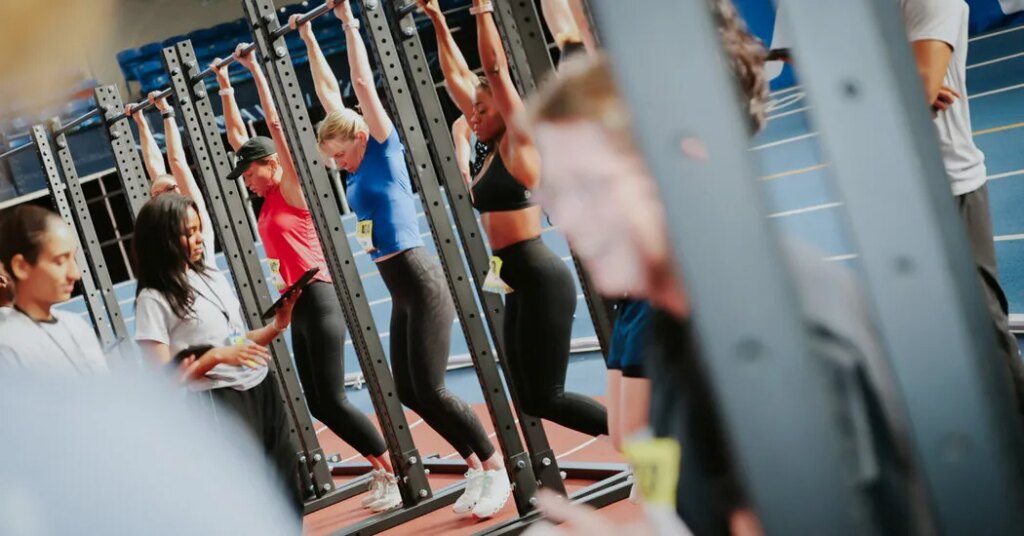
The day before my 60th birthday, I arrived at the inaugural Super Age Games in New York City. Perhaps, I thought to myself, I’ll find out I’m only turning 40.
The event floor thrummed with pop and hip-hop, while two M.C.s provided running commentary. About 500 other amateur athletes, ranging in age from their 20s to their 80s, milled around the arena. Soon, I would tackle eight “trials,” measuring not only my physical traits such as agility, aerobic fitness and balance, but also my cognitive processing speed and social connection. It felt like it was part track meet, part Senior Olympics, part longevity-enthusiast meet-up.
I’d be scored in each category, relative to my gender and age. I would also receive my “Super Age,” based mainly on my aerobic fitness. The organizers claim that, taken together, my scores could help me see how I was performing along key longevity metrics, and could help me forecast my health span and life span.
Longevity has become a booming industry, and several big sponsors were on site, including Whoop, Altra and Braun. Competitors could also try products like Normatec thigh-high massage boots and Emsculpt Neo, a device that uses magnets to purportedly burn fat and build muscle, no Zone 2 required. (Basic registration for the Games was $400, though you could opt for the deluxe “Champions Pass” for $1,400, which included two pairs of shoes, a personalized training program and blood tests, among other things.)
Energy was high among the crowd, some of whom bounced nervously in the start corral. I’ve been an athlete most of my life and consider myself reasonably fit, but I genuinely had no idea how I’d do at the Games. I hadn’t run an obstacle course — our first test, for agility — in at least 30 years.
The Super Age Games were created by David Stewart, 67, who has founded several longevity-related brands. He’d come up with the idea for the Games a few years ago, and developed the concept with the help of the Buck Institute for Research on Aging.
The events were modeled on “scientifically validated, trainable and measurable markers,” Mr. Stewart said. “I’ve been training for 40 years, but for what? I wanted to give people a goal.”
More people are thinking about how they’ll age when considering a fitness program, said Glenn Kelly, 37, a participant and personal trainer who runs a gym in Brooklyn.
“I work with a lot of folks in their 20s and 30s,” he said. “You’d imagine everyone wants to be thin and hot, but they’re saying, ‘I’m training now because I want to move well when I’m older.’”
Many of the participants had arrived in teams, the largest of which was a 58-person squad of women mostly in their 40s and 50s. For months, the women had been training remotely together under the guidance of Denise Kirtley, who runs a coaching platform called Rebellion Body. This was the first time they had met in person.
“The narrative is, once you reach a certain age, decline is the only path,” Ms. Kirtley said. “But that is absolutely not true.”
Since I’d arrived solo, I was assigned to a small group of five that included May McDaniel, 80, from Georgia, and Junior Kennedy, 36, a New York-based SoulCycle instructor, personal trainer and former competitive high-hurdler who had been working with Super Age to help competitors prepare for the events. Teams would be ranked by their total scores, but competition was mostly friendly, and participants mostly competed against themselves.
Ms. McDaniel is barely over five feet tall, with white hair, and had quickly become something of a celebrity at the event. She’d joined, she said, because her husband died last year and the Games gave her something to look forward to. Ms. McDaniel had aspirations to become a fitness influencer. She handed me a business card with her picture and a three-word tagline: Golden. Active. Unstoppable. A QR code linked to her exercise tips.
All but one of the trials were set up around the infield, with the track preserved for the final event, called the Super Age 800: four timed laps, walking or running, while carrying a sandbag that weighed 15, 25 or 35 pounds. Heavier weight got you a time bonus. You could also choose to carry nothing.
Our first test, called The Over Under, was a 90-foot shuttle run that required clearing a 42-inch-tall box, then crawling under an 18-inch-high beam. Mr. Kennedy cleared the box in a single bound, then dove under the low bar. I deployed a more awkward technique, sliding across the box on my hip, then crawling under the beam. Ms. McDaniel was slower, but steady and determined.
The second trial, The Inferno, tested aerobic capacity — participants pedaled an assault bike as fast as they could for four minutes. After that, The Synapse placed us in front of a computer, where we donned three-dimensional glasses and tracked animated balls as they bounced around the screen. The juxtaposition of high-intensity spinning followed by calm focus was tough. I just cracked the top half among men my age in The Inferno, but was in the 80th percentile in The Synapse, the highest score I’d receive.
Dr. Riley Williams, 60, an orthopedic surgeon at the Hospital for Special Surgery in New York, was participating at the Games with a team of his residents and interns. While fit and muscular, he struggled just like me in the trial that required walking on a beam carrying a bag filled with water. “My balance is atrocious!” he said. “But that’s anybody over 50.” We commiserated about the blind spots in our conditioning. He said he was already looking forward to coming back next year, to see if he could improve.
More than any other event, I was dreading The Hang, in which we dangled from a bar for as long as possible. I had flashbacks to the Presidential Fitness Test from grade school, when I struggled to complete a single pull-up in front of my peers. Mr. Kennedy surpassed three minutes. I was hoping for one minute — still a good score for men over 50. I made it to one minute and five seconds before I let go, arms burning.
Of all the tests, perhaps the most unexpected was The Sync, which assessed what the organizers called your “relational skills.” On a screen, a series of facial expressions flashed for less than a second. After each one, you selected which one you had seen from a multiple choice list. I missed a few — was that “anger” or “surprise”? — but scored in the 69th percentile for my age group. Phew.
In the end, my Super Age came in at 51 — happy birthday to me! I took all my numbers with a grain of salt, but it was enlightening to see where I excelled (aerobic fitness and cognitive processing speed) and fell short (sadly, balance and agility).
On my way out, I saw Ms. McDaniel, the octogenarian from Georgia, at the Normatec demo booth. She was fast asleep, reclining in a comfortable chair while wearing a pair of recovery boots. Competitive longevity is hard work, we can both agree.
The post Is Longevity a Sport Now? I Competed at the ‘Super Age Games’ to Find Out. appeared first on New York Times.