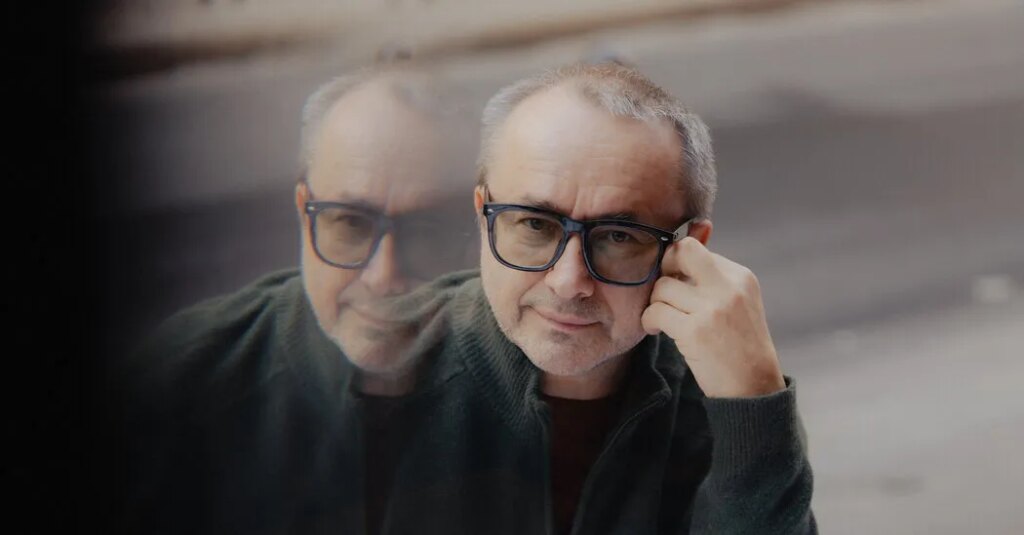
When the Russian filmmaker Andrey Zvyagintsev sat down in Paris a little over four years ago to write a Russian remake of a French New Wave thriller, he understood that something was missing.
He intended to keep the central plot of the movie, Claude Chabrol’s 1969 “La Femme Infidèle” (“The Unfaithful Wife”), about a businessman who suspects his wife of adultery. But Zvyagintsev felt it needed a new workplace story line for the businessman — something that would capture what had become of Zvyagintsev’s native Russia since President Vladimir V. Putin invaded Ukraine.
“It had to be a statement, a film that would bear witness to the times,” said Zvyaginstev, who now lives in France and is best known for his Academy Award-nominated 2014 film, “Leviathan.” “The only question was how to go about it.”
Then, about a week after Zvyagintsev started the project in 2022, Putin declared a “partial mobilization” — a draft — prompting hundreds of thousands of men to flee Russia to avoid being sent to their deaths in Ukraine. One of Zvyaginstev’s friends called from a provincial Russian town in distress, lamenting that the mayor had summoned him and other businessmen to ask which of their employees should be sent to the front.
A lightbulb went on for Zvyagintsev. He called his co-writer, Simon Lyashenko, and said he knew what the second plotline should be.
The result is “Minotaur,” Zvyagintsev’s tense film about complicity and monstrosity in marriage and war, which comes out in U.S. theaters on Nov. 20. It won the Grand Prix at the Cannes Film Festival and is France’s entry for best international picture at next year’s Academy Awards, despite being filmed entirely in Russian.
Shot in Riga, Latvia, “Minotaur” follows the story of Gleb (Dmitriy Mazurov), an executive in a fictitious provincial Russian city, who begins to suspect his wife (Iris Lebedeva) of cheating, just as his business faces pressure from the mayor over Putin’s draft.
With aggressive wartime censorship restricting film production in Russia since the invasion, “Minotaur” is the first major Russian-language drama to show, in unvarnished terms, how the war has transformed Russian society — even if Zvyagintsev’s picture is far from an overt war movie or a political screed.
Many film directors who have remained in Russia during the war have shifted to shooting fantasy and historical movies, avoiding contemporary topics that might run afoul of the Kremlin’s new and uncertain rules. Those engaging with the war onscreen are largely producing propaganda films.
Zinaida Pronchenko, a Russian film critic who lives in France, said that for her, as a Russian émigré who opposes Putin and the war, “Minotaur” answered a longing to see a movie that finally addressed the moral compromises of wartime Russia.
“I really wanted to see something on this topic, and it finally appeared,” Pronchenko said. While some antiwar Russians want a more political film solely centered on the conflict, she said, “it’s clear Zvyagintsev wanted to do something elegant and didn’t want to make propaganda.”
Zvyagintsev is now working in vastly different circumstances from when he produced “Leviathan,” which told the story of a car mechanic in a Russian Arctic village being crushed by small-town corruption.
As “Leviathan” achieved international renown, zealous Putin supporters lashed out at Zvyagintsev for laying bare the moral rot of Russian institutions for the world. A prominent Russian political analyst said that Zvyagintsev should beg the Russian people for forgiveness, and the country’s culture minister said the state would no longer fund films depicting a “crappy Russia.”
In a move that would now be unthinkable, Russia’s film authorities nonetheless submitted “Leviathan” for the Academy Awards, a nod that established Zvyagintsev as a tastemaker in Russia’s film academies. He didn’t for a moment think that “someone might shut me down, that they might cut off my oxygen, so to speak,” he said. He made another film in Russia, “Loveless,” in 2017.
But with the war, everything changed.
By the time “Minotaur” debuted at Cannes this year, Zvyagintsev had been absent from the film circuit for nine years, during which he lost both his health and his homeland.
In mid-2021, he received the Sputnik V vaccine for Covid-19 in Moscow, possibly while he unknowingly had the coronavirus, and days later became critically ill. He lost most of his lung function, suffered a dangerous blood clot, fell into sepsis and spent weeks in a medically induced coma, before contracting Guillain-Barré syndrome, which left him unable to use his arms and legs. In the process, he was medically evacuated from Moscow to Germany.
It was there, during his rehabilitation at a medical facility in Hannover, that his wife came into the room one day and told him that Putin had invaded Ukraine. Zvyagintsev spoke out against the war and decided that he could not go back home, ultimately moving to France, and said he cried for months uncontrollably as he read each day about the horrors being inflicted upon Ukraine.
He emerged from his brush with death with a new, unbridled impatience to get back to work, feeling as if his life could once again “switch off, just like a lightbulb,” as when he went into the coma, he said.
So when a producer in France asked if he was interested in doing a remake of the Chabrol film, Zvyagintsev sprung into action.
After he finished writing “Minotaur,” he invited actors from Russia to final tryouts in Latvia but sent the script to them first so they knew they would be making the kind of movie that could attract retribution from the Russian authorities. He asked those unprepared to take a risk not to come.
Although Zvyagintsev is clear about where he stands on the war — he demanded that Putin “put an end to the carnage” in his Cannes acceptance speech — he said the blunt language of political cinema didn’t suit him.
“It can’t just be a direct, straightforward statement,” Zvyagintsev said. “It should be about morality, about the ethical choices an individual faces, rather than about a political narrative or an overt, direct declaration.”
Zvyagintsev’s films leave much unsaid, asking viewers to fill in the blanks as characters face life-changing moral quandaries, and “Minotaur” is no exception. Chabrol’s original film appealed to Zvyagintsev, because the viewer watches the watcher, following the businessman character as he monitors his wife with increasing suspicion.
“It’s like a layered cake — one that, in essence, answers the question ‘What is cinema?’” Zvyagintsev said. “Cinema is contemplation. Cinema is observation. It’s not about intruding into the action or handing out judgments — labeling one person ‘bad’ and another ‘good.’ It’s simply observation, allowing the viewer to draw their own conclusions.”
Even the film’s title has invited a range of interpretations.
In Greek mythology, the monstrous Minotaur lived trapped in a labyrinth, where he was fed 14 young Athenians every nine years as tribute. Zvyagintsev’s film is in part about Russia feeding innocent men to the beast of war, which seems like a clear allegory but is also a more ambiguous examination of potential treacheries within a marriage.
Zvyagintsev pointed out that in Honoré de Balzac’s 1829 satirical essay “The Physiology of Marriage,” the French writer compares married life to a labyrinth in which a husband wanders from corner to corner, scrutinizing his wife’s silences, comments and secrets — always worried that a lover could one day come along and “minotaurize” him.
The movie is also about complicity, at home and in society, depicting the perverse cascading consequences for Russians who unflinchingly fulfill Putin’s wartime demands and make compromises to protect their own interests.
Although “Minotaur” has no chance of being released in Russia, Zvyagintsev expects the country’s robust ecosystem of pirated content to make it widely available. He said it was pointless to respond to Russians who have criticized him for portraying the country negatively on the world stage.
“People poisoned by propaganda spout utter nonsense. They’re people who refuse to look at themselves in the mirror,” Zvyagintsev said. “Nikolai Gogol’s play ‘The Government Inspector’ begins with an epigraph: ‘Don’t blame the mirror if your own mug is crooked.’”
Some Ukrainians reacted angrily to Zvyagintsev’s win in Cannes, arguing that his public call for Putin to end the war in his acceptance speech downplayed the complicity of Russian society at large.
“Who, specifically, should be blamed?” Zvyagintsev said. “Simply saying ‘society’ is just a nice-sounding phrase. After all, there are actual people who make the decisions.” Complicity in an authoritarian system, he added, boils down to how each individual chooses to act.
Zvyagintsev’s films are famously bleak — happily ever after isn’t in his vocabulary — but in person, his belief that people can defy division with shared humanity was visceral.
“When Ukrainians ask me, ‘Why did you make a film that makes me feel sympathy and compassion for these mobilized men — men who are coming to my country to kill me? Why would you do that?’ I can only answer one thing: It’s not me. It’s you, the people sitting in this audience,” Zvyagintsev said. “You can find the strength within yourselves to remain human — which means showing compassion for people who were never even asked; they were simply taken and thrown into the furnace.”
Oleg Matsnev contributed reporting from Munich.
The post He Survived a Coma and Left Russia. Now His Film Confronts the Costs of Putin’s War. appeared first on New York Times.