I had a master teacher, but it turns out I’m terrible at magic.
I was sitting at a circular table in a blindingly sunny apartment on the Upper East Side, fumbling my way through a series of card tricks I’d just learned from Asi Wind, a magician and mentalist whose book, “How Did You Do That?,” is coming out on Nov. 17.
My hands felt like flippers. I couldn’t turn a card under the table without looking like a shifty pervert. My elbows trembled as I shuffled the deck. I counted on my fingers while doing math for a trick Wind declared “simple enough to do over the phone.”
He was so encouraging and so patient, I was reminded of a long-ago algebra tutor who assured me that coefficients and parabolas would eventually become my friends. (They didn’t.)
“Rehearse, breathe, slow down,” Wind said, quoting advice from the book, which focuses on his philosophy of magic almost as much as it does on tricks.
“There’s a learning curve for everything,” he added. “You’re going to learn the exact maneuvers you need to make.”
In September 2022, I saw Wind perform at a tiny venue in Greenwich Village. What stuck with me — aside from his kinetic energy and mind-bending tricks inspired by a deck of cards personalized with audience members’ names — was his ability to create a sense of camaraderie. Corny as it sounds, this might have been the evening’s greatest feat.
Wind, 47, grew up near Tel Aviv and knew from a young age that he was going to be a magician.
“At 15 years old, I was making money doing shows,” he said. “I don’t think there was ever a period of time where I doubted myself. People doubted me, but I never doubted myself.”
He learned his trade by poring over basic magic books illustrated with simple line drawings. Now he hopes to replicate that experience for a new generation awash in ChatGPT and YouTube.
“It’s a kid who’s trying to get some followers and he’s teaching you a trick that he learned from his uncle,” Wind said of the average magic video. “You’re not going to pick up a guitar and play Bach. You’re going to start with the basics, and if you have a good teacher he will teach you the foundation.”
“How Did You Do That?” includes 176 elegant watercolor illustrations by Wind, who has studied painting, and more than 50 tricks. He traces their origins, crediting the magicians who dreamed them up, sometimes centuries ago. Published by Wind Productions, the leather-bound volume isn’t cheap ($59.95), but it has the feel of a high-quality coffee-table book.
Jamy Ian Swiss, who coedited “How Did You Do That?” with fellow magician John Lovick, said in an interview that unlike many beginner books that tend to recycle the same moves, this one features tricks that have been carefully “curated, arranged and adjusted with Asi’s signature touches.”
Most importantly, Swiss emphasized, the tricks are appropriate for newbies, adults and children alike.
Before I humiliated myself during my magic lesson, Wind and I chatted on a sectional couch in the apartment he shares with Anthony, his husband, and da Vinci, their 17-year-old Chiweenie, when they aren’t in Los Angeles. The place is on the market and, thanks to its minimalist aesthetic (a stack of travel books, a lone cactus), it had the feel of a stage.
“I say to my audience, I know you know this but I’m going to say it anyway: No one can do magic. If you saw magic in my show, it was because you wanted to see it,” Wind explained. “You chose to see it. It’s a collaboration.”
He paraphrased a quote from “On Writing,” by Stephen King: “Description begins in the writer’s imagination, but should finish in the reader’s.”
Wind said, “It’s so true for magic. They want to believe and they fill in the blanks.”
He described how fans tend to “tell a better story,” remembering how he made a credit card spin around the entire room, when in reality the card only spun about three feet from his body.
Perhaps more than any other performer, a magician learns to read a room, and Wind’s audiences tend to fall into three categories: There are the people who “really want to see magic”; the ones who are skeptical but persuadable; and the deniers. (“No matter how polished the trick is, they’re gonna have to find a solution,” Wind said. )
But mostly Wind talked about the spectators who changed his performances for the better: The blind woman who came to his show seven times. The woman who, when called upon to name someone important, mentioned a brother whom she hadn’t seen or spoken with in years. (Wind implored her to be in touch.)
And finally, the husband who, when asked to write his name on a card, jotted the name of his recently deceased wife, who had loved magic. Wind unwittingly called on her during his performance, and the man had to confess that she wasn’t there.
“He says, ‘Asi, I’m so sorry, I really hope I did not sabotage your show. I wrote her name, not mine, in her honor,’” Wind recalled. “We were moved. The whole audience felt it. I felt it. I said, ‘Let’s dedicate the last trick to your wife.’ Stuff like that happens all the time.”
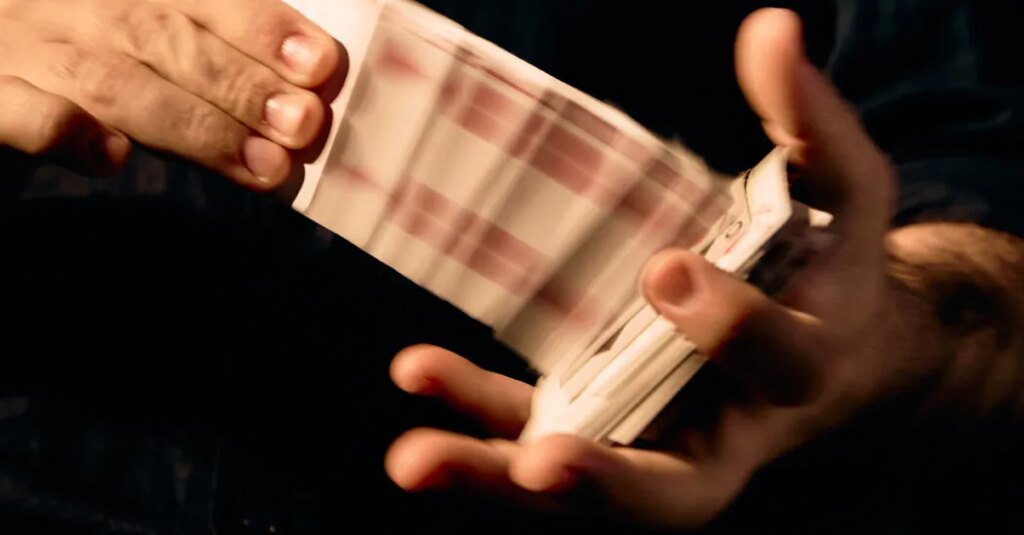
Before he debuts a trick in front of an audience, Wind practices on his own hundreds of times. He plucked a card emblazoned with his initials off the top of a deck, then cupped it in his palms so it was invisible to me. He executed the maneuver again. And again — switching hands, gazing out the window, noting how he gets nervous before a show but relaxes once it starts. He never flubbed the move.
“It’s about efficiency,” Wind said. It’s also about maintaining eye contact, telegraphing confidence and chatting with an audience. To me, this felt like juggling, singing and riding a unicycle all at the same time.
“Maybe I’m having trouble because I’m a lefty?” I asked hopefully.
“There’s no difference,” Wind said.
Later I practiced tricks at my dining room table, feeling like a lunatic as I bantered with my cat: “I know you can’t pick a card so I’ll pick one for you. It’s the ace of spades. Got it?” If cats had eyebrows, mine would have raised his.
I dropped my cards, misplaced the ace of spades and spilled red wine while poring over instructions in “How Did You Do That?”
I don’t think anybody will be asking me that question anytime soon. But that’s not the point, according to Wind.
“Connection is the most important thing,” he said during our interview. “You acquired a tool that allows you to communicate with others. Through these few minutes of performance, we get to experience you — your energy, your brushstrokes, your speed.”
Tell that to my cat.
The post The Trick’s on Me (Again) appeared first on New York Times.