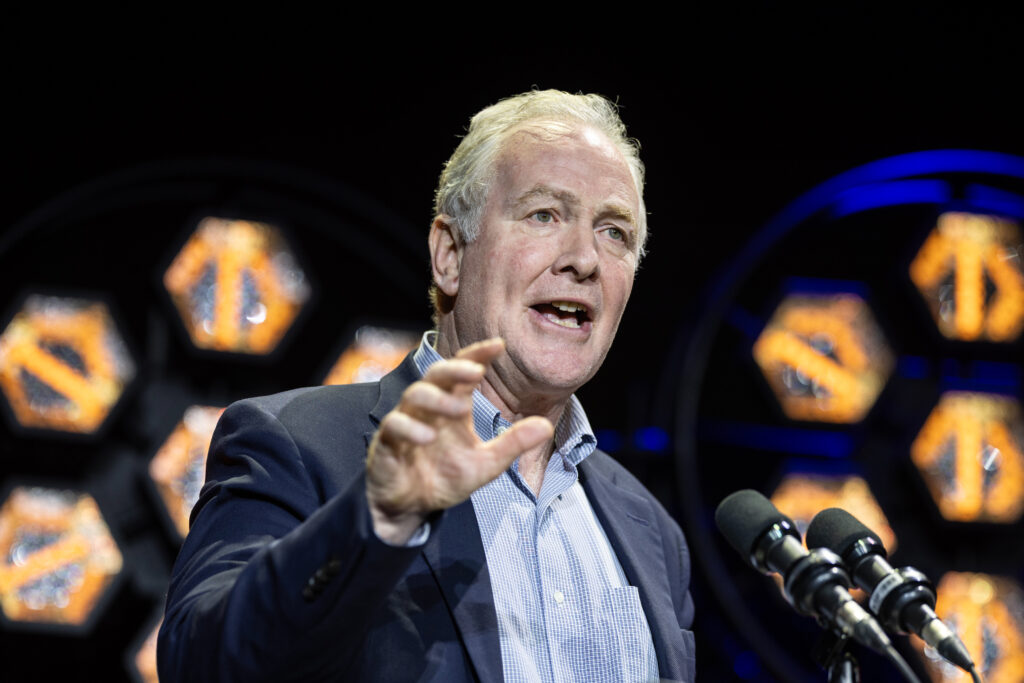
Sen. Chris Van Hollen (Maryland) is trying to become the first Democrat to oust his party’s leader in Senate history — and he’s facing a tough climb.
Van Hollen got a standing ovation Friday when he addressed a Democratic gathering in Denver, declaring that he wanted to go “toe to toe with the president to take on the fights that are too important to lose.”
But nearly 24 hours after Van Hollen announced that he would challenge Sen. Chuck Schumer (D-New York) to be Senate majority leader in the next Congress, just four senators committed publicly to backing him.
Sen. Elissa Slotkin (D-Michigan), who said this week that she could not support Schumer, said Friday that she is glad Van Hollen was running but did not commit to supporting him in the Dec. 1 election.
Van Hollen has acknowledged he is the underdog in the race against Schumer, who has led Senate Democrats for a decade and helped the party regain control of the chamber in the midterm elections.
As minority leader, Schumer “has lots of powers of incumbency to try to make deals or agreements with people,” Van Hollen told reporters Friday in Denver.
Still, Van Hollen said he believes there is a broad desire for change among Senate Democrats.
“A lot of my colleagues want to see a whole different approach to governing in the United States Senate and in the Senate Democratic caucus,” he said.
The four incoming senators who have committed publicly to supporting Van Hollen: Sens. Bernie Sanders (I-Vermont) and Jeff Merkley (D-Oregon) and Sens.-elect Abdul El-Sayed (D-Michigan) and Peggy Flanagan (D-Minnesota). Like Van Hollen, all of them are part of the party’s progressive vanguard. Sen. Tina Smith (D-Minnesota), who cannot vote in the election because she did not run for reelection and will leave office in January, also endorsed Van Hollen Friday.
Sanders and Merkley have a long history with Schumer. Sanders has served with Schumer for two decades in the Senate and also served with him in the House in the 1990s. Schumer recruited Merkley to run for Senate in 2008 when Merkley was speaker of the Oregon state House, helping him flip a Republican-held seat.
“Americans are desperate to restore government by and for the people, not the privileged and powerful,” Merkley wrote Friday on X. “We need leadership that carries that responsibility in their heart and gut.”
Other progressives, including Sen. Elizabeth Warren (D-Massachusetts), have not taken sides publicly so far.
Sen.-elect Troy Jackson (D-Maine), who has said he will not support Schumer for leader, cautioned before Van Hollen announced his candidacy that he would not necessarily support Van Hollen.
“I’m not going to just vote for him because he’s an alternative,” Jackson told WMTW, a Maine TV station.
Hillary Barrett, who served as Jackson’s campaign manager and is now on his transition team, said Friday that Jackson looks forward to speaking with Van Hollen in the coming weeks.
Schumer has said he has the votes to be reelected as Democratic leader. More than a dozen Senate Democrats have committed publicly to supporting him.
“Chris and I agree on many things, and I think he shares the goals of every member of the caucus: to fight as hard as possible for everyday Americans,” Sen. Jack Reed (D-Rhode Island) said in a statement. “I will support Senator Schumer as leader for the simple reason that Chuck is incredibly effective at the job.”
Van Hollen or Schumer will need the support of at least 29 senators to win the secret-ballot election if all senators vote and Democrats have a 56-44 Senate majority. (Democrats have secured 55 seats next year. Former Democratic Rep. Mary Peltola is leading Republican Sen. Dan Sullivan in Alaska in a race that has not been called.)
On Thursday, Van Hollen told MS NOW’s “The Briefing with Jen Psaki” that he had the support of more than 10 Senate Democrats. He declined to put a number on his support on Friday in Denver.
Many Senate Democrats have declined publicly to take sides.
Sen. Ron Wyden (D-Oregon), who has served alongside Schumer since 1999, told The Oregonian that he is focused on “delivering Medicare for All, a billionaire income tax to save Social Security and ending the Trump tariffs, and whoever will best help me make that happen is going to have my vote.”
No senator has ever toppled a sitting party leader, according to the Senate Historical Office.
Sen. Mitch McConnell (R-Kentucky) easily defeated Sen. Rick Scott (R-Florida) in 2022 when McConnell was minority leader and Scott ran against him. No Democratic Senate leader has faced a challenger since Sen. Robert Byrd (West Virginia), who defeated Sen. Lawton Chiles (Florida) on a 32-10 vote in 1984.
The closest a Senate party leader has come to losing to a challenger came in 2002, when Sen. Trent Lott (Mississippi), the embattled Republican leader, stepped down after Sen. Bill Frist (R-Tennessee) said he would run against him. At the time, Lott was facing fallout for having praised South Carolina Republican Sen. Strom Thurmond’s 1948 segregationist presidential campaign.
Some Senate Democrats have started discussing moving up the leadership election to get it over with, according to three people familiar with the matter, who spoke on the condition of anonymity to disclose private conversations. Van Hollen declined to say whether he would support such a move, telling reporters that the issue was “very much in flux.”
Van Hollen said last week that he was considering running for president in 2028, but he told reporters Friday that he would not run.
Schumer’s allies have argued that his work to help Democrats retake the Senate against the odds means he deserves another term as leader. But Van Hollen downplayed the role that Schumer and other Democrats in Washington played in the midterms, arguing larger forces were responsible.
“We didn’t just win Senate races,” Van Hollen said. “We won House races, but also governor’s races, state legislative races, local races. So the notion that this was somehow a Washington-engineered victory is delusional. This was the power of the people.”
Once viewed as part of the Democratic Party establishment, Van Hollen has become an outspoken progressive in recent years. He cast his run against Schumer as part of a history of standing up to his party, citing his 2002 victory over Mark Kennedy Shriver when he first ran for Congress.
“I took on the establishment candidate in my first congressional race,” Van Hollen told reporters in Denver. “I ran against a member of the Kennedy family. All the establishment was with him.”
Van Hollen has sketched out a few differences with Schumer. He has said he would not support a government funding bill — which Congress must pass by Dec. 11 to prevent a government shutdown — unless Trump ends the Iran war. Schumer has also pledged to pressure Trump to end the war but has not made the Dec. 11 deadline a red line.
Schumer and Van Hollen have outlined similar approaches to other issues. Van Hollen said Friday that he opposes the Senate filibuster, which requires 60 votes to advance most legislation, but he did not commit to scrapping it if he become majority leader.
“This is an issue that I think we need to talk to the caucus about,” Van Hollen said. “And I think it’s going to be very important on certain measures, especially democracy-protection measures, that we find a way to make sure that the American people’s will governs.”
In an interview last week, Schumer also did not commit to getting rid of the filibuster — but he did not rule it out, either.
“We’re going to figure out the best way to get our agenda passed,” Schumer said.
The post Few colleagues immediately embrace Van Hollen in his bid for majority leader appeared first on Washington Post.