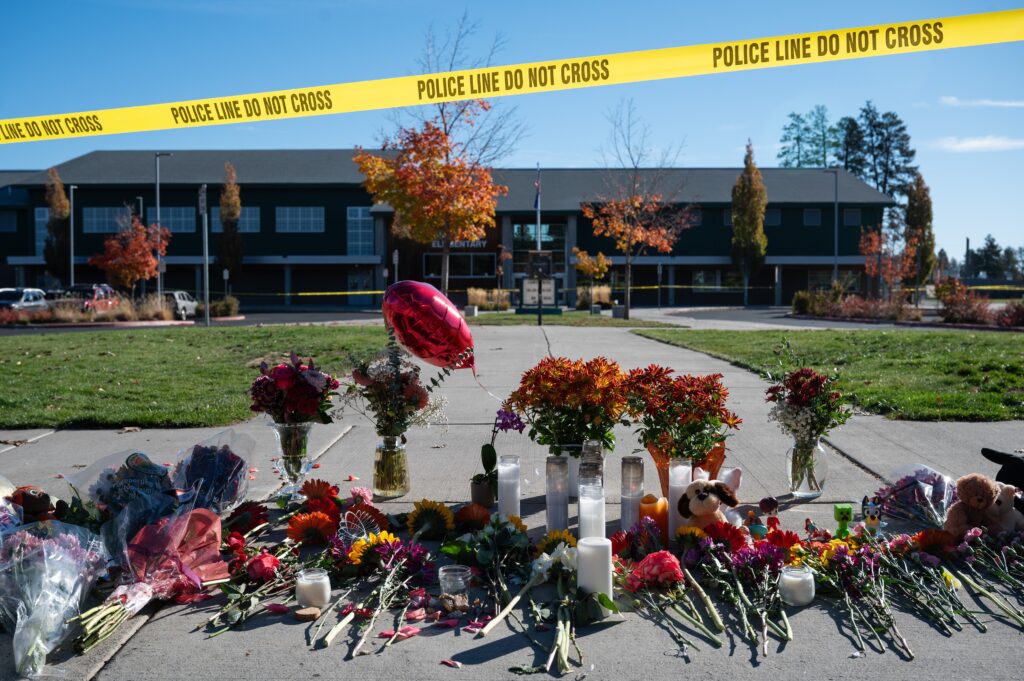
At some point during the chaotic hours after a teenage gunman killed three children and one teacher at an Oregon elementary school, a thought dawned on Bend-LaPine Schools Superintendent Scott Cook: Eventually, he would have to ask children and teachers to return to the scene of the crime.
It was a passing thought, shoved to the bottom of a to-do list that grew longer every second. District officials needed to reunite children with their parents. They had to cancel classes, talk to reporters, work with police detectives and FBI agents on an investigation. But Cook returned to the thought in the days that followed. How could he prepare a community to go back to the place where something so devastating occurred?
Nearly everyone with connections to Silver Rail Elementary had been traumatized. Young children heard gunshots. School bus drivers watched parents vomit and pass out in the street as they waited to see if their sons and daughters had survived. And educators, many of whom are still in their 20s, saw a colleague die.
As mass shootings have increasingly become a part of modern life, schools in even the smallest districts have learned to prepare for incidents like the one that occurred almost a month ago at Silver Rail. They’ve created mental health teams to reach out to young people who might be at risk of violence. They’ve installed extensive locks, and they’ve run regular lockdown drills.
But fewer prepare for what comes after.
Studies show, and Cook began to understand, that the months after a mass shooting are critical. Without proper support, researchers have found, children who are in the building the day of a shooting may be less likely to graduate from college. They may skip classes, fall behind, grow increasingly anxious and depressed. Years later, they may be less likely to find a job or earn a decent wage.
Those outcomes might have been all but guaranteed a decade ago. As Cook pondered his community’s future, though, a federally funded nonprofit on the other side of the country offered a lifeline. Students and teachers would certainly struggle, psychiatrists at the National Mass Violence Center told Cook. But they could heal, too, if the district took steps the nonprofit recommended to ensure the students and teachers had what they needed not only to return but to thrive.
And so, when classes resumed this week, Cook felt anxious but optimistic. They’d done everything they could with a month and an Oregon school budget. Now, it was time to see whether it had worked.
COOK HAS WORKED IN EDUCATION for nearly four decades, first as a chemistry teacher then as an administrator. He has solved all sorts of problems throughout his career, but as FBI agents and victims assistance groups came to town, he began to understand that little had prepared him for the road ahead.
They would need to offer counseling and wrap-around support to nearly every kid over the next few weeks. But some of the students in the building that day wouldn’t graduate until 2038. The district would need to help and track them in ways they hadn’t done before.
“They don’t teach you this in superintendent school,” Cook said, “But it became abundantly clear we were going to be in this for the long haul. … This is an investment in the well-being of people for years and years to come.”
A few days after the incident, Cook found himself on a video call with the National Mass Violence Center. The nonprofit, based in Charleston, South Carolina, is a relatively new organization, but over the last nine years, its team of psychologists, researchers and victims assistance professionals have responded to 65 mass shootings, 19 of them at schools.
When clinical psychologist Angie Moreland first began helping victims, she found that many districts were reluctant to accept outside assistance. Schools operate with significant autonomy, and their leaders are used to meeting the needs of their students on their own. Some were stubborn and others were scared. And even those who knew what to do were often attempting to help students when they themselves were traumatized.
Bend, Moreland found, was an especially open district. Its leaders wanted to know what the research said they should do.
So much remained uncertain in the few weeks after the shooting. Teachers said they didn’t feel able to come back. Some families moved out of state. But the overwhelming majority of families told the district in late October that their children wanted to return to Silver Rail. And Moreland’s team has mounds of evidence to guide school leaders in making that return work as smoothly as possible.
“What we do know from research and from us being in the schools is you want the kids back in school,” Moreland said. “But there isn’t a perfect timeline for when to go back. What we often say is it’s not a set number of days. It’s the things that need to happen before the kids get back in school.”
While construction crews worked on replacing doors and windows and walling off the classroom where the shooting happened, Cook and his staff began meeting with everyone they could. More than 450 students attend Silver Rail, and he wanted to talk to every family member one-on-one at his office. The school has 18 teachers and 30 other in-building staff members, plus bus drivers and other employees who regularly see students, and Cook and his staff met with them, too. Then, in late October, two weeks after the shooting, Moreland’s team went to Bend to help teachers prepare to reopen the school.
Moreland spent her first few days in town teaching the educators how to care for themselves. Moreland introduced them to grounding exercises, like one where they name everything they can see, smell and touch, to calm themselves down if they feel overwhelmed. And she assured them it was okay to take a break or even admit when they felt scared.
“They were also trauma-impacted,” Moreland said. “They’re not expected to be complete superheroes and act like they’re 100 percent fine and nothing bothers them.”
Moreland’s team spent another day talking about what educators can do when a child becomes upset. Most will recover pretty quickly, Moreland told the teachers. But others may find themselves triggered months after the incident. A dropped water bottle might remind them of the shots they heard echoing down the hallway. Moreland gave the teachers several specific exercises, but she reminded them to rely on their expertise: You know how to calm children.
AFTER MORELAND AND HER TEAM spent a few days at the school, she and Cook hosted two town halls for parents and other community members.
Some had grown frustrated in the weeks since the shooting. They wanted bulletproof glass and a quicker notification system. They asked for assurance that their children would be okay. One father, a semitruck driver, had started a Change.org petition to encourage the district to hire more school resource officers. Like most districts across Oregon, Bend has far fewer officers than it does schools. Each of the six officers is responsible for five or six schools, and on the day of the shooting, none were at Silver Rail.
Other parents cried as they described the ways they children are struggling. One mom said her daughter can’t eat or sleep.
“My fear is her going back to school and immediately being triggered,” the mom said. “She is afraid to have fun because that means she’s going to have somebody come and kill them.”
Cook remained calm as parents both yelled and thanked him. He tried to make eye contact with everyone who spoke.
“This moment needs this,” he said later. “It’s my job to hear when folks are telling us we’re doing a good job, and it’s my job to hear when folks are not happy with us. It’s not always easy. It’s not always fun. There are times when the conversations are really challenging. But every person’s experience is theirs, and it is real. I can’t imagine how hard this is for them, but I can be there.”
District and Bend officials have already responded to some parent requests. The police department has assigned an armed officer to spend the rest of the school year at Silver Rail. And Cook hired eight extra adults to either work one-on-one with students or step in for teachers who feel overwhelmed.
And they invited parents to walk through the school in the days before it opened. Cook spent the Veterans Day holiday at the school, watching and talking with parents and children as they faced the building they’d begun to fear. Some broke down. Others were happily distracted with the “sensory bags” district officials handed out — a kit that contained scratch-and-stiff snickers and emotional support stuffed animals. The kids blew bubbles and dared each other to smell the stinkiest stickers.
“Seeing kids be joyful after something like this is real, and it’s helpful,” Cook said.
WHEN SCHOOL RESUMED THURSDAY, Cook woke up anxious and excited and relieved. Several teachers hadn’t decided yet if they’d return or for how long, but every classroom had a qualified and bolstered adult at its helm. The building was ready, and he was, too.
Most families arrived just after 7 a.m., and while the children bounded toward the school, Cook watched as their parents walked back to their cars sobbing. He talked to some, and those conversations felt both validating, he said, and also a reminder of all that the district still had to endure. Later that day, he would meet with the parents whose kids hadn’t survived the shooting.
Cook didn’t yet know what he would say or how he would comfort them . But he knew he could continue to show up. Moreland would return after Thanksgiving to train mental health care workers, and already, Cook’s staff had applied for five federal grants to support their students for the next decade.
“This won’t ever go away,” Cook said. “They may never forget this event, but if we’re doing our job right, it won’t determine their future.”
The post Oregon school carefully welcomes students back after classroom shooting appeared first on Washington Post.