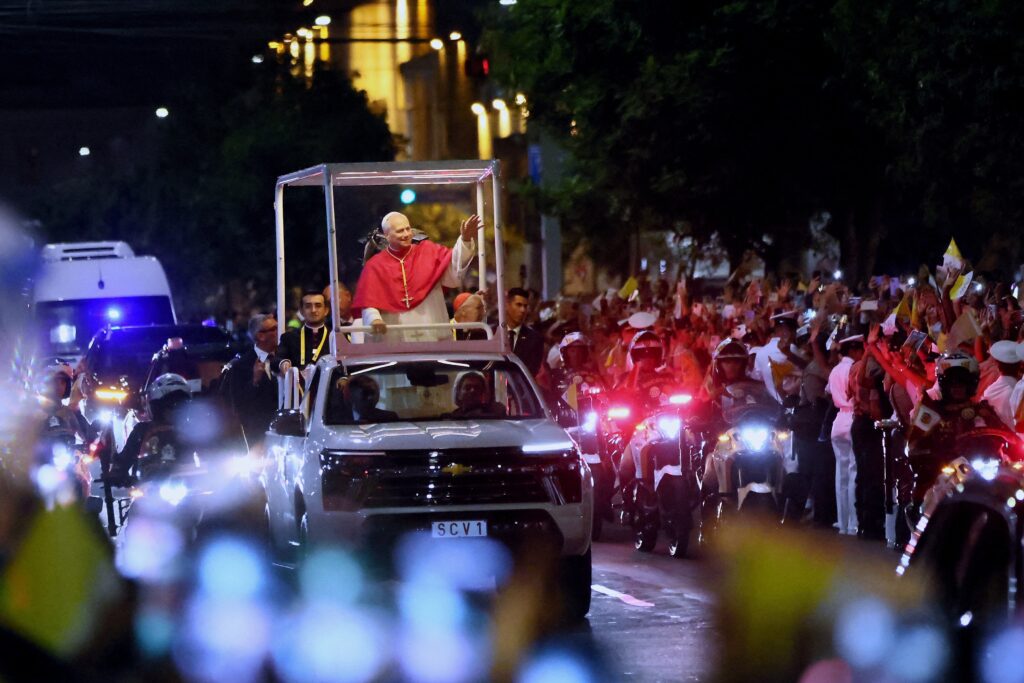
LIMA — He was born in Chicago. But when Pope Leo XIV touched down Wednesday in Peru for the final leg of his South American tour, the cleric previously known as Robert Francis Prevost came home.
Upon landing at an air force base on the outer edge of the capital, the pope appeared emotional as he was greeted by ecstatic crowds. For a pope naturalized as a Peruvian citizen in 2015, a remarkable multitude of some 3 million people — a record for his papacy — lined the route of his welcome convoy for miles into the city, some in tears, others lifting hands in prayer, most training cellular phones. They roared as their adopted son returned.
The record-breaking crowd that greeted the pope in Peru — the tally was from the Vatican, citing Peruvian authorities — came just days after he had set a record for his papacy in Argentina, where some 2.5 million swarmed to his Mass in Buenos Aires on Monday. His 12-day trip is drawing by far the largest crowds of his papacy, propelling the new pontiff into the leagues of frantic popularity witnessed under Pope Francis and Pope John Paul II.
If he rode a sentimental wave in the home country of the Argentine-born Francis, in Peru, the crowds are all about Leo.
Peru was the backdrop for the formative years of Leo’s religious life, a discontinuous 20-year period that began in the 1980s, when the Andean nation was convulsing in a barbarous civil war between the Shining Path guerrilla movement and state security forces. A decade later, Leo — then an Augustinian missionary in the northwestern city of Trujillo — would take to the streets to protest human rights abuses under right-wing President Alberto Fujimori, the late father of Peru’s current leader, President Keiko Fujimori.
She welcomed Leo at the air base, and later sat beside him at Lima’s Grand National Theater. Leo is not given to gushing, or expressions of nationality, whether as a Peruvian or American. But on Wednesday, he declared, “I can tell you, with deep gratitude, that I am … returning to my homeland.”
He also issued what has become his trademark: veiled political criticism. Fujimori has stood accused by her opponents of lacking empathy, ignoring the underclasses facing natural disasters. “The solidarity that Peruvians demonstrate in the face of emergencies deserves to be matched by equally committed institutions, capable of preventing disasters and acting in a timely manner when a life is in danger,” he said.
His naturalization in 2015 was a prerequisite for his elevation to bishop of Chiclayo, and the man-who-would-be-pope would mesh with this country in profound ways. He embraced its custom of popular religiosity — vibrant expressions of Catholicism rooted in Andean traditions, which he still champions, to the chagrin of some purists.
As pope, Leo has surrounded himself with Peruvian aides — including Edgard Rimaycuna, the Chiclayo-born cleric so frequently by his side that it is said in Vatican City that only God and Rimaycuna are constantly with the pope. Leo often speaks in deeply fluent Spanish forged in Peru. One of his favorite meals is el frito: a hearty Chiclayo pork breakfast served on weekends.
In his first speech as pope, he gave a shout-out to his C-town — Chiclayo, not Chicago. In a theoretical World Cup match between his native U.S. and his adopted Peru, Leo has said he would root for the latter.
Peru has returned the favor, embracing him as an adopted son — including with the construction of a 46-foot giant statue of Pope Leo XIV in the port city of Callao, where the pope will visit on the final day of his trip.
“You could say he penetrated our culture, he understood it, the thinking of Peruvians,” said the Rev. Ramiro Castillo Castro, a senior Peruvian Augustinian cleric who was a student and friend of Leo’s during his years in Peru. “You could say he became one of us, that he picked up the flavor of Peruvian culture, the customs of Peru and the way the people lived the faith.”
Ahead of Leo’s visit, some Catholic critics appeared uneasy with the extent of Peru’s embrace of the pope himself. Commenting on the giant statue of Leo erected in Callao, John-Henry Westen, the conservative, Canada-based co-founder of LifeSite News, quipped on social media last week that “Catholics do not worship popes.”
Leo’s homecoming spans six days — an extraordinarily long papal visit for a country the size of Peru — and notably comes before any visit to his birth nation. It is a trip set to show the world a different side of the White Sox-loving, U.S.-born pope — as a Peruvian and a global citizen.
His connection to Peru, and to its people, will be on full display, said Véronique Lecaros, head of the theology department at the Pontifical Catholic University of Peru. “It could help solidify his image as a global pope.”
He comes as Peru has declared a national emergency in much of the country as the effects of the El Niño weather phenomenon induce coastal flooding and extreme rains. Nevertheless, Leo is crisscrossing Peru, from the Amazonian town of Pucallpa to the high Andes. On Sunday, a 71-year-old pope who underwent lung cancer surgery only last month will visit the ancient Incan capital of Cusco, where the high altitude can induce breathing problems even in the young and healthy.
In towns and cities across Leo’s itinerary, churches are redoing facades. Mobilizations of millions are planned, including potentially historic outdoor Masses in and around Lima and Chiclayo.
Leo initially insisted on traveling to some of the remote mountain towns surrounding Chiclayo that he was known to access by horseback in years past. Local organizers tried on several occasions to fly helicopters to these areas to organize papal visits, but the logistics and weather made it too risky, said Hugo Gabriel Sánchez Romero, a Chiclayo priest who formerly worked closely with Leo and has been working on the papal trip.
The pope, Sánchez said, was “not happy” about his inability to visit those communities, and so the Vatican decided to call surrounding residents to Zaña, a more accessible town of 14,000 people that will be flooded with upward of 300,000 people. It’s home to communities that have often been neglected by the government. It has no bank, no radio station, no hospital, no ambulance. But it is home to a historic chapel, of Santo Toribio de Mogrovejo. It is also where, as bishop, Leo helped oversee the construction of a church school and a well.
That his visit is mobilizing vast crowds at a time when Peru is experiencing a weather crisis could complicate things for local authorities. But it has also surfaced memories of the days when Leo, both as missionary and later as bishop, would take a hands-on approach to Peru’s frequent natural disasters, rolling up his shirtsleeves and pitching in.
“When he came [to Peru], they were still recovering from the Niño floods of ’83. He would see the people working together and worked with them,” said Bishop Daniel Turley, rector of the National Shrine of Saint Frances Xavier Cabrini in Chicago. A fellow Chicagoan and Augustinian who served for 52 years in Peru, he was Leo’s boss during the pope’s initial years there.
Peru was formative for Leo, who in the 1990s forged a role as a budding human rights and pro-democracy activist of sorts, protesting Fujimori’s heavy-handed rule — establishing a distaste for authoritarianism that still echoes through his papacy today.
“Peru in the ’90s was really spiraling downward,” said the Rev. John Lydon, director of Villanova University’s Mother Cabrini Institute on Immigration, who lived with Leo when they were both missionaries in Peru in the 1990s. Both focused on promoting human rights through their parishes, he said: “We participated in the marches for democracy, the restoring of democracy.”
After Leo became pope, there was little doubt he would seek to return quickly to Peru. Sánchez recalled seeing Leo two days after the conclave anointed him. The new pope greeted him by his first name, asking about his mother’s health and about the parish he had entrusted to Sánchez back in Chiclayo.
“We will be waiting for you in Chiclayo,” Sánchez told him.
The pope promised him he would visit — and that it would be soon.
Schmidt reported from Chiclayo, Peru. Stefano Pitrelli in Rome contributed to this report.
The post Mammoth crowds greet Pope Leo on return to Peru, his adopted homeland appeared first on Washington Post.