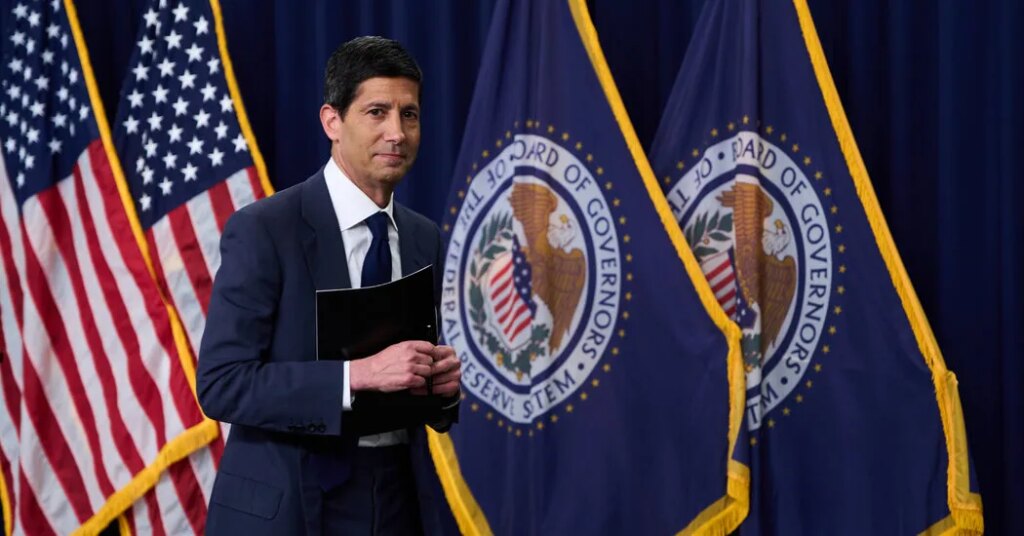
The Federal Reserve announced a revised schedule for its policy meetings next year, scrapping a vote on interest rates in October and spacing out other gatherings such that officials will no longer meet in December. The changes are part of a broader plan Kevin M. Warsh, who took over as chairman of the central bank in May, has put in place to cut back on the number of meetings each year.
According to a revised 2027 schedule the Fed released on Thursday, officials will still meet eight times over the course of next year. But instead of discussing the near-term policy outlook, the Oct. 26-27 meeting will now be “dedicated to the discussion of broad monetary policy strategy issues.” A meeting in November was set for the middle of the month and without a December gathering, the Fed will not vote on rates again until it meets Jan. 25-26, 2028.
Mr. Warsh unveiled last month the broad contours of his plan, which by 2028 will involve the central bank reducing the number of rate-setting meetings to six and holding two strategy-focused meetings. The strategy meetings will not involve a policy vote and are not expected to be accompanied by a post-meeting statement.
“Getting policy right involves assessing near-term developments at timely, regular, and information-rich intervals,” Mr. Warsh said at a news conference in late October when explaining his decision. “But it’s equally important we reserve time and space, as an intellectually diverse group, for strategic deliberations — for thinking anew about big questions, looking out over longer time horizons, focusing, as I say, on the left side of the decimal point.”
Mr. Warsh said the cadence of the Fed’s meetings was “more than some administrative detail.” Instead, he said it was an “institutional choice, affecting the nature and the quality of our deliberations and, ultimately, the wisdom of our decisions. It’s yet another change to get the conduct of monetary policy on the right track.”
One potential cost of the Fed meeting less frequently is that officials there will have fewer opportunities to adjust the central bank’s policy settings if the economic backdrop shifts. That raises the possibility the Fed will have to call impromptu meetings, which in the past have typically been reserved for crises.
In addition to changing how often the Fed meets, Mr. Warsh has vowed to overhaul the way the central bank communicates. He has already drastically shortened the policy statement that is published alongside each rate decision. His news conferences have been much more abridged than his predecessors’, and he has opted against submitting economic projections as part of a quarterly release of forecasts that policymakers have published for years.
Mr. Warsh’s rejection of the “dot plot” reflects his opposition to providing any guidance about the outlook, a practice that he argues has not only boxed in policymakers, but also disrupted important signals they would otherwise get from financial markets.
He has dedicated one of five task forces to look into how the Fed communicates, suggesting there could be significant changes to come.
The post Fed Will Not Hold Policy Vote at October 2027 Meeting appeared first on New York Times.