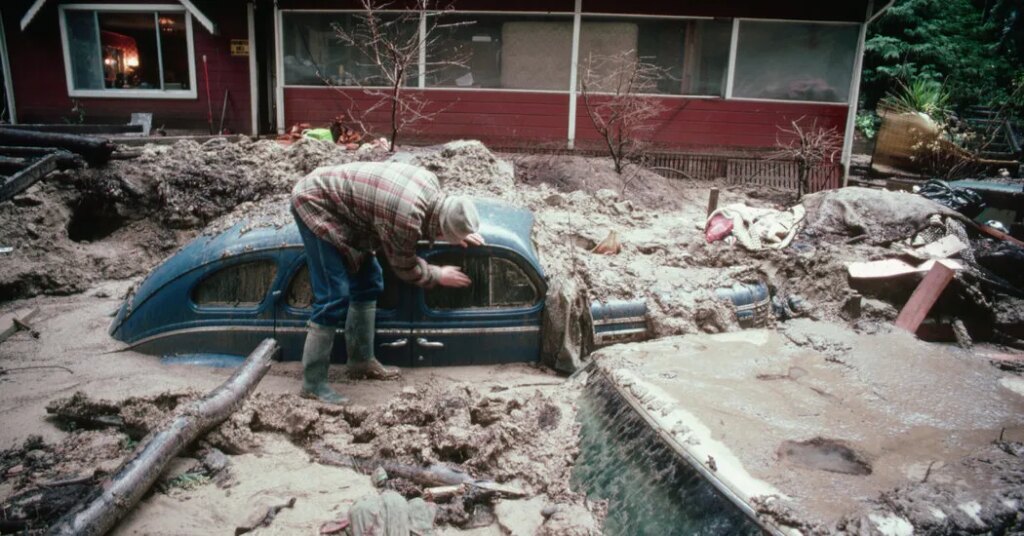
A very strong El Niño flexed its muscles in 1982-83, and relentless storms pummeled the California coast. Houses fell into the ocean, piers were smashed in two, and beaches vanished when powerful waves dragged their sand out to sea.
El Niño was not a household name then, but it soon became one for Californians, whose Pacific coastline is often the first area affected when the weather pattern’s effects come ashore. In the winter of 1997-98, another strong El Niño brought unmerciful storms, leaving at least 17 people dead and causing over $550 million in damage across the state.
The winters were disastrous and lived on in popular memory. Now scientists say this winter is almost certain to deliver the strongest El Niño on record, once again drawing dire predictions for how this winter will, or could, play out across the state.
But the story doesn’t always unfold as expected.
The winter of 2015-16 also brought a very strong El Niño. Like this year’s, it was, to that date, one of the strongest on record. As winter — typically the time of year when El Niño’s effects on the weather are strongest — approached, it prompted anxiety among residents and intense media coverage.
The state was living through one of its worst droughts in recorded history, and many looked to the rains that El Niño typically brings for relief. But while the winter brought active surf that eroded California’s beaches, it fell short on rain as many storms that would have crossed over into California got ushered into the Pacific Northwest instead. The state ultimately recorded much less rain than forecasters had predicted.
So what about this year? Here’s how experts think the next few months could play out.
More rain is almost certain. But where and when is not.
California has felt the impact of El Niño this year already, as warm ocean water fueled a busy hurricane season in the Pacific. The tropical storms and hurricanes remained far off the California coast, but over and over again they sent large swells to the state’s coastline, flooding homes in Long Beach and elsewhere.
Those far-off summer storms were a prelude, experts say. The state gets most of its annual precipitation in the winter months, and much of the preparation has been geared toward even more rain than usual. Gavin Newsom, the governor, declared a state of emergency in September “ahead of potential winter storms and other impacts.”
The National Oceanic and Atmospheric Administration’s official winter outlook, released in October, anticipated a wetter-than-average winter for much of the southern half of the United States, including California.
In their latest update in mid-November, NOAA’s forecasters said it was becoming more likely that the state would record above-normal rainfall from January to March, particularly in Southern California.
“California is likely to be wetter than average this winter, with odds decreasing as we get into spring,” said Johnna Infanti, a meteorologist with NOAA’s Climate Prediction Center.
But what all that rain does will depend on the how many storms there are, how strong they are and the timing between them.
“If I were betting, I would say we’re going to have above-average rainfall, but a bigger factor is the distribution of that rainfall,” said Jan Null, a veteran meteorologist and former forecaster for the National Weather Service.
If storms are spread out, flooding is minimized, and the rain and snow end up being mostly beneficial, feeding rivers and reservoirs.
But back-to-back storms can push rivers over their banks and create life-threatening, costly flooding. A single supercharged system could also unleash torrential rain, as happened in 1998 when a wet late February storm set off mudslides and flash flooding that damaged homes in Southern California. Two tornadoes, rare in that area, were reported just south of Los Angeles.
In the seven strongest El Niños since 1950, Southern California recorded above-normal winter precipitation in all except one. In the strong El Niño of 1997-98, Downtown Los Angeles recorded nearly four times as much rain in February as it usually does. The outlier was the winter of 2015-16, when Southern California was unusually dry.
Northern California also tends to be wetter, though it has had more winters than Southern California in which rainfall has been average or below normal.
Sea levels are higher along the coast.
In any winter, big storms and waves crashing into the California coast can flood beachside homes and boardwalks, tear into sea walls and piers, and gnaw at cliffs and bluffs. During El Niño, the risk is greater — and so are the potential effects.
Waves tend to be more intense during El Niño, and this has been the case in all three of the most notable recent strong El Niño seasons: 1982-83, 1997-98 and 2015-16.
Sea levels are also higher. The waters of the Pacific Ocean actually shift during El Niño. The winds at the Equator change direction, and the water that typically sloshes to the west gets pushed east toward the West Coast.
“It’s the same mechanism if you blow across your coffee cup to stir up the cream,” said Emily Becker, a climate scientist at the University of Miami.
Those sea levels bump up even higher during the exceptionally high tides, known colloquially as king tides, that occur in November, December and January.
The nightmare scenario for emergency managers and residents alike is a major storm that happens at the same time as the highest high tides.
“When you get big waves on top of higher sea levels, you can get erosion and flooding,” said Mark Merrifield, director of the Center for Climate Change Impacts and Adaptation at the Scripps Institution of Oceanography in San Diego. “If you get heavy rain on top of that, you can get even more flooding.”
El Niño could help calm next year’s fire season.
California has had few big wildfires this year, with about 340,000 acres having burned by the fall, compared to a million acres in a typical year.
Next year could be similar: A wet El Niño winter is often followed by a quiet summer wildfire season. But “often” is far from a guarantee.
Rains soak the landscape enough to keep vegetation from drying out under the spring and summer sun, but it also encourages new growth. The fresh grass dries out quickly in the heat of summer, and that new vegetation can provide fuel for small, fast-burning fires.
The trees and brush that fuel large, long-lasting forest fires can hold onto the moisture longer.
Jonathan O’Brien, a meteorologist with the U.S. Forest Service, said it usually takes two or three years after an El Niño winter before the state records another “significant” wildfire season. That’s exactly what happened after the wet El Niño winter of 1997-98, he said — the state next saw a particularly active wildfire season in 2000.
The post A Concerned Californian’s Guide to El Niño appeared first on New York Times.