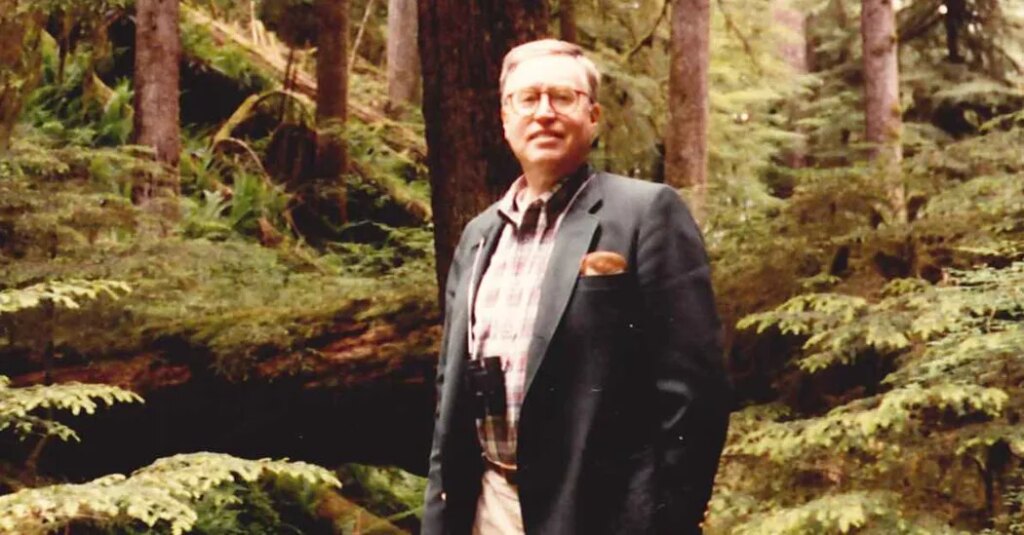
Michael McCloskey, the executive director and chairman of the Sierra Club during America’s environmental awakening in the late 20th century, died on Oct. 30 in Portland, Ore. He was 92.
The death, at an assisted living facility, was confirmed by his stepdaughter Rosemary Detweiler, who said the cause was congestive heart failure.
In a Sierra Club career that spanned 39 years, Mr. McCloskey was responsible for leading the transformation of a small and revered California conservation group into a national environmental organization that influenced the development, passage and enforcement of the trailblazing U.S. statutes that cleaned up the country’s air and water, and protected wilderness and wildlife.
A son of the Pacific Northwest whose reverence for snow-peaked mountains, rushing rivers and trackless forest matched that of John Muir, the Sierra Club’s founder, Mr. McCloskey organized campaigns and drafted legislation that still safeguard some of the country’s most spectacular wild places: Redwood National and State Parks, North Cascades National Park, 104 million acres of wilderness in Alaska and more than 6,000 miles of free-flowing wild and scenic rivers.
Sierra Club colleagues concurred with Mr. McCloskey’s own assessment that he excelled at aligning the group’s disparate local chapters and offices into a powerful lobby in Washington, while simultaneously leading programs to increase the club’s membership, staff and budget.
As executive director from 1969 to 1985, Mr. McCloskey helped to recruit more than 300,000 new members, opened dozens of local chapters and increased the group’s annual budget to $23 million from $3 million. The Sierra Club’s staff grew to 300 from 30 during the same period.
“That’s where I made the most difference,” Mr. McCloskey said in a 2024 interview for this article. “I professionalized the work in the Sierra Club at that time. It spread its influence throughout the leadership of the movement.”
Mr. McCloskey leveraged the organization’s growth to position it at the front of a determined civic movement that began with Earth Day in 1970 and was grounded in the principles of ecology.
One consequence was that Congress approved, by large bipartisan margins, the federal statutes that serve as the foundation of U.S. programs that reduced pollution, cleaned up toxic chemical wastes and protected endangered species and public health. Mr. McCloskey added a legal defense unit to the Sierra Club in 1971 and charged it with filing lawsuits to define and defend the laws.
As board chairman starting in 1985, Mr. McCloskey guided the groups’s work to merge environmentalism with the other great social movements of the era — civil rights, human rights, women’s rights, animal rights and environmental justice. By the time he retired in 1999, the Sierra Club was widely regarded as a titan of grass-roots environmental activism in Washington and in state capitals across the country.
John Michael McCloskey, the oldest of three sons, was born in Eugene, Ore., on April 26, 1934. His father, John C. McCloskey, was an English professor at the University of Oregon. His mother, Agnes (Studer) McCloskey, was an elementary school teacher.
Mr. McCloskey spent much of his youth mountaineering in the Cascade Range near his home. After graduating from Harvard in 1956, serving two years as a U.S. Army artillery officer at Fort Sill, Okla., and receiving a law degree at the University of Oregon in 1961, he continued an already-budding career in conservation.
During breaks from college and law school, Mr. McCloskey became active in drives in the Northwest to preserve undeveloped tracts of U.S. Forest Service land as protected wilderness. His prowess in recruiting allies and managing campaigns and his stamina for long hikes to scout terrain attracted the attention of David Brower, the Sierra Club’s charismatic director at the time.
In 1960, Mr. Brower recruited Mr. McCloskey to lead a summer campaign to prevent logging on a stretch of old-growth forest in eastern Oregon. The Supreme Court Justice William O. Douglas, a steadfast conservationist and Sierra Club board member, knew the tract and had asked Mr. Brower to intervene.
It was Mr. McCloskey’s first paid Sierra Club assignment and steadily led to others. By 1962, the organization’s 70th anniversary, he earned $400 a month as a salaried organizer with the group. He wrote the 100-page prospectus outlining the scope and need for establishing the 504,000-acre North Cascades National Park. A bill creating the park was approved by Congress and signed by President Lyndon B. Johnson on Oct. 2, 1968.
The ideas for wilderness protection outlined in the prospectus — and the grass-roots support it received — pushed Mr. McCloskey and the Sierra Club into the mainstream of the campaign to pass the Wilderness Act, which established a national system for preserving the wildest tracts of the public domain. By the time Mr. Johnson signed it into law on Sept. 3, 1964, Mr. McCloskey’s Sierra Club career was in ascendance.
In 1965, he was appointed the group’s first conservation director and principal lobbyist and worked to establish Redwood National Park in California. He assisted Mr. Brower in developing full-page newspaper ads, to run in The New York Times and The San Francisco Chronicle, promoting the formation of the national park and opposing construction of two immense dams in the Grand Canyon. (The two dams, Marble Canyon and Bridge Canyon, were not built.)
Mr. Brower’s devotion to the advertising campaign — and to publishing beautifully photographed but expensive books about wilderness preservation — led to budget deficits and, ultimately, to a standoff between the Sierra Club’s board and Mr. Brower. He resigned in 1969, and the board quickly replaced him with Mr. McCloskey.
Half of the Sierra Club staff followed Mr. Brower out the door. But Mr. McCloskey steadied the group with his disciplined, nonconfrontational manner, which he credited to his Army training. His efforts came just in time.
On April 22, 1970, more than 20 million Americans participated in the events of the first Earth Day, initiating a decade of policy innovation, activism and law, much of it heavily influenced by Mr. McCloskey and the Sierra Club.
His wife of 40 years, Maxine (Mugg) McCloskey, a marine mammal conservationist, died in 2006. In addition to Ms. Detweiler, Mr. McCloskey is survived by three other stepchildren, Claire McCarthy, Laura King and James Johnson; five grandchildren; and four great-grandchildren.
Mr. McCloskey’s 2005 memoir, “In the Thick of It: My Life in the Sierra Club,” focused on how he had built relationships with Sierra Club colleagues, elected leaders and professionals from other environmental organizations. A measured and collaborative approach, he said, was the most effective way to secure the country’s natural resources.
“The dominant club feeling has been that our business is to get things done, to make change,” Mr. McCloskey told an interviewer in 1983. “Standing up and saying something that is going to alienate all of your friends and not advance your cause one whit is not what we should be doing.”
Ama Sarpomaa contributed reporting.
The post Michael McCloskey Has Died. He Helped Make the Sierra Club a Political Force. appeared first on New York Times.